

Conjuros y ebriedades: Cantos de mujeres mayas, Incantations – Jessie Kanji MFA Print 27′
July 1
The mayans word for book, Jun or vun also means paper, and the making of paper it a critical Mesoamerican tradition. The ancient Mayan god Itzamná is said to have created the invention of writing.
Long before the arrival of Europeans, Maya scribes created extraordinary codices from bark paper coated with fine layers of lime plaster, producing smooth pages that could be folded accordion-style into books. These manuscripts produced while only native people inhabited the land recorded astronomy, mathematics, history, ritual calendars, medicine, and genealogy, reflecting one of the most sophisticated systems of knowledge in the Americas. Writing itself was considered a sacred practice, closely associated with the deity Itzamná, who is credited in Maya tradition with the gifts of writing, knowledge, and calendrical wisdom.


Paper also held an important ceremonial role. During certain rituals, blood drawn from the tongue or ears was absorbed into strips of bark paper before being burned as an offering. As the paper transformed into smoke, prayers and messages were believed to pass to the gods. The material itself acted as a bridge between worlds—a vessel capable of carrying both words and spirit.
Much of this knowledge was violently interrupted during the Spanish conquest. In 1562, Bishop Diego de Landa ordered the destruction of countless Maya books, declaring that they contained “nothing but superstition and lies.” Today, only four pre-Columbian Maya codices are generally recognised as surviving. The loss represents one of the greatest acts of cultural destruction in the history of the Americas.
Working at Taller Leñateros has transformed the way I think about paper and books. The workshop is not simply producing handmade paper or artist books; it is participating in the continuation of a tradition whose roots extend back more than a thousand years. Through papermaking, printmaking, storytelling, and publishing in Indigenous languages, the collective creates works that honour Maya knowledge while speaking to contemporary realities. Their books are not replicas of the ancient codices, but they share the same understanding that a book can be far more than an object—it can be a keeper of memory, language, identity, and resistance. Incantations by Mayan Women is the first book Mayan people created that was written, illustrated, printed and bound in paper of their own making in nearly five hundred years.


At a time when many traditional craft practices are increasingly vulnerable to economic pressures, the work of Taller Leñateros feels profoundly important. Each sheet of handmade paper and every libro objeto they produce carries forward a lineage that colonialism attempted to erase. To support this work is not only to preserve a craft tradition, but to ensure that Indigenous ways of making, remembering, and telling stories continue to evolve for future generations.


Entering the conversation – Mahrukh Khizar MFA Printmaking’ 27
My first week with Mahwari Justice began with a series of WhatsApp groups, introductions, and video calls. I was connected with the wider team by Faiqa, the Media and Communications Director and a young period activist, as well as Bushra Mahnoor, my supervisor. I also met several of the other interns, many of whom were young women based in Lahore, artists, creatives, and students who had come together because they wanted to contribute meaningfully to the organisation’s work.


What struck me almost immediately was how openly everyone spoke about menstruation. We were discussing periods, menstrual health, and the challenges surrounding them with a kind of ease that felt like a breath of fresh air. In a society where menstruation is still often surrounded by shame, secrecy, and discomfort, being part of a group that could speak so freely about it was both refreshing and inspiring. The enthusiasm of the team was infectious, and I quickly began to feel that I was not simply joining an internship, but entering a community of people who genuinely cared about creating change.
My first project with Mahwari Justice was to develop a zine about menstruation for disabled menstruators. During my first few days, I began researching, organising the content, and planning a timeline for the project. Faiqa also shared the organisation’s extensive research and interviews exploring the experiences of disabled menstruators and the particular challenges they face in accessing, understanding, and managing their periods. Reading through these accounts was deeply moving and made me realise how easily conversations around menstrual health can overlook people whose experiences do not fit into the mainstream narrative.

This research made the purpose of the zine feel especially urgent. It was not enough for menstrual education to simply be available, it needed to be accessible. As I began thinking about the project, I found myself considering how design could help bridge that gap and how visual communication could become a tool for inclusion rather than another barrier. This became the starting point for my work with Mahwari Justice.
Casa de Papel – Jessie Kanji MFA Print 27′
June 24. From the Hills of Chiapas.. Taller Leñateros
I have now spent a month at Taller Leñateros. As the rainy season has settled over San Cristóbal, our days are punctuated by cups of hot tea, animal cookies, and the steady rhythm of work in the workshop. During this time I have become especially close with my colleagues, Luciana and María. Together, Luciana and I have begun filming a documentary that explores the history, people, and making processes of Taller Leñateros, documenting the knowledge and expertise embedded in every stage of production.


Living and working here has given me a deeper understanding of the complex economy in which traditional craft exists in Mexico, and of the important place handmade practices continue to hold within the community. It has been fascinating to learn about weaving as a form of script. Tzotzil women are able to read the patterns woven into textiles, with each motif carrying stories, meanings, and cultural knowledge that have been passed down through generations.
Over the past month I have also come to better understand some of the financial challenges facing the organisation. Following the passing of its former director, Javier, in March this year, Taller Leñateros has entered a period of transition. Although the workshop continues to produce its distinctive handmade papers, sculptural journals, and libros objeto (artist books), sustaining the cooperative remains difficult. Many of these works find buyers in northern Mexico or in regions with stronger tourism, making income both seasonal and unpredictable.
These conversations have encouraged me to think about how my own skills might contribute beyond my research. Together, Luciana and I have been discussing the possibility of developing an artist residency programme at Taller Leñateros. The idea is to invite artists to learn directly from the collective’s papermaking and bookmaking traditions while creating a new and sustainable source of income for the workshop. Luciana is excited about the proposal, and I have begun drafting promotional materials and programme documentation that can be shared with the members of the collective as the first step towards bringing the residency to life.


Working at Taller Leñateros has become much more than an opportunity to learn about handmade paper. It has offered a glimpse into the resilience of a community committed to preserving cultural knowledge while adapting to contemporary challenges. I feel incredibly fortunate to contribute, even in small ways, to a place where making, storytelling, and community are so deeply intertwined.
Folding Paper Cranes and Creating TEAACH Act Resources- June Ahleman, BFA Painting ’27
Hi everyone!! I’m excited to share about a workshop I facilitated, as well as some updates on an educational toolkit, calendar, and art-specific resource to support the TEAACH Act.
Cranes for Peace
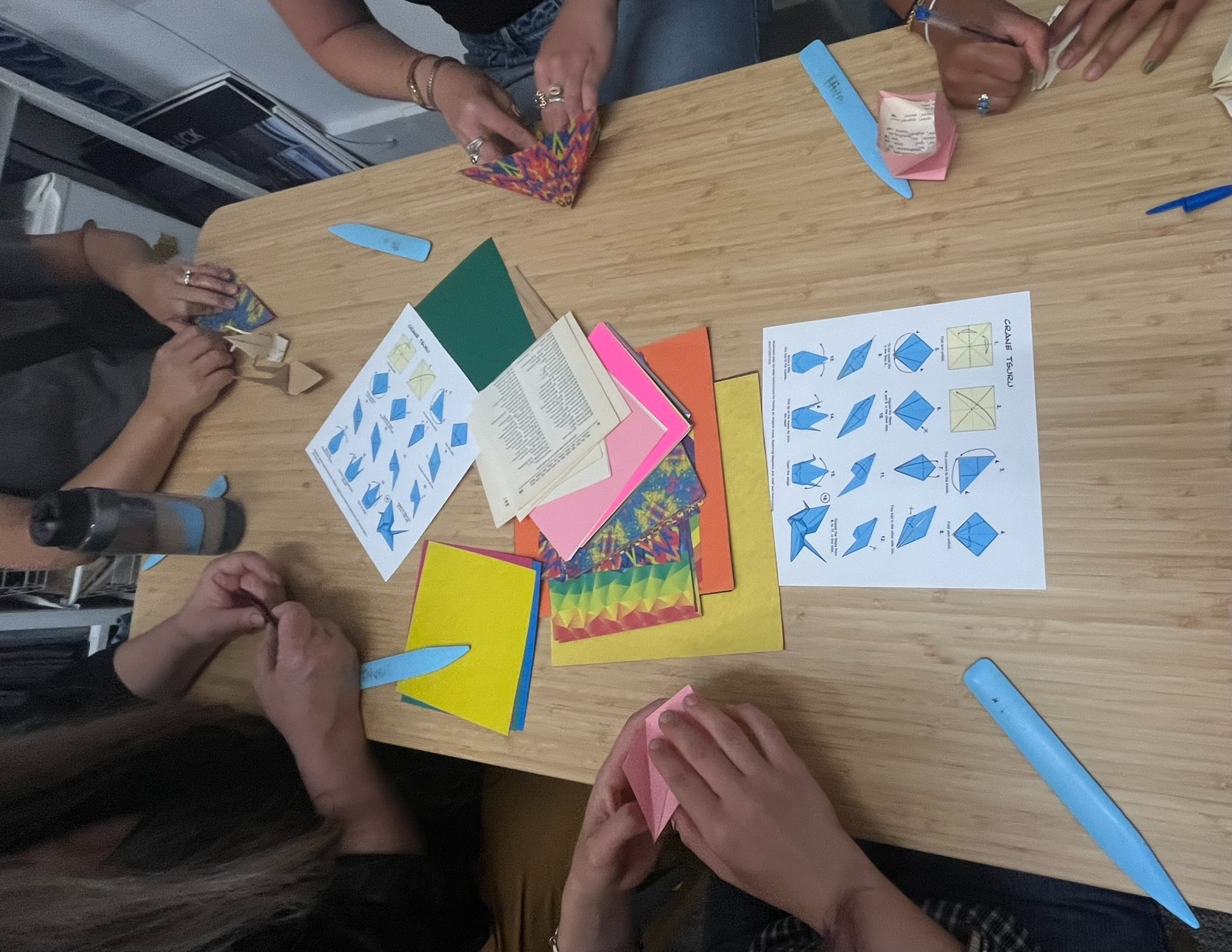
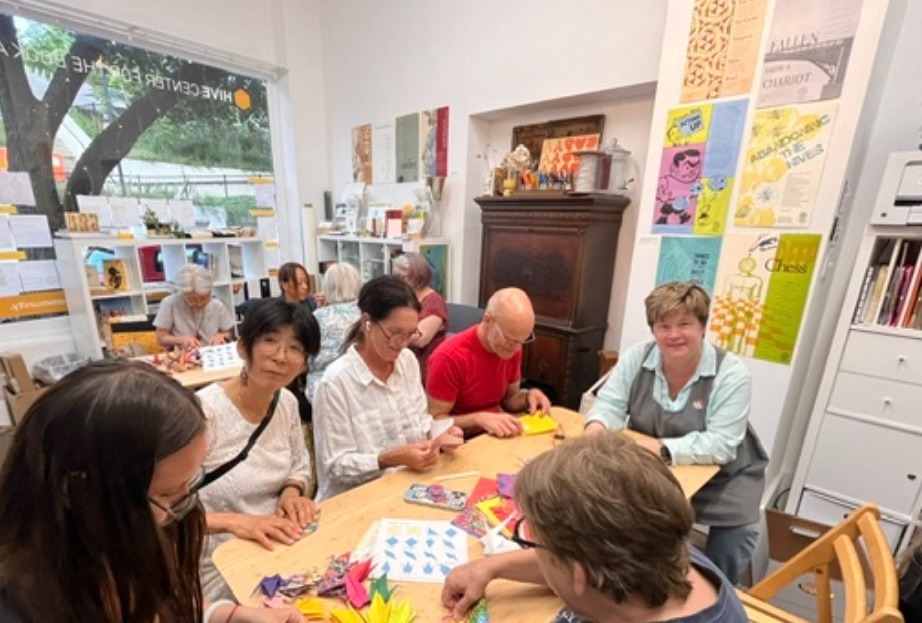
Since my last post, I facilitated another workshop! This was a workshop for EASPA in collaboration with The Japanese Cultural Center of Chicago and The Osaka Committee of Chicago Sister Cities International at the Hive Center For The Book Arts. The cranes produced from this workshop, as well as many others throughout Chicago, will be installed together in a cultural institution such as the The Obama Center (omg!) or the Historic Water Tower in 2027. This workshop was super well attended and cultivated many interesting conversations about cultural exchange both locally and across countries. It was an incredible experience leading a workshop within such a large scale project across so many organizations, and I’m so excited to see the installation next year!


TEAACH (Teaching Equitable Asian American Community History)
Now that we are through July and most of EASPA’s cultural programming for the summer is complete, I’ve been able to dial in on the TEAACH act more extensively. This includes creating an educational toolkit template for EASPA to utilize in the future, a calendar of Asian American historical events and holidays, as well as an art specific resource! The art specific educational resource is a catalogue of Asian and Asian American Artists paired with related TEAACH Act resources and requirements. The first two pages are attached below!


I’ve been having so much fun putting this resource together; I really enjoy drawing connections between historical events and artists! It’s especially exciting to organize this information in a resource that can be utilized in both arts and social studies contexts. I recently had a great conversation with Melissa Molitor, the Founding Director of EASPA, about the importance of not only teaching Asian American history but also helping people understand how it connects to current questions of identity, belonging, and social and political issues. An example of this is how the United States vs. Wong Kim Ark case serves as the foundational legal precedent for birthright citizenship in the United States. Wong Kim Ark’s story is important not only because it is part of America’s past but because it is a big part of America’s present. On that note I want to shout out Karen Hu, another 2026 Maharam Fellow who’s working directly to support immigrants with Alliance to Mobilize Our Resistance (AMOR).
My favorite quality of art is its ability to mediate and navigate multiple theories, histories, and modes of being at once. This conversation with Melissa about past and present, external experiences and internal thought reminded me of what I love most about art and how it can be helpful in historical and educational contexts. I’m excited to provide more perspectives on how AAPI history can be taught and understood through this resource!!
I also want to note that I took an amazing course at RISD last semester called The Kinship of Repair: Asian/Asian American Art of Collaboration taught by Jung Joon Lee that has not only informed how I approach the community and research work I’ve engaged with this summer but also given me many great Asian American artists to add to this resource so thank you Joon!!
I will spend my last week with EASPA completing the educational resources mentioned in this post!!
Regulating the rain, timing the tides – Stephanie Van Riet, MFA Sculpture ‘26
On a 114F / 45C day in the Sonoran Desert, I am writing from an ocean climate, overlooking a developing coral reef. Like the other Biosphere 2 biomes, the ocean biome is a site of active research, where scientists are exploring the effect of water temperature on coral resilience. To do this, the one million gallon “ocean” tank is heated up incrementally, during which scientists monitor previously stressed corals vs. corals from less stressed environments.

As I observe the biologists don scuba gear and document the marine ecosystem, I have also been collecting my own data. Each day over the course of my fellowship, I have been tasked with recording PH measurements of water tanks holding composite cement blocks of varying material configurations. These blocks were created by civil engineer Dr. Hee-Jeong Kim at University of Arizona. As the PH levels rise, I am witnessing how the introduction of new material has an impact on water chemistry, and on a larger scale, in our environment. Having experimented with different biocomposites in my sculptural work, finding substitutions for concrete through mixtures of sodium alginate, oyster shell and additional aggregates, it is fascinating to record the impact of more sustainable building materials.


The Biosphere 2 facility allows researchers to undergo experiments at a life scale while maintaining more control than would be possible in nature. At any moment, researchers have the ability to induce droughts, or raise the temperature of the water. The tides and rainfall exist on timers, leaving only one natural timer from the outside world – sunlight. By scaling down Earth’s ecosystems, individual actions become more visible within larger biological cycles. Spending two months immersed in these interconnected biomes, I became increasingly aware of my own breath as an intimate part of the system.

All photos by Stephanie Van Riet
Teaching at Homeboy Art Academy – Elsa Fishman BFA Sculpture 2026
Hello from LA! Things have been going well here at Homeboy Art Academy, and I am now in the middle of our summer classes, which will end in a few weeks. I started teaching my Sculpture classes on Tuesdays and Wednesdays, and it has been challenging but a great learning opportunity.
I have been teaching both young adults (18-25) and youth (14-18), which have both posed different challenges and rewards. We started with wire sculptures on wood blocks, which students were able to manipulate and sculpt. We then added nylons on top, creating organic forms, which students were able to further manipulate. The following week, we gessoed the sculptures, turning them into beautiful forms that look like they were carved out of plaster! The students have had a variety of reactions to these sculptures, but the majority of students have enjoyed creating something tangible and three dimensional with their hands.


As someone with an abstract sculpture background, I’ve been trying to slowly integrate more abstract forms into their experience of art. This has been a challenge! It’s difficult to explain the importance of abstract art to students who have little to no art background. At the same time, this has also begun to shape the way I am approaching sculpture as a field. I’ve begun to ask myself why I am so drawn to abstract and non representational work and what experiences I have had that have shaped this tendency. To some extent, I feel like I’ve been able to look at sculpture through the lens of my students, and that has been a humbling and grounding experience after RISD.


We have since moved on to polymer clay sculptures that we are turning into keychains, and the students have loved this. The youth, in particular, are really enjoying making things that they want to keep and take home. A highlight was when a few students asked if we could continue working with the clay next week even though I was going to introduce something new! Something I have learned this week is that making projects that students can finish in a day and then take home is a great way to encourage engagement and a sense of accomplishment.


In the next few weeks I will continue teaching and supporting the Art Academy with events and other classes. I’m looking forward to continuing to build relationships with my peers, students, and growing as an artist and educator!
From the Hills of Chipas.. Taller Leñateros – Jessie Kanji MFA Print 27′
June 12. From the Hills of Chiapas.. Taller Leñateros
Arriving at Taller Leñateros in San Cristóbal de las Casas has been an exciting start to the Summer. Nestled in the mountains of Chiapas, the workshop is beautiful, it has 3 distinct areas designated for book-making, screen-printing and paper-making. During my first days here, I have been getting to know the workshop, meeting members of the community, and learning about the history of the organization. Founded by poet and artist Ámbar Past, Taller Leñateros is 50 years old and has been developing innovative papermaking techniques using locally sourced plant fibres while supporting collaborative publishing projects with Maya artists, writers, and artisans. Walking through the studio and seeing handmade papers, books, and prints in various stages of production has already provided a rich source of inspiration!


The first week here was blue skys and super sunny, with the second week seeing the very start of the rainy season. I have started working closely with Maria and Luciana to learn sustainable papermaking practices and explore how handmade paper can function as both a material and a carrier of cultural memory. I have been plucking flower petals and ‘velo de novia’, a type of plant that we add to the paper pulp just before pulling the paper. There is an archive room where a lot of the paper is stored, and some of the paper is several decades old.
I am particularly interested in the ways that traditional knowledge and local ecology intersect within the workshop’s daily activities, and the community here has been inquisitive about my artistic practice and seeing how we can collaborate. Over the coming weeks, I hope to deepen my understanding of fibre preparation, sheet formation, and collaborative methods of paper-making. I am excited to read more of the historic ‘libros objectos’ here to gain insights into the Mayan culture and way of life. There is one specific book here published in 1998 Conjuros y ebriedades: cantos de mujeres mayas in Spanish and Tzotzil and more recently in 2005 translated into Incantations in English, this book contains essays and poems written by Mayan women that I am looking forward to studying.
First Weeks at VeryNile – Salma Hassaan, MFA Digital+Media 27′
My first few weeks at VeryNile have focused on becoming familiar with the community and environment of Qursaya Island. Each day begins with making my way to Bahr Al-Azam in Cairo, then crossing the Nile by boat to reach the island. Finding my way around the island and getting to know the women of the local community has helped me better understand the social context surrounding VeryNile’s work. From my first day at VeryNile, everyone was welcoming and made me feel like part of the team.


During these weeks, I focused on learning about the processes VeryNile uses to recycle and upcycle plastic collected from the Nile. The main materials I have been introduced to are HDPE and LDPE plastics. Each material requires a different method of transformation. HDPE plastic, such as bottle caps, is shredded, melted, and compressed into solid sheets. These sheets are then cut with a CNC machine to create products such as keychains and buttons. LDPE plastic is processed by layering and fusing lightweight plastic bags with heat. Through ironing, the bags become a stronger fabric-like material. This material can be sewn and combined with discarded fabrics to create bags, accessories, and other functional objects.


Now I am much more familiar with recycled plastic as a material with its own qualities and challenges through this process. For instance, the plastic comes in different thicknesses and colors, and how such factors can affect the final result. One of my learning goals is to become more comfortable experimenting with these variables and documenting what works. I also had the opportunity to visit the VeryNile shop, where many products made through these recycling and upcycling processes are displayed. The shop is located on the rooftop beside Shoka w Megdaf, VeryNile’s community kitchen. The kitchen hosts visitors and creates a space where we gather and share meals. Eating together with the team and community has been one of the highlights of my experience. VeryNile’s work extends far beyond cleaning the Nile, it mainly focuses on building relationships and supporting the livelihoods of the Qursaya Island community.


I have also started researching new possibilities for working with LDPE plastic. Since the fused material has qualities similar to fabric, I am exploring how it can be layered and woven in different ways. My own practice often involves textiles, material experimentation, and installation. I am discovering how these methods can overlap with VeryNile’s current processes. I look forward to continuing to learn from the women of the community while collaboratively testing new techniques. These first weeks have shown me that sustainability and environmental change begin with an initiative and grow through communal hard work.
ATW80F at The International Folk Art Market – Alyssa Gorman, BFA Textiles ’28
My internship with Around the World in 80 Fabrics began with a trip to Santa Fe, New Mexico. This place is pure magic! For four days, I explored the city while volunteering at the International Folk Art Market. I had the chance to meet my supervisor, Carroll Dunham, in person after months of communicating online. This week was a beautiful introduction to my work with her.
Arriving at IFAM
I arrived in Santa Fe on Wednesday evening, and immediately met Carroll in the Santa Fe Plaza. She introduced me to the city center, explaining the layers of cultural history and architecture around us. From there, we went to the opening community celebration for the market. Despite a long day of travel, I was thrilled to see the artists arrive for IFAM. As volunteers, we guided artisans in the parade to the stage where they would be announced and celebrated! Afterwards, Carroll and I attended a dinner hosted by the Centro de Textiles Tradicionales de Cusco. The CTTC is a Peruvian nonprofit dedicated to revitalizing ancestral textile traditions in a variety of Cusco communities. I had the opportunity to meet Nilda Callañaupa Alvarez and her granddaughter Diana, two amazing women working to preserve Cusqueñan textile practices. It was incredible to admire the work of the CTTC and learn more about the weaver’s natural dye processes and backstrap weaving techniques. I only made one purchase at the market, a beautiful woven bag from Nilda’s booth.

My introduction to IFAM was rich and full of energy, and the following day was full of even more excitement. Carroll and I arrived at the market early to assist the artists in setting up prior to the opening night celebration. I was lucky enough to be assigned to Mexican designer Carla Fernández, a fashion house focused on preserving the textile legacy of indigenous and mestizo communities in Mexico. As a brand, Carla Fernández collaborates with artisans skilled in a variety of handmade textile techniques. I worked with creative director Carla Fernández and designer Carlos G. Velazquez as a volunteer, steaming pieces and assisting to organize the booth prior to the market opening. It was incredible to be paired with such a lively booth, and it was almost difficult to keep up with the number of purchases made on opening night. Carla has participated in IFAM several times, and many people at the market were familiar with her work. It was beautiful to see the collaboration between indigenous communities handicraft and innovative fashion design.
After my volunteer shift, I had the opportunity to wander the rest of the market. Let me explain a little further about what the International Folk Art Market is! Every year in Santa Fe, over 100 artists from more than 50 countries come to New Mexico to sell their work. The market’s mission is to create economic opportunities for folk artists around the globe, encouraging the preservation of traditional handmade methods of making. IFAM is a vibrant market full of color, rich folk art traditions, and beautiful storytelling; there is so much to be gained from speaking with the talented artists behind each booth. The future is handmade!
Pictured below: a selection of work from Somporn Intaraprayong (Thailand), Giovane Francisco de Oliveira Cardoso Nau Cultural (Brazil), Kavita Parmar — The IOU Project (India), Lidia Amanda Lopez de Lopez (Guatemala), Faustino Flores & Meche Yauri Hilos y Colores (Peru), Púrpura Tixinda (Mexico).


Santa Fe — The City Different
Along with spending time volunteering at IFAM, my time in Santa Fe was defined by meeting Carroll’s friends and community in the city. As a medical anthropologist and National Geographic Explorer with decades of fieldwork experience in Nepal, Carroll is connected with a variety of incredibly interesting people in Santa Fe! I am grateful that she was so willing to introduce me to her world in New Mexico, and I was able to have many engaging conversations. Santa Fe, often called “the city different,” is a city rich with Native American and hispanic storytelling, art, and culture. The central streets are lined with museums, galleries, jewelry, and western wear. The city is also surrounded by beautiful mountainous landscape, which I was able to spend time exploring too.


One evening resonated with me the most. After a day of volunteering at IFAM, Carroll and I attended two openings. We saw Nevada Wier’s Veiled Reveries showcasing a selection of her infrared photographs from remote regions around the world, and weaver Polly Barton’s Seduced. After engaging with the artists and the work, she suggested we go out to the badlands to catch the sunset over a picnic dinner. We walked through the desert landscape up to the perfect ledge for a good view. The sunset was unbelievable, and it might be my favorite part of the entire trip.

Next Steps for ATW80F
Of course, Carroll and I did also work on projects for Around the World in 80 Fabrics. We planned for the next steps of the Pop-Up Exhibition, and I gained more insight into what the nonprofit needs before the arrival of their upcoming book. With newly cemented details, I am extremely eager to get started designing a display for ATW80F to bring to book signings and events. The display will incorporate parts of the textile collection with accompanying storytelling and data, but remain transportable so that it is a mobile exhibit. One morning in Santa Fe, Carroll and I drove to pickup a trunk to transform into the exhibit… she’s beautiful and spacious. For the next month, I’ll be working to design the exhibit, curate the fabrics and their stories, and renovate the trunk into a beautiful traveling textile showcase.


My trip to Santa Fe was incredible– I learned so much about a variety of textile processes and the collaborations that exist to allow remote artisans to sell their work at wider markets. By volunteering at IFAM, my internship with ATW80F began with direct community engagement, allowing me to ground myself in a dialogue relevant to the nonprofit’s sustainable textile collection. Some of the pieces in Around the World in 80 Fabrics’ collection were even created by IFAM artisans. I feel even more excited to be working with Carroll to both promote ATW80F’s new book and organize the collection later this summer.
In August, I return to Santa Fe, and this time the collection will be present in New Mexico. I am beyond looking forward to seeing each piece while assisting with organization and documentation. Soon, I’ll create another blog outlining progresses on the mobile exhibition. More to come in a couple of weeks!!
Allegory of the Sphere and Other Shadows – Stephanie Van Riet, MFA Sculpture ‘26

With a highly publicized history, Biosphere 2 remains an extremely unique human venture, originating from a desire to understand the mysteries of how our planet operates. Being curious about the ways our species seeks to understand our place in this web of life, I jumped at the opportunity to spend two months here, immersed within the rhythms and research carried out by passionate scientists and engineers. The facility looks like a spacecraft, nestled at the base of the Santa Catalina mountains in Arizona. In addition to its unique facade, the space provides the ability to walk through a rainforest, savannah, desert and ocean biome in the time span of fifteen minutes.

Within my first days on site, my body was sensorially saturated by the experience of moving between the different biomes, each carrying their own characteristic scents and humidity levels. A warm breeze swirls around the ocean biome prompted by the wave machine, while the scheduled rain in the rainforest amplifies the smell of decaying leaves. I’ve learned to avoid the top level of the rainforest midday, as it becomes unbearably humid and hot. After two weeks onsite, I have adjusted to the environment changes, almost forgetting that I have spent the entire day “indoors”.


Documentation of shadows and temperature differences within biomes
Peter Pierce’s space frame overhead, characteristic of Biosphere 2, is a strong reminder of being in an enclosed space. Fascinated by the shadows cast by the geometrically arranged bars, I have been routinely tracing the shadows with ink on watercolor paper. As the shadows travel across the page with the afternoon sunlight, the ink records begin to overlap. Adding observational details to each shadow drawing, I reference the hydrosphere (ocean biome), lithosphere (landscape evolution observatory), and atmosphere (rainforest biome).


Sketches created in landscape evolution observatory, ocean biome, and rainforest biome
Tucked underneath the biomes there is a network of hallways that contain various pipes and busy machines, crucial to the facility function. It is easy to get lost in the concrete surroundings, guided only by text over the doorways that read “Rainforest Mountain Level 2” or “Desert Basement.”


Below the savanna biome

While navigating the hallways, I became curious about a particular airlock door with a window to the outdoors. The door exists in a dark corner, and I have discovered that when I hold my phone camera to the window, a camera obscura effect occurs, reflecting an upside down image of what is going outside. I still haven’t figured out exactly what is happening. I am reminded of Plato’s cave as I use this reflection to observe what is happening outside of Biosphere 2 from the inside —particularly interesting considering that the facility once operated as a sealed container.
All photos by Stephanie Van Riet
You must be logged in to post a comment.