

August at Homeboy Art Academy – Elsa Fishman BFA Sculpture 2026
The last month of my fellowship has gone by in a blur! Truthfully, I am a little behind on my blog posts, but August was filled with so many exciting events, projects, and classes with the students at Homeboy Art Academy. Over the past month, I really felt like I found my place as a teaching artist at the Academy. I feel like I have started to solidify my teaching style while also building stronger relationships with my students. As I watch them come and go, and see them navigate struggles that I myself have never, and likely will never, experience, I am left with so much awe and admiration for their willingness to immerse themselves in a program like Homeboy Art Academy.


Throughout the month, I helped with many different projects and classes, especially the 3D printing class, which the students have been incredibly excited about. We even had the opportunity to introduce them to Blender as a new software. We experimented with different colors and types of filament, which the students loved. I think there is something especially exciting about watching a material slowly grow into something tangible and seeing an idea become a physical object right in front of you.
Alongside the daily classes, a smaller group of students and I have been working on a collage project for a barbershop in Colorado. The shop employs formerly incarcerated barbers and is collaborating with Homeboy on several collage pieces made by the students, which will be sold at the barbershop. I was able to work alongside the students as they developed ideas for their collages, all of which center around the theme of transformation, and support them in bringing their individual visions to life. Most of the students were new to collage, so I was able to introduce them to different examples and demonstrate how to build an image, starting with the background and gradually working toward the foreground. I really enjoyed watching them experiment with a new process and discover their own ways of working with the material.
We also spent time wood carving in my sculpture class, which was especially engaging. The students seem to gravitate toward activities that are hands-on and have a tangible, rewarding result, and I felt that wood carving gave them a chance to slowly become more comfortable with sculptural materials. It was exciting to see them take their time with the process and begin to understand how much they could transform a material with their own hands.
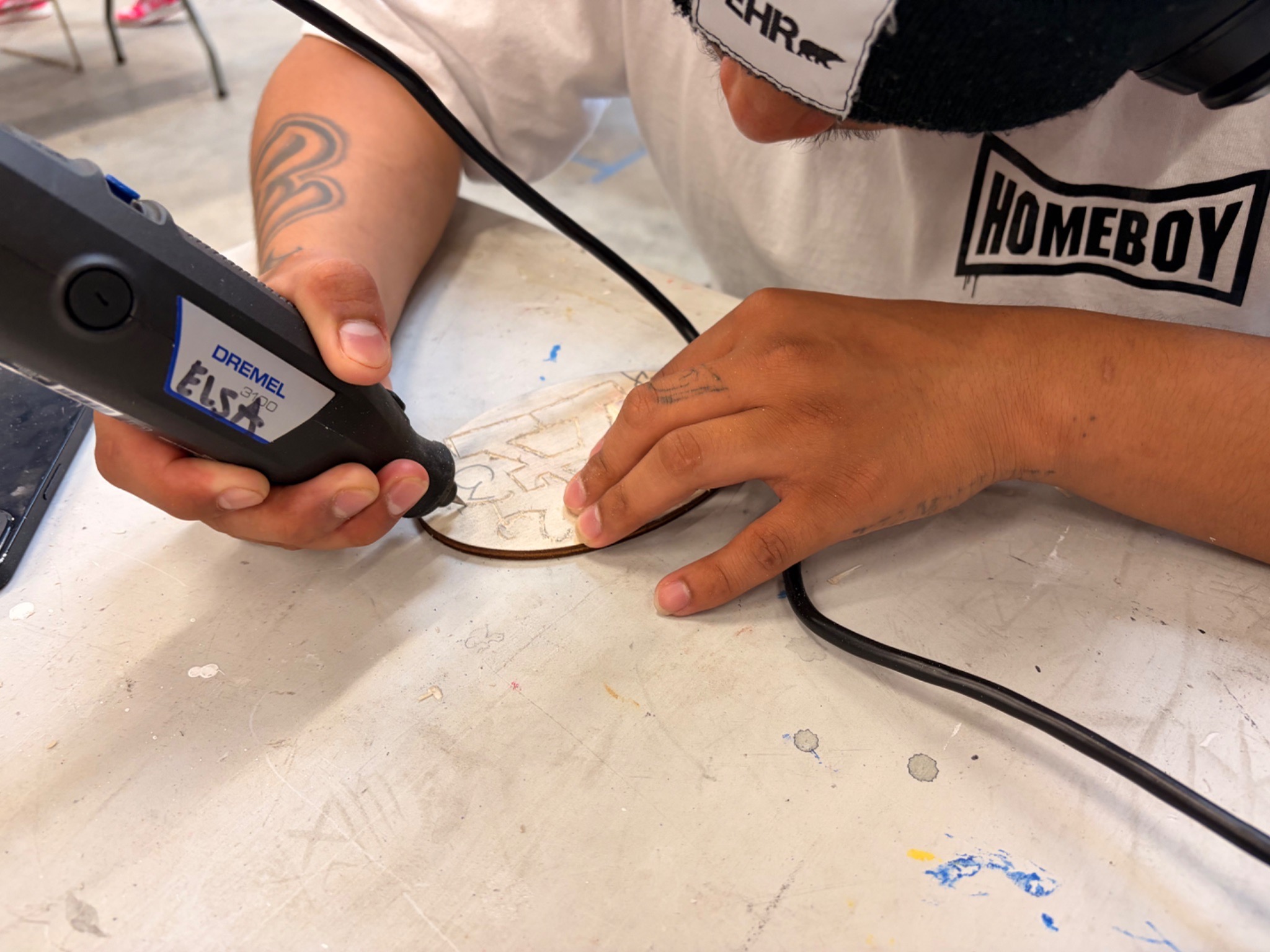
As August came to a close, I found myself feeling more comfortable and confident in my role at the Academy than I had at the beginning of the summer. It has been really rewarding to see the students become more comfortable trying new materials and processes, and to see how each class can take on a life of its own depending on the group.
Open Call for Artists to Join the Movement for Immigrant Justice Update – Karen Hu, MFA Printmaking ’27
This past week with AMOR, we finalized and posted the art open call, marking a significant milestone in our collective organizing efforts. I focused on developing the practical skills needed to create an open call and plan for a curated collection of artworks, learning how to translate movement intentions into accessible artist opportunities. The prompt slides I designed are bright and bold to make the political stakes clear while offering artists a tangible sense of what a meaningful response could look like. They reflect our commitment to reaching artists whose work is rooted in solidarity with communities targeted by state violence.


In AMOR’s ongoing work to build collective power to end ICE violence, through the Deportation Defense Network, every action is guided by an intention to bring people in, build shared unity, and sustain our movement over the long term. This open call is designed to reach artists who want their work to be used in future actions, protests, and organizing efforts. The art which would be collected is not merely displayed but embedded in and actively furthering the movement. By inviting artists to contribute their visions, we are strengthening the culture of our resistance and crafting an intentional space for creativity in our political practice
This experience has shaped me as an artist by deepening my understanding of how works of art can be collected, shown, and used with intention. I am now thinking critically about the relationship between artistic practice and movement-building, and how the life of an artwork extends beyond its creation into its circulation, reception, and political impact. Learning to design an open call has given me a new appreciation for the labor of organizing artists, and I am excited to carry these insights into my artistic practice.


You can find the open call at https://www.instagram.com/p/Dcttz6vlgQ4/?img_index=1
Submissions are due Oct 1 if you would like to join the movement!
Calling Artists to Join the Movement for Immigrant Justice – Karen Hu, MFA Printmaking ’27
Over the past few weeks, I have been working on an art open call at Alliance to Mobilize Our Resistance (AMOR). My goals for this work were to: a) learn the practical skills to create an open call and plan for a collection of artworks, b) understand the different ways that people approach art open calls and why different decisions are made, and c) apply this by working with AMOR to understand how an open call could align with the needs and work of the organization in a way that makes sense and could further their future work.
So far, I explored how artists and artwork can support the mass movement work that AMOR does through the Deportation Defense Network (DDN) in RI. The Deportation Defense Network is a network of volunteers that rapidly responds to ICE terror in our neighborhood. Through a whatsapp alerts channel, verified ICE sightings are reported to the community and volunteer and community members protest, outreach to the neighbors, and share know your rights information. DDN also operates a hotline (401-675-1414), which you can call to report activity that could affect your neighbors, and you never have to identify yourself. Learning more about the particular intentions of the network, to build a mass movement against ICE terror, was central to deciding the ways we could bring artists in to support this movement.
We spent time deciding on the specifics: the submission and evaluation timeline, and whether there would be a celebratory or revealing event at the end. One thing that was really important was deciding on the prompts to center the work of the DDN and connect with artists who resonated with this work. In the end, we decided on these prompts:
- ¡El pueblo, unido, jamas sera vencido!
- ¡Solo El Pueblo salva el pueblo!
- Abolish ICE!
- ICE out of RI!
- Mobilize, organize, and build
- Migrar es un derecho
I started to work on the post for the art open call:

Throughout this work, a common theme has emerged: when working within the context of a movement intended to build collective power to end state violence, there is always an intention to bring people in, build with them along our collective unity, and think about the long-term struggle.
The number to the Deportation Defense Network hotline is 401-675-1414. I am also attaching the qr code to the whatsapp alerts channel. We are all needed in this movement against ICE terror!

A Glimpse into the Fabrics — Alyssa Gorman, BFA Textiles ’28
For my final blog post of my Around the World in 80 Fabrics Fellowship, I wanted to share some of the incredible stories behind the fabrics I worked with this summer. Between working remotely on the Pop-Up Exhibition for Carroll’s new book and handling the pieces in person, there are some stories which have resonated the most with me during this internship. I hope you’ll take a look into some of these fabrics and the cultural heritage surrounding them! All the information and stories I’ve included can be found in more detail on the Around the World in 80 Fabrics website and are linked.
I have to start with the fabric made from beetle wings. It is one of my favorites and it’s so incredibly beautiful and unique. This fabric originates from the Jewel Beetle (Stenocera aequisignata). Beetle wing elytras are ethically sourced in Thailand as a food source byproduct and incorporated directly into the textile. Unfortunately, the use of Beetle wings in Thai craftsmanship is a traditional arts form which is disappearing. The beetle wing fabric in ATW80F’s collection was made by artist and designer Fa Wuthigrai Siriphon.


This fabric was one of my favorites to see in person because the piece is so large and colorful. The wool used to make this fabric was sheared from very special sheep. On North Ronaldsay island, there are a group of Scottish sheep that eat primarily seaweed. These sheep have an adapted gut microbiome to support their diet, and are confined to an area of the shore by a large dyke. Each year, the North Ronaldsay Sheep Festival takes place to rebuild the historic dyke and conserve this sheep breed.

In the collection there are many pieces woven by the Centro de Textiles Tradicionales del Cusco. Led by Nilda Callenaupa Alvarez, the cooperative achieves the most beautiful naturally dyed pieces. I had the opportunity to meet Nilda herself at the International Folk Art Market. Nilda’s organization empowers women weavers by preserving traditional weaving methods in the Cusco region.

4. Algix
I absolutely love learning about the different companies creating bio-based textiles and materials. Bloom creates products made of algae and seaweed with the intention of moving toward a circular economy. Algae is harvested and transformed into a rubber which can replace petroleum based fabrics in shoe soles and more.
5. Simplifyber
Another company using bio-based methods to create fabrics, Simplifyber starts as a cellulose liquid. Simplifyber materials can be created additively, and are recyclable. Super awesome!!

These are just five examples of fabrics in the ATW80F Collection. With 250+ pieces, the opportunity for exploration of petroleum free fabric alternatives is endless. I’ve loved my time at Around the World in 80 Fabrics, and I’m leaving with soooo much inspiration for my own plastic free design practice. I have so much gratitude to Carroll and Lesli for bringing me further into this world of sustainability. And of course, thank you to the Maharam fellowship for allowing me to engage in this internship opportunity.
Organizing the ATW80F Textile Collection — Alyssa Gorman, BFA Textiles ’28
Upon my return to Santa Fe for the second time, we got started right away on organizing the collection. Around the World in 80 Fabrics is in a transitional period. The fabrics need a more permanent place to call home, hopefully at an institution where they can be utilized as a learning resource for students.
Last week, Carroll, Leslie, and I worked to get the collection archived, documented, and organized so that it could be evaluated and potentially acquired. Luckily, Carroll had a friend who donated a space in a square called Sena Plaza, and it was right in the middle of town! The space itself was beautiful and allocated the perfect amount of room for unboxing each fabric of the 250+ piece collection for inspection.
I loved getting to handle each of the fabrics I was already remotely familiar with, pairing the stories I had read about with the physical forms of material. Once we ensured each of the fabrics was in the right location and systematically documented, the process of curating the room for visitors began. We decided to hang the biggest and most contemporary pieces from the ceiling. I then focused my attention on curating a materials table focused on dye practices, innovative biomaterials, and some of the most precious fabrics to be out on display. The entire week while working, I was able to listen to Carroll tell the stories of procuring each fabric, and listen to the stories of cultural heritage behind each piece. I’m leaving New Mexico with so much inspiration for my own practice.
I would love to dive into some of the stories of the collection in my next (and final) blog post for the fellowship. It feels only right to share some of what I’ve learned about each piece. Here’s a collection of photos that I took during the process of organizing the collection.


A glimpse of some of the colorful fabrics I encountered while unboxing the collection, each with rich histories of making and incredible textile processes.


Images taken while curating the space using a table and hanging rack. We had to choose the most relevant and intriguing pieces for display.

A blurry celebration of the collection being organized! Lovely views after a day of work.
You must be logged in to post a comment.