

The Lung – Stephanie Van Riet, MFA Sculpture ‘26
As an artist at Biosphere 2, I am grappling with many truths and complexities within the research and facility. Also within a larger scope, with the scientific and cultural of space exploration. Curious about the internal organs of this place, I consider how they function together, and how I can use my artistic training to visualize the invisible arteries. Since arriving at Biosphere 2, I have been mesmerized by a “floating” aluminum disc in a circular room – this room is referred to as “the lung.” To get to the lung from the biomes, you must walk through a long sloped tunnel that opens into the neoprene-scented room, bringing into view a forty-thousand pound aluminum disc which is suspended by hypalon over a seventy-foot diameter circular pool. The hovering disc moves up and down, regulating the atmospheric pressure of the whole facility. During the initial experiment in 1991, two “lungs” (south and west lung) were critical to control the atmospheric pressure of the biomes while the facility was sealed for two years. Today, only the south lung is in operation.


Left: close up of interior lung. Right: exterior lung, encased by a geodesic dome
In my first week at Biosphere 2, I was struck by the scale of the room and its acoustic resonance; it feels cavernous, yet claustrophobic. There is something haunting about this futuristic space – perhaps it is the emptiness, or the chorus of echoes when the slightest sound is created. After spending time exploring reflections, light and sound, I decided to create a projection to activate the wall and pool within the lung. Though there are no windows to the outside environment and no potential for animal or plant life, the lung it is vital to the functioning of all the living spaces and beings within the facility.

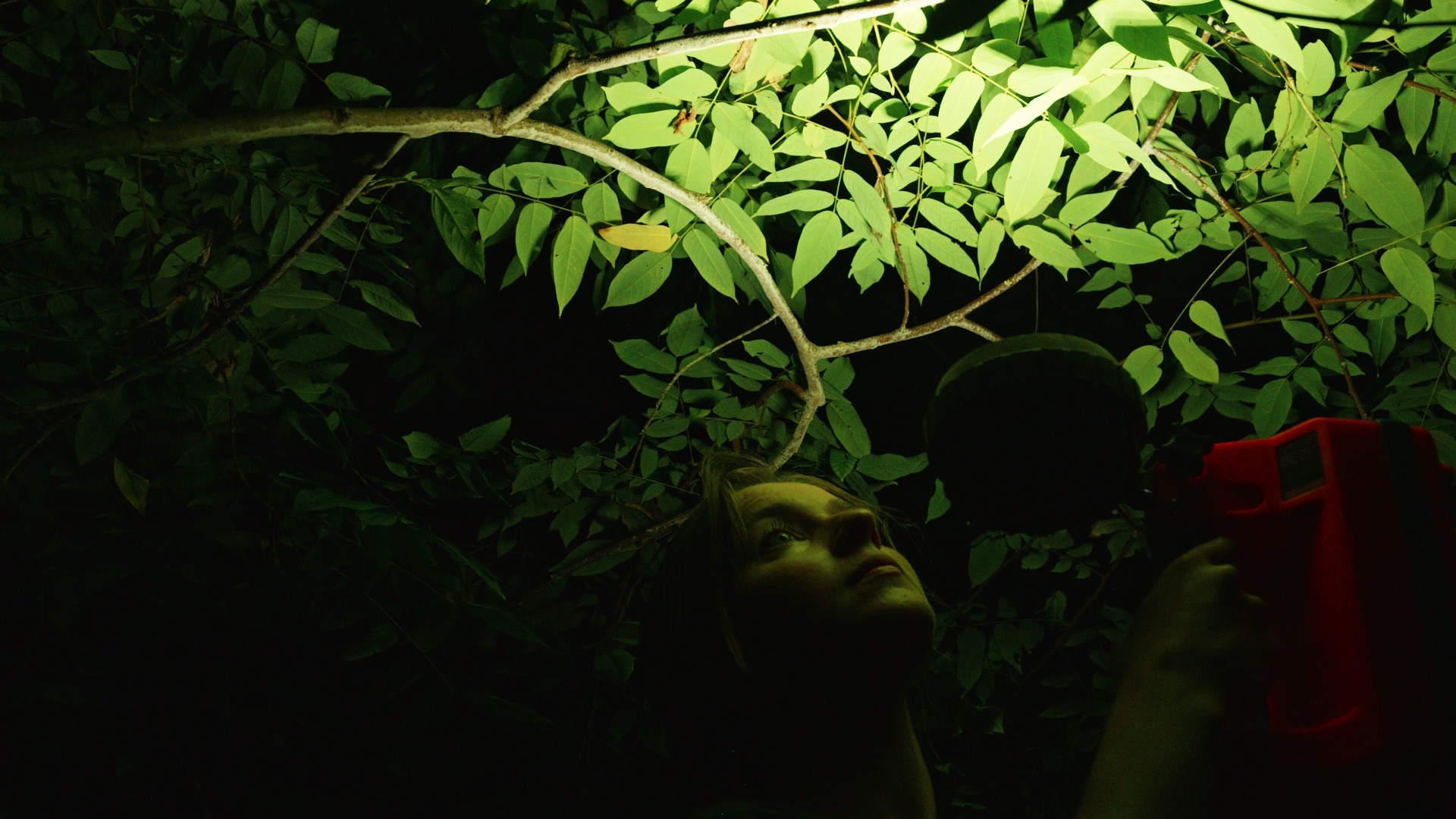
Tracking the sap flow within the cacao trees of the rainforest biome is an ongoing research initiative in Biosphere 2. Due to the cacao tree’s cultural significance and economic value, it is of interest to many to understand how it is affected by climate change. Using sensors throughout the tree, Biosphere 2 scientists are tracking the velocity at which the sap flows from the roots to the branches of these trees. To visualize and animate the unseen data, I have been collaborating with Devin Bayly, Data Visualization Analyst at the University of Arizona. We have been converting data sets into particle flow animations and tree renders, which I have overlayed and stitched together into a video that illuminates with the cadence of my own breath. I also sought the help of Aaron Bugaj, Media Producer for Biosphere 2, to film a performance within the rainforest at night. It was interesting to see this space in the dark, lit only by flashlight – a reminder that while the facility was closed, the biomes are still alive and active.