


Inside of the Bwindi Impenetrable National Park: Intro – Zenzele Ojore – BFA Photo 2018
As the first person outside of Uganda to ever be allowed to work in partnership with the Uganda Wildlife Authority, I’ve been given the unique opportunity to learn about the workings of a protected national park. The opportunity has afforded me the chance to create work in an area that is dense in wildlife but also a vibrant community that borders it. My role in this internship is to support the Uganda Wildlife Authority with content creation inside of the Bwindi Impenetrable National Park (bordering the Congo and Rwanda). This content would then be used in working towards development of the Wildlife Authorities current structure of outreach and communications. Through the process of creating content I will be learning about the various departments inside of the park and their role is in protection of the forest and wildlife inside of the park is, as well as how the park ultimately contributes to the local community.


Ranger, Godfrey


An Artist – Ana Mosseri, BFA Furniture, 2017
Every Monday and Wednesday I teach at the Davey Lopes Recreation Complex along with the help from two youth staff. This past Wednesday I sent one of our youth staff, Andre outside to grab around six local plant specimens that we could use for an observation activity with the kids. Ten minutes later he came back with these! I was like, “where did you even find these?! this is practically the most beautiful arrangement of plants I’ve ever seen!” Not to mention the extremely broad range of color, texture and form that he composed. I asked him if anyone has ever told him he’s an artist. He replied,
“yeah.”
I laughed, of course.

One of my favorite parts about working with the youth staff after a few weeks is having discovered each of their strengths and being able to put them to use. It would be amazing to be able to work with them for a year in order to really be able to take advantage of what each individual has to offer. For now, it’s been really fun for me just getting to know them.


How We Feel – Ana Mosseri, BFA Furniture, 2017

This past Thursday we took a break from farming to learn about salt marshes and how valuable they are to coastal regions. We watched a few videos and listened to a Rhode Island Public Radio report about salt marsh conservation before taking a field trip to see a salt marsh in person. We drove thirty minutes to the Touisset Marsh Wildlife Refuge in Warren, RI. On the drive up I had four of the youth staff in my car and we each took turns picking songs to play. It was fun to listen to everyone’s choices, all singing a long in some moments and in others discovering song’s we hadn’t heard before (K-Pop as a personal example).
When we arrived at the marsh, Alyssa, one of SCLT programmers, gave us the assignment to complete a “sit spot.” A sit spot entails sitting in one place for about ten minutes and situating yourself so that no other humans are in your field of vision. In those ten or so minutes, you are meant to observe the movement, colors, sounds, smells around you as well as your own emotions. This exercise, as simple as it was, was the main activity we did on site. Afterwards, we each went around and shared one thing we noticed. The overwhelming response from the youth staff was that they loved the experience. Most of us found it to be relaxing and everyone had noticed different things about the same place. Mostly, it was really exciting for all of us to see such striking scenery so close to our home.

This experience, a long with many others, made me see the value of just hanging out together as a group. It is important that we learn about the food system, it is important that we better understand farming and it is important that we see the effects of global warming on our lives. It is also important that we have fun together in a beautiful place or just driving around listening to music. When I talked to my supervisor Kevin Jankowski about these experiences he reminded me of the Maya Angelou quote:
“At the end of the day people won’t remember what you said or did, they will remember how you made them feel.”

Before I begin | Mudita Pasari, MA ’17, Art + Design Education
After a bus journey, a few elongated flights and a car drive I have finally covered the mammoth distance to the city of my childhood. After years of living in different parts of the country and world, I am back here for the summer and the Maharam Fellowship project.
The past year at RISD, for me, has been about extensive research into possible ways to discuss the disappearance of the pangolin- a little known endangered species of mammals that walk our two largest continents. This enquiry into a single species became the face of my interest in discussing the disappearance of fauna due to various human activities. Trying to dissect the possible psychological fronts in the context of the disappearing pangolin has opened various pathways for future study of related subject matter rooted in understanding our relationship with the natural world. This research has lead me to experiment with various points of design interventions as a source of disseminating information as well as encouraging local involvement.
My name is Mudita, I am a Narrative and Strategic Designer, who is currently writing from Guwahati, Assam. The Indian state of Assam shares its northern border with Bhutan, its southern tip with Bangladesh and is known for its extensive tea production industry. Guwahati being a relatively smaller city, yet the largest in north-eastern India, is often visited by tourists on their way to the rest of the north-eastern states. The project I plan to pursue through the Maharam Fellowship is the next step in my endeavor to bring to light the discussions of biodiversity, its disappearance and conservation; hopefully creating a larger impact starting in Guwahati, Assam. For the next 8 weeks, I will be working with Mr. Jayaditya Purkayastha, a herpetologist who is the General Secretary at Help Earth, an NGO working tirelessly to drive the conversation about the conservation of urban biodiversity into every household.
Over the past week, I have had two meetings with Mr. Purkayastha, to discuss the possible ways in which I could integrate my interests and aspirations with the functioning of his organization. A widely published author, Mr. Purkayastha has written books on the variety of birds, snakes and turtles found in Assam. His organization is now interested in encouraging school students to be invested in the documentation and conservation of urban biodiversity in Guwahati.
This is where I step in.
Over the next few weeks, I will be spending time with the research papers and other theoretical documents produced and collected by Mr. Purkayastha and his team. I plan to transform these into age appropriate educational material integrated with activities which can be used by schools to encourage the involvement of students in the larger conversation of biodiversity and its conservation.

If this experiment goes well, we would have the opportunity to further promote and integrate biodiversity centric, activity based educational material within the mainstream educational system; starting from this obscure, often forgotten city of Guwahati.
My Sunset is Your Sunrise/ Chris Cohoon, TLAD MA 2017

It was appropriate to watch the sunset from my window seat as I flew out of Japan. Two months in Okinawa feels like two days. Until now, my shortest stay on the beautiful island had been just over a year. To have such a short time to enjoy its bounty felt a little stifling, but I am thankful for every minute I was given!


Cody and Dave apply primer to the foam
Restrictions placed on marines by their command caused attendance dwindled during the summer. Because of this, their project fell behind and its completion looked bleak. Over the last two weeks, however, a couple of the marines and an airman were able to spend extra time catching up and completing the board. Both classes worked hard to finish their projects, and they look fantastic! It was a joy to work with each group, even amidst the frustration of red tape and language barriers. A valuable lesson to learn, however, is that every design solution must overcome its own set of unknown problems. And, what often seems like the death of an idea, is the birth of a better one.

Post-production party! My co-worker, Kenji, and I are flanked by marines and airmen. The graphic design for this board is based on the Okinawa flag. The kanji, “Taco Casa,” is our faux design company name. In Japanese, it translates as “octopus umbrella.” The multi-language pun was born out of discussions about empathy in the high school class.

The board design features a silhouette of Okinawa and represents the fusion of local and foreign island culture. Okinawans often identify with Hawaiian and Jamaican culture. At any given festival, you might take in traditional Okinawan dancers, a hula performance, and a reggae band.
Now that my portion of the fellowship is over, the program is in the hands of my supervisor and of the chaplain who participated in the adult class. The chaplain is planning to start a surfboard design program on the base where he works, as a way to mentor more young marines. My supervisor is looking at future design projects with high school students. He is also training his staff in Design Thinking for creative leadership. I am now back in the country scouring job boards for gainful employment (I’m open to suggestions). Meanwhile, I will continue developing the creative leadership curriculum for community development organizations and philanthropic companies. Design Thinking and creative leadership can be valuable tools to enable communities to design sustainable, indigenous solutions toward a better life. I am ever grateful to Maharam and RISD for such a rich opportunity to explore an idea and empower others to create!


Miyagi-San invited me back to the studio for a private master class. I threw 3 somewhat round vessels. Once they had dried, Aki, his studio assistant shaped them into beautiful bowls. It’s incredible what the master can do with such poor material!
The Final Stretch | Yuko Okabe, ’17 BFA Illustration
Ideas, Ideas, Ideas

The last couple of weeks brought a huge wave of brainstorming, sketching, creating, and discussion with Jason and the team. As of last Friday, I have spoken to 48 different patients, still keeping up a wide age range. The more I spoke with patients, the bigger the game world within the Neuromotion platform grew in my head. What world should they encounter? What sort of problems? The original plan was to have the player go to different cities around the world during the game, but I kept thinking that the metagame could be a great opportunity to imbue something more engaging and creative, while still keeping the experience cohesive.
When I brought up this thought to Jason, he thought of how aside from the biofeedback component, helping children with emotional regulation often means teaching them necessary executive functions. After a thoughtful pause, he pondered, “What if each place the character could go to could teach different executive functions? It could be a good chance to teach some psychotherapy in the game.”
I ruminated on this thought for a few seconds, but the cams and cranks in Jason’s brain were already flickering a small light of inspiration. Without missing a beat, he slid over to his computer and e-mailed me an article about this subject, simply called Executive Functions by Adele Diamond, a professor from the University of British Columbia and BC Children’s Hospital, Vancouver. She wrote:
Executive functions are “a collection of top-down control processes used when going on automatic or relying on instinct or intuition would be ill-advised, insufficient, or impossible.
For her, there were three core executive functions and an additional minor one. Jason’s current idea is that the mini-games could be categorized accordingly into each function: Cognitive Flexibility, Inhibitory Control, Working Memory, and Fluid Intelligence. That way, the games could be more organized and this would provide a bit more cohesion. Of course, play-testing would be the ultimate judge of this idea, but it’s a start!
To provide more brief definitions of these terms, I wrote up bullets for my own notes and for the rest of the team: Executive Functions

Sketch— Inhibitory Control: giving into external lures, handling impulses. Lack of: Characters with chronic hoarding issues?
Though this metagame idea is farther down the road for the team, it’s important to think of the proceeding steps since the start-up constantly changes. Jason had me start thinking of how these worlds could look, and that we can talk through their accuracy and accessibility. I have to say, it made those hyper-conceptual RISD assignments have come to good use. Project tasks like “Please Illustrate De Ja Vu” and “Create a 12-dimensional self-portrait with gouache” actually DO resurface in the non-RISD world. This gives me hope, albeit a lasting migraine to wrap my head around these concepts while also keeping themes and illustrations understandable.

Sketch—Working Memory: Holding information in mind and mentally working with it. Lack of: Some form of negligence. Purposely getting lost and not caring?
Aside from this brainstorming around the metagame, we came to the conclusion that there should be an avatar character that the child can play as. I would say pretty much all of the kids feel relatability and customization would be crucial to this game to connect them to the game (as well as having a large world of possibility to explore). If the avatar could have natural dialogue with the friend (coach) as well as with other characters, the experience can play out as a story and less as a one-way teaching tool. I think we can learn a lot when situations play out in front of us; for some reason, we can reflect better in the third person.
So in a sense, now friend character will become secondary to this avatar character. We’re now questioning how much the friend should intervene, and how much we can use this narrative framework to instill independence for our users. Jason and I had a brief discussion, and he thought that at this point, the avatar becomes the main character of this game. Thus, when I started to create final splash screens and home screen backgrounds, I questioned whether to represent an avatar as an independent traveler or have them accompanied by their friend.


Progress—Splash Screen and Home Screens. Show mid-travel spots. Keeping it vague, but inviting.
Progress: Avatar customization. Dr. Alex Rotenberg suggested that this could be an opportunity to use a VAS scale (visual analog scale) where a child can choose an expression that feels represents them. He asked whether that could give insight into “an inherent problem” that the child perceives themselves in a certain way.

Also the team has been helping to create other opportunities to introduce the avatar and friend into the beta game. We have a tutorial or “emotional warm-up” where players have to raise and then lower their heart-rate on the screen as well as a game-over screen where the friend, when appropriate or occasionally, could appear with advice.


It’s Not Your Fault
So it’s production mode until the end. With one more week left, I still plan to see more patients. I think this last week would be a valuable opportunity to ask some final big thinking questions. For some of the patients I met, I asked, “What would be something that we should definitely do in this game?” Then followed by, “What is definitely something we shouldn’t do?” One older boy thought that there should be a main lesson in the end, so there’s a working goal. A couple of 7 year-old girls both said that it would be important to have your character travel around and help other characters because that would help them feel better about themselves.
If I can share one response that resonated with me these past couple of weeks, it would be one experience in the Inpatient Unit with a teenage boy. He was the only person I interviewed that afternoon, mostly because I had to leave early to see another patient in the Outpatient Clinic.
“The g-game should teach you how to…get better…and …get out of the hospital.” I noticed the “Welcome to the [Inpatient Unit Name]” notebook on the table in front of him. He also said that the character you play as has to have a motivation, an ultimate goal to reach at the end of this game. “Also teach…skills, like coping…skills.”
He was a very soft-spoken person, but his face was very physically scarred and his eyes very tired. He was also shaking the entire time. Each time he had to stop to cough, he apologized. A couple of times, he was shaking so violently that he couldn’t verbalize his thought.
During a particularly strong episode, he tumbled through his words. “I’m s-sorry…it’s my med-medication tha-that’s…ma-making me…shake”
“It’s okay, it’s okay.” At that moment, his quivering head slowly turned towards me, and I knew I had to look him square in the eye. It’s not your fault, I thought to myself. It’s not your fault. In a weird way, I thought he could hear me. I let him speak for about 40 minutes until I had to leave. Each time he coughed, I waited. Each time he needed to collect his thoughts, I waited more. In the beginning, I contemplated whether or not I should have turned to one of the nurses there to see if they needed to help him. But after those first couple of minutes of speaking with him, I realized that this boy was trying so so hard to get his thoughts across. He was very thoughtful, gave great critical feedback, and really valued the importance of having a character give you advice during the game, not a disembodied voice.
Very politely, he shook my hand at the end of the interview. “G-good luck.” I think he smiled a bit.
I smiled back. “Thank you so much. G-have a good day.” I nodded my head, thanked the nurse, and walked out with another nurse.
Should I have said ‘good luck’ back? Should I have even said ‘have a good day’ even? These phrases are so casual in day-to-day life, but in an inpatient unit, it’s just irony. I thought about this on my way to the Outpatient floor where I realized my patient cancelled and I had another hour or so until my next expected patient.

Progress—launcher screen
Not to get too philosophical here, but it’s moments like these where it’s important to separate the body from the mind. Though this boy had little control of his actions, his sharp, serious expression exclaimed his presence. It takes a little longer and a bit more patience to really see it, but it’s there. I had to give him time to speak and not impose anything which has been a constant anxiety for me when talking to patients. In a way, this experience has become less about finding information about what motivates these children, but more-so learning to present myself as an active listener and empathetic speaker. How can you really hold a conversation with a child, any child, and have them know that an adult is taking them seriously? Though I may be dressed in business casual and have a fancy hospital ID around my neck, I still want to get down to their level, which really becomes the task for any pediatric clinician at BCH. And there’s a lot more nuances than people think. Some kids have been easier to reach than others, but again, it’s part of the learning. I didn’t study any of these techniques or terminology; at that moment I can only reach them through small questions, a bit of joking, and a handful of writing and doodling.
But sometimes simplicity is the answer I suppose?
Eureka!!! -Chris Cohoon ’16, TLAD
Eurecka!!! Louis Pasteur forgot to close the window to his laboratory and discovered penicillin. The pacemaker was invented when Wilson Greatbatch was working on a heart monitoring device and pulled out the wrong resistor. And the new, hybrid, paddle-board hull was created during a serendipitous moment in a buoyancy testing session.

Our high school class gathered to discuss the scale models for their paddle board designs. Most students created 1/10th scale prototypes while one group went with a 1/5th size. As we talked about how the features of each form would affect the performance of the board, we decided to conduct a test in water. The tide was out, which allowed us to find just the right tidal pool in which to conduct our tests. Everyone set their boards in the water and weighted them with water bottles. We knelt around our test-pool, pushing foam boards around and discussing how each reacts uniquely, but none contained just the right combination of qualities we were looking for. The flat boards were less likely to tip but were more difficult to propel. The v-shaped hull cut through the water but was easily tipped.

Shaping the stringer (central wooden board) to initiate the building phase!
When the focus shifted from observation to the discussion, the kinesthetic students started playing with the boards like little kids playing with toy boats during bath time. One of the small v-shaped boards got lodged underneath the large flat-bottom board. Someone picked it up and said, “What if we align the small board down the center and see what it does?” Held by water tension, the boards stuck together. They placed the new design back in the water, gave it a shove, and EUREKA! We found the attributes we had been looking for, all along! Suddenly, a new energy and excitement came over the group and we spent the next two hours spooling up for the full-scale prototype.While the high school class continues to rock the design process, the marine class has been less successful. Work and duty schedules, island-wide travel restrictions for military personnel, and constrictive communication channels on base continue to inhibit young marines’ participation. Each week a new combination of students shows up, which makes continuity difficult to maintain. As I have pondered this development, I’ve wondered how to work around it. Rather than an eight-week program, one or two multiple-day intensive sessions might work better. If the program were to go all day over the weekend, and then during the next two evenings during the week day, scheduling may be more manageable. It is difficult to say for sure without trying it. A leader who is here long-term also has the advantage to scheduling sessions throughout the year. Although attendance is unpredictable, good conversations continue each week, and we all continue to learn from one another.

Hank, and Airman, uses a broom to “paddle” as he checks out the size and shape of the adult class’ board
During some of my down time, I have been able to enjoy the island and local culture. Last week, I received news that a friend would be on island. I met him during a random pit-stop in Iowa, while on a road trip in 2003. Two or three years later, we randomly ran into one another, again, in Mainz, Germany. This time around, I heard through mutual friends that he was coming to Okinawa for a meeting. We caught up over Japanese curry for lunch, where I discovered that he collects pottery. I took him up to meet my good friend, Mitsunari Miyagi, who generously gave us a tour of his studio and 40 year old family kiln.

Miyagi-san is a master potter and long-time friend. This awamori (Okinawan sake) flask displays his crab design, for which he’s well known.
Miyagi-san is a traditional master potter. His grandfather was designated as a national living treasure for helping to save the traditional craft after WW II. When I previously lived in Okinawa, Miyagi-san was my neighbor. Even though we spoke very little of one another’s language, we grew to be good friends through art, baseball, and cooking (he’s a fan of bratwurst). One of my dreams is to open a gallery to show and sell the incredible pottery that Miyagi-san and other Okinawan artisans produce.

More of Miyagi-san’s amazing work in his studio
“That which I cannot build, I cannot understand”, Callie Clayton, BFA TX ’17
In my last blog post I proposed that the “involvement of art, interactive-critical thinking and processing seem[s] a key interpretive element for larger topics of access, understanding and analyzing the purpose and effect of genetic engineering experiments.
After two additional weeks of reflection, observation and visual protocol interpretation drafts, I don’t believe that the “involvement of art, interactive-critical thinking and processing just seems a key interpretive element-
I avidly believe it is.
Up until two weeks ago, high school students that are taking part in the Genspace iGEM team had been coming to the lab to do serial dilution tests (test the survivability of e.coli after different time increments of dehydration followed by resuspension and plating onto agar- essentially, rehydrating e.coli samples to see how well they grow after different amounts of time being dehydrated as a basis of comparison to be executed with tardigrades-testing this water dwelling, eight legged micro animal’s ability to survive under dehydration conditions due to certain genes. Identifying and isolating these genes for potential use in the production of vaccines- allowing vaccines to retain effectiveness in the presence of heat when traveling to high temperature countries lacking access to certain vaccines is an ultimate goal of this project). They have also been isolating tardigrades (essentially extracting them from the water and moss they live in) and considering utilization of the CRISPR technique with the tardigrades. Twice a week and beginning two weeks ago, everyday, the high school students come to work on this project during which I participate and observe. Participate to understand protocol processes, teaching methods + mediums for teaching, how students are learning and perhaps integrate another viewpoint- ex: commenting on changes in transparency of agar interacting with bacterial colony growth which results in light (when the petri dish is held up to be seen more clearly) highlighting certain “focal” points of this circular, 9 ” radial composition.
Common responses to these comments I make include but are not limited to: smiles of acknowledgement for the comment (I find these a bit funny and endearing), comments like “oh yeah! cool!” and “huhs” followed by what I have hoped to be looks of pondering, pondering alternate methods of viewing physical aspects of results/protocol steps.

I muse about ideas and reactions to my visual interpretations within the lab context of collecting quantitative data for a “what does this mean and how will it have subsequent effects in the minute steps that add up to addressing a broader exploration/topic” versus a “what is this now and how can it be understood outside its current context” mindset.
How can alternate forms of interpretation such as poetry, process and visual similarities with patterns in literature, bee flight paths, people’s tracked habits, etc. patterns allow one step in an experiment, one petri dish, be appreciated and understood outside of the exclusively quantitative? However, that being said, one could argue the opposite- that all patterns are only able to become recognized as patterns due to their calculable, repetitive nature which allows us to quantify the image, action, anything; thus patterns fundamentally are the summarization of quantification? and can identified repetition ever be completely fixed? A habit, predicted flight behavior of bees, predicted and actual growth rate (number of colonies predicted for growth) and cell behavior with the uptake of certain plasmids, etc. exist as predictable as a pattern due to quantification but within a statistical range. I’ve come to better understand and believe in the idea of maximum 99.99% accuracy. Results and protocols in the lab are treated meticulously and done in repetition in order to set up conditions for accuracy however innumerable factors such as the nature of the human hand confirming human error, changes in environmental factors and the constant changing responses of living organisms means that prediction maintains variability, quantification exists within a range of error thus meaning pattern (summarized quantification) must be expressed through a range in order to be represented/explored/interpreted “accurately.” How do we interpret range in this context? I think of it as integrated multiplicity of interpretations. Multiple translations outside of numbers and observational text capitalizing on the 0.01% bias. So let me rephrase: How can considerations of quantification (pattern) be expanded to regularly necessitate interpretations besides numbers and observational text? In order to be “regular and intelligible form or sequence” as described by one definition in Oxford Dictionary, a pattern must undergo multiple forms of translation to be understood. Translation, interpretation and the infinite concept of languages, my friends.
–
During breaks in setting up experiments- waiting for new agar plates to cool and set, solutions to dehydrate, etc. I’ve asked a number of high school students about how they understand and interpret content taught in the lab- tardigrade anatomy, CRISPR basics, 3A Assembly protocols, etc and what “type” of learners they perceive themselves to be. One student noted the importance of color in cognitively differentiating content within written and drawn information. “Writing becomes a blob of lines and color that mixes together” in an undefined way in that student’s opinion. Intentional color and alternating use of visual and written content she agreed may help her better interpret what is being taught. Upon my suggestion of “icon” visuals to piece together protocols with, in conversation with a small group of students, one student acknowledged that while icons could potentially simplify protocol building and interpretation, icons = another language such as hieroglyphics which adds an additional step of time and translation. Additionally, protocols are different lab to lab (similar to cooking- similar or same end result, minute differences in protocol peppered throughout) – meaning standardization is difficult. Work initiated and being done by the Synthetic Biology Open Language, a project and initiative funded by the NSF, federal agencies and other sponsors, started a readable visual simplification of genetic parts, devices and systems. While the symbols facilitate interpretation of certain genetic parts well, they don’t address the next step of ‘protocol’ and piecing a protocol together. (below from http://sbolstandard.org/visual/)
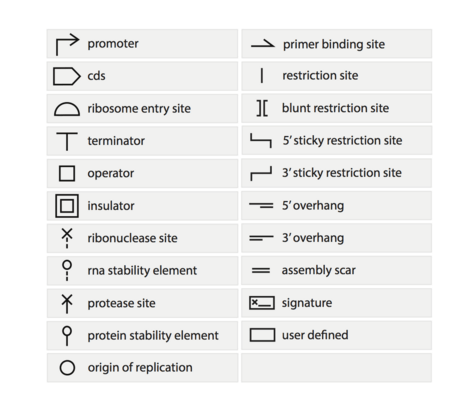
I had a great talk with one of the cofounders of the lab around the evolution of interpretation and languages in synthetic biology. Essentially it’s all about the development of “languages” he said (as I have come to understand myself as well). In order to expand rate and quantity of not only synthetic biology lab work, but also any lab or “hand-crafted” work as he said, languages for facilitating this work must be expanded upon. With hand manipulation of a majority of elements in an experiment comes human error, problematic experiments, confusion on what went wrong and decreased rate of results. In order to increase accuracy and efficiency, attempts through standardization have resulted in the recent development of many programmed operating languages developing to be read and carried out by a computer. The day when a protocol can be electronically sent from one computer to another to then be carried out by that computer seems to be approaching. This development of automation points to potential increases in productivity, thus allowing not only for expansion of biotech companies and more engagement in the DIYBio realm due to decreased necessary time investment, but at a fundamental scale- this allows people to spend more time ideating, conceptualizing than carrying out repetitive protocol steps in the lab. I find these developments of programmed languages for synthetic biology exciting however potentially limiting? Will understanding of actions being carried out from a protocol by the computer and the meaning / effect of those actions be hindered by the ease of technology’s commanding role? And how does this type of development affect the public without extensive understanding of science least synthetic biology, their process of learning in the DIYBio, Synthetic Biology communities? Could these communities become perhaps commercialized in unwise ways because the language containing the knowledge about what’s happening to those cells is encrypted in a code that makes executing protocols concerningly easy (touch of a button). With generally ok national public engagement / understanding in the sciences, does this engage or disengage people? I feel the simultaneous development of visual languages is imperative to address educational aspects of the Synthetic Biology community- facilitating understanding while efficiency is increased.
While at Genspace, I’ve come to recognize difficulties it and other community bio-labs face as nonprofits- similar to familiar challenges for all nonprofits. A wonderful yet potentially difficult aspect of a space in which everyone interested in taking a class and becoming involved in the community is welcome, is that unsurprisingly multitudes of collaborations, projects and ideas come out of this space each year. However, as is such with “personal projects,”and funding challenges at times, the completion and documentation of ideas/projects sometimes lacks. A really exciting project started by Genspace’s 2014 iGEM team is Open Lab Blueprint, a site for aiding the creation of community bio-labs, including a proposal for a lab protocol platform. While started, it was never completed due momentum slowing after the competition deadline. I’m excited to be talking with a designer next week about the platform called “Bioglyphics” and plans for its future development.
This week’s title “That which I cannot build, I cannot understand” was heard in the lab and is a take off of Nobel Prize winning physicist Richard Feynman’s quote: “What I cannot create, I cannot understand.”More insight on this quote to come in the next post.

Plans for upcoming week:
Continue protocol drawings and equipment use standards to make a booklet for beginners in community biolab classes such as the beginner biotech class at Genspace.
Write interpretations of lab protocols- free verse poetry.
Consider questions, prompts, topics to be considered as alternate methods of interpretation and integrate them in booklet.
Obstacles and Opportunities in the Creative Journey -Chris Cohoon ’16, TLAD
Change is the only constant in the life of service members and their families. Major moves (often transcontinental) occur anywhere from yearly intervals up to four years. The span between moves is often interrupted by multiple deployments which range from training missions, to humanitarian aid, to combat. A friend of mine, who is a former pilot in the Air Force, averaged 310 days worth of deployments in the calendar year – and that was during peace time. From the transient environment, come sarcastic colloquialisms, such as: “Home is where the military sends me,” or “Home is where I store my stuff.” One learns to not ask a military kid, “Where are you from?” unless one wishes for a look of confusion and/or disdain. A former student of mine had moved 14 times before her 13th birthday.

Amidst the flurry of brainstorming
The military is known for being regimented. When I ask marines what they do at work, training nearly always comes up in their answer. The Marine Corps ensures that each of its members knows their job backwards and forwards. It makes sense that, in the chaos of battle – or even in the transient lifestyle – one needs to know their job by rote. The means to this end is simplification and efficiency – even at the expense of the simplest, most efficient solution. Job descriptions and policies are often written by what seems to be a good solution at the time. The training criteria is then disseminated and leaves little room for questioning or interpretation. Another oft uttered colloquialism is that “if the military wanted your opinion, it would have issued you one.” So, while one’s job differs greatly from location to location, and times change quickly, the slow grind of the bureaucratic structure and the unflinching culture of tradition, duty, and authority severely limit the potential for more efficient solutions.
One of the reasons that I chose to work with marines for this project is because of the general lack of creativity within Marine Corps culture. In the last two weeks of classes, this point was highlighted as we learned about brainstorming and ideation. The creative dichotomy between the high school class and the marine class is palpable. It has taken much longer for the marines to warm up to creative ideation, even though they are only one or two years older than the high school students. I feel that the heart of the matter is one of permission. In many ways, the straight forward direction and rote training of the military makes sense. In certain situations, repetition and muscle memory will save your life. It is difficult for young marines to feel the freedom to think outside of this context, even when not at work. It has even been a challenge for my marine participants to call me “Chris,” rather than “sir.” We are getting there, slowly.

Hydroelectric generators, coolers/seats, hoods to keep your feet dry, sonar, PET bottle construction material, so many creative ideas!!
The fluctuation of personnel constantly transitioning in and out still has its effects on policy, despite the attempts at standardization. On my way out here, my supervisor had secured a building on the Marine Corps base for a classroom studio space. By the time I flew out, the commander who had approved the space transitioned out, and his replacement decided that there were other priorities that demanded the use of that site. My supervisor quickly worked to find a workshop off base. Being off base makes it more difficult for young marines to make it to class, as they are not allowed to drive. At the same time, however, this turn of events created a greater opportunity to recruit local Okinawans to participate in the design project with us. What better way to learn about empathy than by working with people from other cultures? Unfortunately, the language barrier has proven greater than my hopes, so far. Translators are difficult to come by, as are English speaking Okinawans. With four weeks left, I’m still hopeful that those connections will happen.
My Maharam Fellowship experience in Okinawa is challenging, as I face systemic and cultural barriers. But a good challenge provides good opportunities to design solutions to meet those challenges. The shape and tempo of classes change (sometimes weekly) to meet the needs of participants. And with each class, we have had great moments of synapses connecting and lightbulbs turning on over our heads. In one such moment, one of the marine participants returned to class after a research/survey assignment. The assignment was to survey as broad of a population as he could, in order to gather information about potential “customers” in the base population. It was clear that his samples all came from his peers. When I probed as to why he didn’t survey others around him, he informed me that the other people around him are sergeants, and he doesn’t like sergeants. The conversation turned back to the data he collected. It was apparent that his peer group is unable to purchase a paddle board from our mock-business at a price that is sustainable. The logical follow-on question was to ask who, then, is a better customer target? He concluded that sergeants earn a considerably higher salary and would likely be a good target. He quickly realized why it might be beneficial to empathize with sergeants though he might not sympathize with them.

One of the young marines joined with the high school class to help shape prototypes.
The conversation then took a turn toward the importance of empathy in leadership. The marine admitted that he didn’t like sergeants because they doll out extra work and discipline arbitrarily. Sergeants, in his mind, don’t deal fairly with subordinates because they don’t know them. So, perhaps, a lack of empathy leads to poor leadership. Pressing on, we discussed that in may also be that the views of the subordinate marines are also skewed because they don’t understand the experiences of their superiors. The eureka moment, however, hit when he realized that, if all goes well with his career, in a couple of years, he will be one of those sergeants. This thought had never been within his grasp in his short tenure. Together, we concluded that empathy is a very important part of leadership, and a dose of humility to recognize that we aren’t superior to other peoples is a great first step to being a good leader.
The past couple of weeks have been perplexing, and even frustrating, at times. The Marine Corps culture and the circumstances here on Okinawa don’t make promoting creativity any easier. In the midst of it all, however, there are still great moments with the marines and the high school students that I feel utterly privileged to be able to work with.

Students working to bring their ideas into the tangible world
Searching for Meaning in Their Faces: More Interviews, the Inpatient Unit, and a Little Green Notebook | Yuko Okabe, BFA Illustration 2017
Meeting New People and Interviewing Like a RISD Student
“It’s very important to get down to their level, and ask them if they know about the center and what it’s about. Sometimes, parents don’t fully explain why kids are brought to places like ours.” -Dan Cheron, Ph.D, Judge Bakers Children’s Center
Since my last post, I was able to interview many more patients and clinicians. I have contacted 9 therapists and prescribers (clinician who assigns medication) on the outpatient floor so when and if appropriate I can interview any of their patients for a few minutes. So far, I have interviewed 28 patients and with more to come with ages ranging from 6-20. Jason and I spoke how though the game would be primarily directed towards 6-12 year olds, getting insight from older teen patients would be vital. In a way, I think that teenagers would have a better understanding of what they need over what they want out of therapy, particularly if they have been going through it since childhood. Having spoken with a few, they talk very much like veterans and they have so much dignity and awareness of their situations. They’re honesty and sincerity has been great to see and the energy and curiosity of the younger children has been amazing to experience.
For a little bit, I would use a notebook and pen to write notes. But then I realized, “Hey, I’m not a therapist and I’m from RISD so what am I doing?” It didn’t feel natural. So instead I started using drawing/note taking on a large sheet of paper so that kids can see what I’m writing. This proved to be so much more effective, especially kids with low focus or low verbal skills, this stimulated our conversations to a great level each time. They sometimes draw with me, too!


Got really into this one. We had to extend to a couple more sheets.
Just to share some clinical insight form these past couple of weeks, I spoke with the Assistant Director of the Center for Effective Child Therapy from the Judge Baker’s Children’s Center, a center dedicated to improving children’s lives by empowering their emotional, intellectual, and developmental well-being. The Assistant Director, Dan Cheron, Ph.D and I had a conversation about his methods and practices as well as his thoughts about our biofeedback game. He related how he always introduces himself to a new child first before the parent. “It’s very important to get down to their level, and ask them if they know about the center and what it’s about. Sometimes, parents don’t fully explain why kids are brought to places like ours.” I appreciated the thoughtful considerations he has towards communicating with children, especially what he said about keeping conversations on a first name basis, so kids can call him “Dan” instead of Dr. Cheron.
“It keeps our conversations more casual,” he explained.
He also shared how he would keep language developmentally appropriate, a method which ended up coming in handy during my patient interviews, particularly if someone is very young or has certain cognitive disabilities.
We treat kids like human beings, not their diagnostic. -Miranda Day, Creative Arts Program, Boston Children’s Hospital
“Younger children understand emotions better than terms.” he said. “So instead of saying, ‘oh, so your parents brought you here because your anxiety got worse,’ you would say ‘what makes you feel sad?’ or ‘do you feel scared and mad sometimes?'”
But on that note, the older kids seem to appreciate my interviews more when I don’t beat around the bush and I flat out say that this is a “therapy” game we’re making, particularly for kids who need to learn how to stay calm and focused. I have to asses each situation separately and be careful about language and wording each time.
Going back to Dr. Cheron, for the encouraged that we should include a tool box of skills that a child can refer at crucial times. He also said that, as much as possible, we should make opportunities for children to feel like an expert. He said this would increase parent/guardian/caregiver engagement and the experience would become more collaborative. To an extent, this gives children a sense of control and agency of their experience.
On that note, I also spoke with the Director of the Children’s Hospital’s Creative Arts Program, Miranda Day who also believed that children should be given as much control and customization in the game as possible. A quote that stuck out to me during our interview was, “We treat kids like human beings, not their diagnostic.”
Miranda’s job is essentially to lead and organize music therapists, artists in residence, and a multi-media studio in the hospital called Seacrest Studios (created in partnership with the Ryan Seacrest Foundation). Music therapists are fully trained staff in a clinical setting who use either singing and/or instrumentation to help children heal. Artists in Restidence are not fully trained in therapy but instead come from either educational and/or professional backgrounds in fine arts or design practices. They share their creative skill-set to children through writing, illustration, printmaking, digital media, etc. and in turn, patients can experience these creative projects and even continue to apply them when they leave the hospital.
Visiting the Inpatient Unit
Before our conversation ended, Miranda said that she could connect me to the Inpatient Psychiatry Unit in the Hospital since Jason and I only had luck interviewing from the Outpatient Clinic. To expand our audience, Miranda said that reaching out to her or her other colleagues about the inpatient unit would be a great asset to our research.
“They’re a very creative bunch over there.” She related how much the patients valued having the arts program visit them since it keeps them stimulated and excited about their projects.
This past week, I went to inpatient twice with the expressive arts therapist group. I have to say the reason this experience was very meaningful but moreso relieving, and it may have been relieving for reasons different from what other people would feel. For personal reasons, I’d like to save some exposition until after the internship ends because I can better collect my thoughts and I’d like to reflect on the experience as a whole in that way. But what I can share right now is that having the opportunity to visit the inpatient unit was initially both very exciting (because seeing new patients is always exciting) but also very worrisome. In a way, I knew what I was going to see but I also had no clue what I would actually experience, especially emotionally.
If you can ignore the ambiguity of that description for now, I’ll sum up my experience at the present as, yes, “relieving.” And I say this because a lot of my preconceptions were wonderfully proven false. I expected to see lifeless, bare walls and ceilings but I saw colorful paintings and carpeted floors. I expected to see barred windows but they were large and hopeful with sunlight streaming through. I expected the space to feel like a cold tight space, like a prison, but there was a communal kitchen, a beautiful art room with a stereo and a Shrinky Dink, handwritten nameplates for patients’ rooms, and a decent amount of space to walk around. And the best part of all was seeing the patients.
I wouldn’t generalize anything, especially with gender. It’s easy to put a strong male character, but we should show that anyone can be strong. Also show real-life problems. -Girl from Inpatient
Of course, not all the patients wanted to speak with me, but the ones I got to speak with were really great. Some were reluctant at first, like this one 11 year old boy, but the open-note taking/doodling method had them open up to me a lot more. I wasn’t trying to jip them of anything: I really wanted to hear their thoughts and really find meaning in their words and faces.
The patients there, as well as the patients in the outpatient clinic, highly believed that customization, having multiple characters are vital components to engage children. For the friend/coach character, they should be somewhat androgynous, if not explicitly, as well as be expressive and fun while also calm and “coach-like” when timely. When I asked one teenage girl in inpatient, What is something that this quote-unquote therapy game should definitely do or definitely not do, she said, “I would not generalize anything, especially with gender. It’s easy to put a strong male character, but we should show that anyone can be strong. Also show real-life problems.”
With just a few weeks left (ack!) to interview patients and create design/illustrations based off this research, I’m in early stages to develop a character. I’m seeing the current iterations as plans rather than drawings, thinking through what elements of each kids respond to the most and then continuing to reiterate as frequently as possible. I’m thinking through the subtleties, such as body language and how the character introduces themselves.


“Coach” character thoughts. Expressive, outgoing, but can still be serious and calm, especially when sharing coping skills. Can be a little older though. Also thinking through having two characters (a coach and a friend) to see them interact with each other.

Concept sketch for outer game world-journey, creative places to explore.

Concept Sketch for outer game world
Thinking about the Audience: The Little Green Notebook
What is it? Is it going to taste bad? -“Mikey” reacting to new medication
Before signing off on this post, I wanted to reflect on this project on the perspective of the audience that Neuromotion is addressing. Of course, this game will initially target younger kids, particularly ones with emotional regulation issues often associated with anxiety and ADHD, but the audience we need to also reach are the parents of these struggling children.
I’ve been making my own sort of assumptions about how these parents must feel having gone through so many therapeutic and medication options to help their child, and I could only imagine how tired these people must be. But one of the clinicians who I approached about interviewing their patients thought that before I interviewed someone, I should sit-in on their prescriber meeting. I mentioned this aside in the beginning of this long post, but basically unlike therapists, prescribers help decide what medication would suit a client, in this case, a little boy.
We were all in one office: the prescriber, the two parents, the child, me, and I think another clinician or intern who sat in the corner. I first met the parents and their child (let’s call him Mikey) in the hallway with the prescriber, and we both explained what my project was about and how I’d really like to interview their son. They were a really nice couple and Mikey was a little shy, but I liked them a lot. There were just a normal family. But then when we were all in the office, the prescriber began to discuss more official business about the son’s prescription amount, how many milligrams they increased and if they need to add more milligrams or try out a new medication. The Zoloft wasn’t working, the mother shared with a deep sigh, saying that his son had repeated outbursts and was taken out of school twice. The prescriber then proceeded to make other suggestions and look back at Mikey’s medication history on his computer. All the while, Mikey was sitting in between his parents, fidgety and anxious. He only focused when he pulled out his 3DS and played, seemingly blocking out what his parents and the prescriber were discussing over his baseball-capped head.
At one point though, when the prescriber suggested a new medication to the mother, Mikey, without looking up from his game, demanded, “What’s that? What’s that?” He repeated it over and over. After a little bit, he looked up to his father and asked, “What’s that? Is it going to taste bad?” His father shook his head and tried to calm him down, but Mikey then turned to his mother: “Is it going to taste bad? Is is going to taste bad, mom?” Intently listening to the prescriber, the mother didn’t respond so Mikey dropped his face to his game, defeated.
I was overwhelmed, but I did my best to sit there and contemplate whether I should nod sometimes or just mostly look at the prescriber. A few times, I’d make eye contact with the mother, seeing her worried even desperate exhaustion. I found myself nodding reassuringly, but I have no idea why. I wasn’t qualified to reassure anything, but I didn’t know what to do.
I’ve never heard so many medication names within a span of 15 minutes. Aside from Mikey questioning the new medication, what affected me the most was a little green notebook that the mother wrote in during the meeting. As the prescriber listed different medications and their milligrams, she wrote down all his words.
I kept looking at that notebook, and I had several thoughts then and after. I wonder if she bought that notebook specifically to write down Mikey’s medications. I wonder how she feels pulling the notebook out of her purse each time at these meetings or when she’s picking up medication at a local CVS. I wonder if she hates that notebook, that she’s imaging the day that she doesn’t have to take it out of her purse anymore.
Afterwards, Mikey and I were able to go to the waiting area and I think it was a relief to both of us that we could just talk about games and characters.
“He [character] should be a hero!” Mikey flashed a large grin and he drew a Luke Skywalker outfit on one of my doodles. “Can he have powers? He should defeat a bad guy, like how Luke defeats Darth Vader.”
What I gleamed from Mikey’s interview as well as from all the other interviews so far is that these children, these teens, these people want to have a sense of choice and strength. This want freedom to explore, to discover, to have fun especially considering their situations where they very little choice in deciding their therapist, their prescriber, their medication. They want to see themselves in the game, they want to be Luke Skywalker or Batman or Superman or a fairy or a princess in a pink dress…and they want to defeat the forces that scare them the most.
There’s a lot of promises I feel like I’m making with this game. Some higher forces might come into play unfortunately, like budget, time, budget, staffing, budget… a start-up can only accomplish so much. But at least for now, I’d like to put that away from me. I’m not about thinking about financial practicalities because that’s only going to hinder any progress. And it’s not fair to the kids if I just write off everything they shared with me so far. So my goal is to get as much done as possible and to record everything I find. The ultimate goal is to increase patient motivation and see what these kids want as well as what they need from this game, and I have to say I think I have a very strong idea of what that should be.
Until next time~
Cheers,
Yuko
You must be logged in to post a comment.