

BARK, CLAY, COTTON, WOOL: The elements of Shipibo textiles
Eliza Squibb : Shipibo-Konibo textiles
My days in Pucallpa quickly fell into a comfortable rhythm. Waking up early in the calm, white rectangle of my mosquito net, eating breakfast in San José, and then heading to Yarinacocha to wait for a car to San Francisco. I got into the habit of calling Teresa from town to ask what groceries she might need for the day: maybe a fish, a new kitchen knife, a papaya or pinapple. I did my best to help out, although I was liable to mess up her requests and once brought bananas, thinking they were plantains. Almost every day, Teresa and her sister Adelia (both great-grandmothers!) brought their textile projects to the porch of their mother Anastasia’s house, because her health has been deteriorating lately.
Teresa sits on a piece of foam while painting a textile with bark dye, and Adelia faces away while painting with clay slip. Anastasia relaxes in a rocking chair. I would usually sit and work pitifully slowly on a small piece of embroidery. There was a constant flow of conversation in Shipibo, with many relatives stopping by to sit and chat, children, grandchildren, teenagers arriving and departing and needing attention, and traditional healers coming to help Anastasia. I loved being able to observe all this action while being mostly ignored, although almost everyone would check on my embroidery from time to time and pass judgement on how well I was advancing. We sat under the palm from roof, held up with a structure lashed together with wire, and full of mysterious rustles and chirps of bats or birds.
In a house across the yard, Ebelina, a cousin or in-law, would usually work on her embroidery in a hammock while her toddlers played nearby. And now for the technical information! Or actually, some vague information on what remains an incredibly mysterious process: Shipibo natural dyeing techniques. I started out full of questions, not understanding the actions that I was observing. How was the dyed fixed? Why didn’t they boil the cloth with the dye? Why didn’t they hang the dyed cloth on the clothesline to dry? A little bit of patience, observation, and simply doing as I was instructed led me to a better understanding…
  First, corteza, bark is collected from three different trees and boiled in the evening for a number of hours. The next day, the arduous dyeing process begins. Fabric is soaked briefly in the dye, wrung out a little, and then laid as flat as possible on the ground to dry. Why? Here comes the magic: As the sun dries the fabric, it darkens and sets the dye, so that the sunny side of the fabric becomes a few shades darker than the back.
  To get the fabric to the desired shade, it is soaked and dried in the sun a total of eight times, which usually takes two days. This dyed cotton cloth (usually bleached muslin) is called tocuyo. Dyeing, as well as other textile projects take place in the midst of all other daily chores, such as washing laundry, tending to children, cooking lunch over outdoor fires or indoor stovetops, and chasing chickens away from the cooking lunch.
 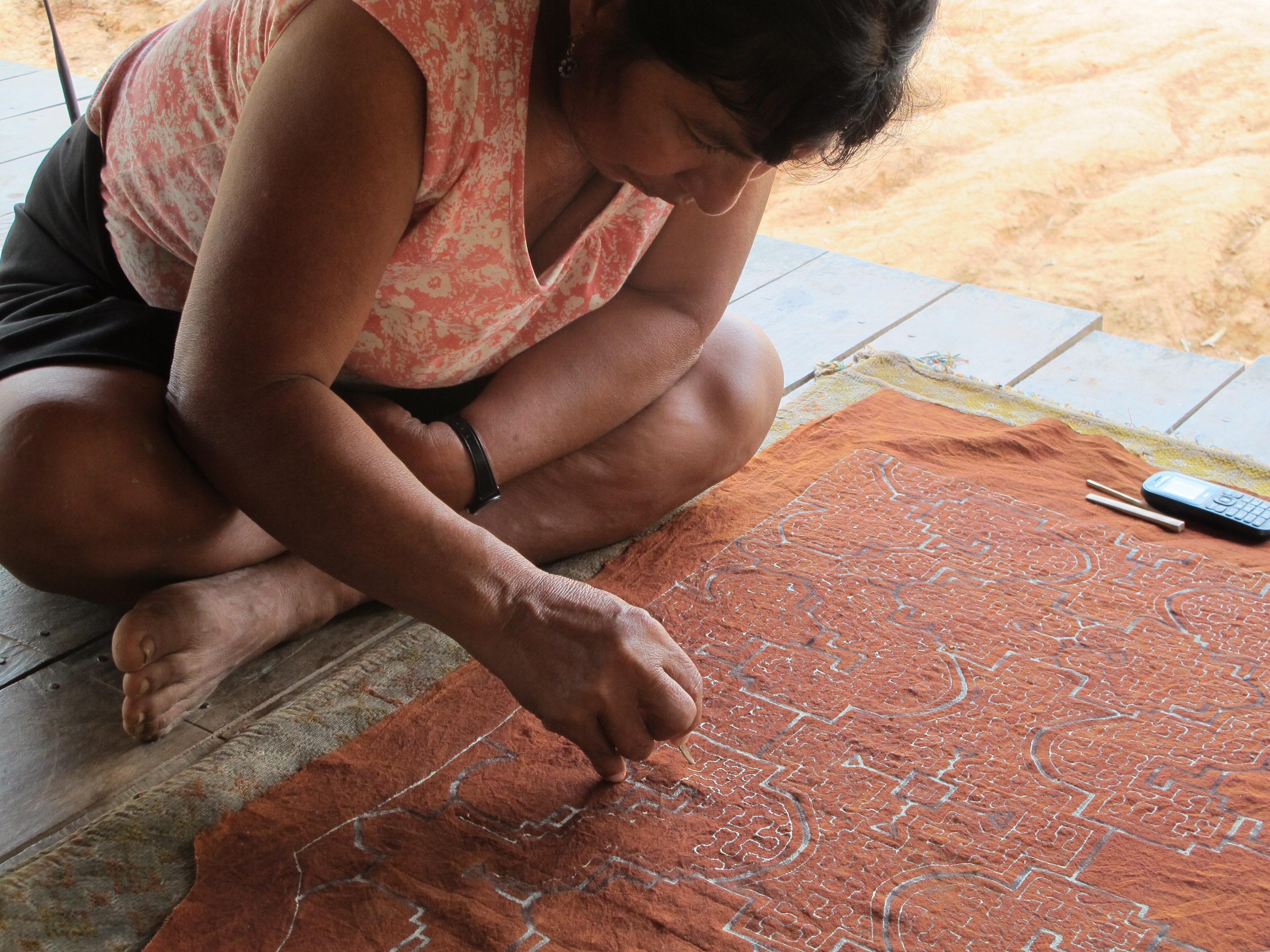 Once a fabric is sufficiently dyed with bark, it is painted with barro especial, a clay slip that is grayish white in color. Here comes more magic: When the clay touches the dyed cloth, it turns it jet black almost immediately, and once dry, the clay can be rinsed off, but the black remains permanently.
 Adelia works on a complex and meandering kené pattern using a stick tool to move the clay across the fabric.
 Teresa works on a different variation that involves painting kené with bark dye onto an un-dyed fabric.
  Once this pattern dries, the whole cloth can be rinsed briefly in clay slip, and then immediately rinsed with water. The clay instantly turns the pattern to an indelible black.
 Adelia puts the final touches on a large embroidery that is used as the traditional patterned skirt called a pampanilla. She uses colorful wool thread that costs a lot less than cotton thread, and the loosely woven, white cotton base cloth is called cayamasu. Behind her, the house is also decorated with kené patterns. Most women around the age of Teresa and Adelia wear black wrap skirts and tee-shirts while they are at home working, but when they head into town to get groceries or sell their crafts, they dress in vibrantly embroidered skirts, colorful frilled blouses, and an immensely heavy, white beaded belt.
 Teresa is about sixty, and Anastasia, her mother, is around seventy-two, but their hair is kept a glossy jet black with the use of another natural dye, the fruit of the huito tree that was also used in the past for painting semi-permanent kené patterns on the face and body. Teresa’s palms and the tips of her ears were usually black from hair dyeing, but I saw no one use this for body tattoos while I was there.
For anyone who is interested in further information on natural textile dyes of the Amazon, there is a great article on Yanesha culture and natural dyeing that can be read in both English and Castellano. The Yanesha are a different indigenous group from the Shipibo-Konibo, and their traditional dress and patterns are distinct. They use an amazing, colorful range of natural dyes as well as native Amazonian cotton. This article also highlights the potential of textile art for increasing cultural visibility as well as providing an economic outlet, which is the focus of my research as well:
Update from the Green T demonstration block:
Update about the demonstration block: The trees have been cut down. There are several tires onsite and multiple other pieces of large trash that weren’t visible before. If there weren’t any tires on the site, I would’ve been surprised!

2013.8.1 _ demonstration block tree removal
Tires are the most common form of trash that you’ll see dumped on vacant land throughout Detroit. Why? Why not?! It only makes sense because first of all, it’s the motor city. Rubber is not easily recycled. It can’t be incinerated. It’s not very easy to breakdown. Garbage companies don’t often pick them up to haul to the dump. People don’t know what to do with them so they are often lying around Detroit in lonely piles. With a little bit of searching, it often isn’t hard to find piles containing a few dozen or even over a hundred.
I’ve been long fascinated by the endless possibilities associated with the reuse or recycling of tires. As a designer, I’ve considered the qualities of the material quite a bit. Thick rubber can be very strong. Thin rubber is malleable. Waterproof. Durable. Flammable. Black [neutral]. In Detroit, they are abundant and free. This summer opportunity has presented me with an ideal opportunity to create a project that can utilize the unwanted tire as the focus material. It is a symbol of Detroit’s economic rise and decline. They are now discarded and forgotten just like many buildings and land parcels throughout the city. How can the tire which has become detritus, be re-purposed and given new life? It microcosm in the world of adaptive reuse within this city. If successfully reused, I see the tire as a small piece of inspiration for other, larger scale projects throughout Detroit. Projects that will consider new uses for every type of old material, building, and infrastructure.
Monday morning, our Green T team met with the general manager and the superintendent of engineering for the Detroit Water and Sewage Department [DWSD]. Exciting and informative! DWSD controls wastewater collection and treatment within the city of Detroit. They have an enormous task to manage all of it as well as try to figure out how to scale the operation down. As Detroit’s population shrinks, the need for water management also downsizes. It will be a difficult task to plan for integration or de-integration of the DWSD infrastructure into GI projects because they don’t have a comprehensive plan of the entire system. I am surprised to learn that they don’t have an overall map or guide of the infrastructure and its flow directions. We do know that the majority of surface water in the LEAP district ends up in the ‘Conner Creek Detention Basin’ which is located on Jefferson Ave at the South edge of the LEAP district.

2013.8.7 _ conner creek basin pumping station
Any surface water remediated in the area lightens the load at the local catchment basins. If there is enough change to an area, there is potential to completely remove the entire local catchment basins and disconnect them from the sewer infrastructure. This in turn would lighten the load on the ‘Conner Creek Detention Basin’ and ultimately at the main DWSD water treatment facility downriver [9300 W. Jefferson Ave]. Less water at the treatment facility means less money spent at the facility. Detroit is a massive city in terms of land area. Green infrastructure projects therefore could have a huge impact on the environment and cost savings for DWSD and the City of Detroit. In the midst of a financial crisis, the city must consider these GI options!
Research, Research, Research!


No A/C + heat wave = research by the pool

Whether we’re in a coffee shop, in our apartment or by the pool, Keela and I have been scouring every nook and cranny of the Internet for its information on election design this summer. Through our contacts and mentors, we’ve gathered a never-ending pile of documents, reports and papers to pour over. While the physical evidence of strong design in elections in this country may be limited, we have certainly been kept more than busy with all of the literature surrounding it.
The organization, legislature and history of elections is so full of intricacies; it is difficult not to get sucked down every rabbit hole we stumble upon. Each article we read points to other papers, each paper points to more studies, and on and on. We have to tread a fine line, as we want to become EXPERTS on everything related to our topic, but we also know our time is limited.
While the sheer amount of material to sift through seems daunting at times, it is comforting to know that we are not the only ones that realize our election systems need improvement. It also seems, however, that there have been countless analyses, surveys, and audits performed without anything to show for the work. Virtually all of the reports Keela and I have read have only recommendations to show for all of the work. Sometimes I feel my engine revving impatiently and want to start designing in response right away. I have to remember, however, that our research, as stagnant and overwhelming as it can seem at times, is crucial to the process and long-term goal. We have to be patient, and have faith in the fact that we will eventually have the opportunity to enact tangible change in Rhode Island, and that this change can possibly serve as a model for other states and their towns and counties. As we think ahead to the designs our research will eventually inform, I know they will only be as successful as the research it stands on. So, for now, we’ll keep on reading 🙂
Slimy, Nervous Tracing
Lizzie Kripke Marine Biological Laboratory, Woods Hole, MA
One of the best things about working in Woods Hole during the summer is that when you’re not working in the lab, you’re probably at a nearby beach. There’s nothing quite like finishing a day of microscopes and cleanliness with shoulders planted in the sand, inviting Cape Cod’s gentle breeze to turn the pages of your salt-caked book.
Of course, as summer goes on, this behavior inevitably leads to fat clumps of sand clogging your shower drain. And if, like me, you share a bathroom with a few other beachgoers – the long-haired, lady scientist kind – your toes will begin to make regular company with a soggy hairy pellet friend every time you take a shower.
Now, venture with me as on a humid day in late July, you think it’s a good idea to pick up that gooping chunk of hair n’ things and bring it near to your face. You start to examine it carefully. Is it possible to classify its different contents? Is that a strand of hair? Perhaps sand? Maybe just general grime bits? And as you attempt to parse out the individual hairs and trace their tangled pathways (hey, maybe you even try to match each strand to its original housemate!), it dawns on you that the sheer act of looking – and I mean, really looking closely – at this ordinary drain creature somehow brings you to a deeper connection with the tangible, orderly chaos that underlies our everyday lives.
This summer, I find myself examining the skin of squid. Relative to a wad of drain muck, squid is surprisingly more slippery, far more motile, and its odor of rotting fish is markedly more pronounced. Squid are readily found in the coastal waters off New England, and frequently make appearances on nearby restaurant menus and popular TV shows.

In other words, I have seen squid plenty of times, but it was not until I first started examining them – and I mean, really looking closely – that I became enthralled with the swarming, intricate curiosities embedded in this common marine form.
My current affair with squid finds me lost in microscope images of their skin. The aim is to understand and trace certain hair-like structures, called nerves, which in some unknown way network together and bestow this organism with its unmatched ability to manipulate the color of its skin.

As it turns out, doing this is a lot like making sense of the individual hairs and debris embedded in our familiar little hunk of drain slop. You’ll get a sense from the image below about why this is such a daunting, and largely unattempted, task.
To sort through such messy complexity, science often works by isolating and reducing things. So, when trying to map nerves, it is useful to develop staining methods that exclusively trace out the nerves and differentiate them from other neighboring biological structures. Our current methods of staining have only done this in part. Another additional challenge is that these microscope images are really just two-dimensional slices of what is really a three-dimensional structure. In other words, I must piece together two-dimensional information in order to comprehend a three-dimensional form (1).
Confronting visual complexity and dancing between multiple dimensions, however, is absolutely captivating for me – as, I suspect, is the case for many a RISD student. In fact, it was the realization that I could do this in both studio art and neuroscience that initially motivated me to simultaneously pursue the two.
And so, happily, I look – and I mean, really look – at these tiny parcels of squid skin. Right now, I see a disorienting corner of the world that is little understood. But I keep watching. Keep looking. There’s divine order there, ripe for discovery.
I keep looking.

Microscope image of squid skin. This is a small portion of one of the data sets I am currently analyzing.
(1) Nerves change their shape and activity over time, so, ultimately, they must be considered in greater than three dimensions.
Re-visiting
It’s hard to believe that Kelsey and I got started on this election track the winter of 2012, after we noticed that there was a lack of student voter resources on campus and overall election awareness. We created RISD Votes to help aid students in casting their ballot for the 2012 General Election, while advocating for the intersection of design and government. We were lucky to have Marcia Lausen come speak at RISD about her work in election design, she co-founded AIGA’s Design for Democracy and came out with a book about her experience, “Design for Democracy: Ballot + Election Design.” She and her cohorts at Design for Democracy have been pivotal mentors to us and we hope to continue down the path they paved for future designers.
This past weekend I re-visited her book, accompanied by a cup of Joe of course. Having spent some time away from her book (and after our research experience this summer), I found myself connecting to different things in her methodologies and research.

One of the things I connected most to was the forward by Richard Grefe, Executive Director of AIGA:
A government creates trust almost exclusively through communication—using words and images to convey meanings. Most of the communication between a government and its citizens consists of asking for and providing information. These interactions can be positive and engaging experiences, or they can be difficult, frustrating, disengaging ones. The difference is often a matter of communication design.
Followed by Marcia Lausen’s preface:
Graphic design professionals rarely cross paths with election officials. Many election officials are unaware of the existence of our profession, let alone the value of our expertise. Designers often prefer to work in a world where clients come to us, understanding what we do and bringing well-organized projects with reasonable budgets and reasonable schedules—qualities that are not always present in the production of elections.
The complex workings of election administration are burdened with inherited often antiquated processes and systems of production that make change difficult, if not unwelcome. Budgets are small and time pressures severe. Most ballot design, if it can be called that, happens where election officials, lawyers, typesetters, and printers interact in mad rush to “get it done on time.”
A big shout out to Marcia and everyone else who has started to change how elections are understood and run. Kelsey and I are trying to do our little part in hopes that incrementally, change will occur.
Kelsey’s computer is a wounded solider this week, so she is going to do her research on one of the computers at the RISD library. She is not a happy camper.
Until next time,
Keela
Catch-up Post: Don’t Pity the African Boy Without Pants

I grew up joining in on clothing drive efforts at school, advertising to students to bring in their old clothes to donate to poor kids on the other side of the world. I also grew up seeing lots of NGO campaign photos of African babies without much or any clothes on. And so I automatically equated little or no clothes to poverty. However, this long-held notion of mine was challenged when I talked to the manager of the Kireka Rehabilitation Center near the Banda Slums of Kampala. Miriam Akot, pictured below, was an energetic interviewee and had lots to say about poverty porn.

Miriam Akot, Manager of Kireka Rehabilitation Center and a positively sassy lady who believes Africa needs opportunities for industry development and ownership as well as individual skill development to maintain those industries without permanent foreign help.
Our interview turned into a conversation and soon we were talking very honestly and openly – so much so that we began talking about male genitalia. She made me stop the audio recorder and began talking about how there is a very good reason why some boys we see in the slums or elsewhere don’t wear pants. It’s not because they’re poor and can’t afford them. No. It’s because the lack of pants, or any kind of restrictive article of clothing for that matter, allows for the proper development of the kid’s “male parts.”
Oh.
Wow.
I was mind-blown. Not only because we were having a much too lengthy conversation about penises and what not, but also because of the fact that I had realized what a seemingly small piece of local knowledge could do to change a long-held misconception around. This is not to desensitize anybody about poverty and down play the fact that there are definitely children who cannot afford proper clothes or any at all. But what this conversation taught me was two things – 1) that understanding the local context was important and 2) a photograph can’t always capture that local context.
When we see photos of poverty, we need to know that they’re photos of poverty because somebody behind the camera framed it that way. Sometimes it’s true, sometimes it’s not. Even if it’s a seemingly candid photo, the decision to wait and take a photo at a certain point of the person’s state is in itself a conscious artistic decision to achieve a certain result. I’m not saying that photographers are evil and manipulative, but only that there is a depth and diversity of narratives that can go missing if we rely on just one person’s original news caption.
Cheers,
Leah
Protest Against the Sexual Victimization of Incarcerated Youth
Today I attended a silent protest meant to give a voice to incarcerated youth who are sexually victimized in Illinois youth prisons.
The U.S. Justice Department found that based on their survey of 461 Illinois juvenile prisoners in 2012, more than 15% reported being sexually victimized (most often by staff members). Illinois youth prisoners are sexually assaulted and abused at a rate 35 percent higher than the national average which was under 10%. The children were assaulted in showers, recreation areas, their cells, classrooms and even in kitchens. Some young people said that they had been given alcohol and drugs by staff before their assaults.
Here is the flyer I made for the event:

And some photos from the protest with signs I made:


Bianca
a short story …
I heard a story the other day.
The lovely family hosting me are called the Pandeys. Incidentally, they are a family of artists. Anyway, the Pandey’s have a male Dachshund dog called Arnie. Across a small park from the Pandey’s house lives a family with a female Dachshund. This family wanted Arnie to mate with their Dachshund, so they went to the Pandey’s home armed with gifts (a dowry of sorts) to introduce the idea and ask for permission for their two dogs to mate. The Pandey’s agreed and Arnie moved to the neighbour’s home for a couple of days to consumate the agreement. When he returned to the Pandey’s he slept for two days.
There is something so customary about the gesture of gifts and the agreement that was made between the Pandey’s and their neighbour. Traditionally marriages in India are arranged. ‘Love’ marriages are more frequent these days, but still the majority of people enter into marriages arranged by their families. Customarily, when a woman enters a marriage here, she enters it with a dowry that is offered to the family of her husband. And so it really interested me (and I found a beauty in the internalization of it) that this same gesture that is deeply embedded in tradition, had been extended in this case to the mating of household pets.
I think traditions and their related customs are some of the things that shape a sense of identity and belonging and they ground us in this big world. However, the fact that love marriages are becoming more frequent is a testament to the notion that traditions, customs, cultures, social norms are not static but evolve over time, slowly. Where these small evolutions can be observed, I think, is in the minutiae of every day interactions and attitudes. However, conversely, it is in these same minutiae that we can observe the perpetuation of assumptions that lead to problematic actions and attitudes about so many things.
So Nupur and I have decided to focus our attention on illustrating how the most quotidian of actions in the day to day perpetuate a problematic system of assumptions about sexuality and gender.

India Project – Progress and Updates
BLOG ENTRY 3
Nupur Mathur
New Delhi July 30th 2013
In the last post I had put down three possible directions we could possibly go in. Since then we’ve zeroed in what we will be doing here, if you scroll down you can read our project note. In all honesty the process of working out what we need to do has been a challenging one and we find ourselves wishing for 8 more weeks rather than the four we have left. That being said the next four weeks promise to be action packed.

Tattoo parlors like this are recent phenomenas

Observing emerging cultures
A STORY OF SEXUALITY (Title TBD)
Bathsheba Okwenje & Nupur Mathur
In collaboration with Pattie Gonsalves, IDEA | Supported by the RISD Maharam STEAM fellowship
Project Description:
The purpose of our project is to stimulate and sustain dialogue on issues relating to gender disparities that lead to problematic ideas about sexuality.
The project will draw from and represent real life accounts of instances in which men and women have been confronted with gender-specific assumptions in behavior and attitude in the context of sexuality. These experiences will include, but are not limited to the following:
- Ideas, expectations and behaviours related to masculinity.
- Ideas, expectations and behaviours related to femininity.
- Attitudes and assumptions surrounding the idea of service as an action of femininity.
- Attitudes and actions that contribute to the suppression of female sexual desires and the resulting behaviours.
- Assumptions, behaviours that are established as a result of a separation of the sexes and how this impacts the quality of relationships.
- Attitudes and judgements based on the way women / men represent themselves through clothing and / or adornment.
- Assumptions and actions that allow the public face of Delhi to be largely male.
Our aim is to illustrate how our individual actions and attitudes, especially those that live in the everyday, contribute to and perpetuate a problematic system of assumptions in the context of sexuality.
Process:
Through a series of interviews, we will collect experiences from a diverse group of men and women within the urban middle / upper class in Delhi. The demographic will include young unmarried men and women, young married men and women, middle-aged married men and women, and senior citizens.
Treatment:
Personal intimate experiences in the form of anonymous, audio narratives will be layered with video footage that illustrates the day-to-day activities or actions in Delhi that contribute to assumptions around gender and sexuality.
Each video will be approximately 30 seconds to 1 min long.
For example:
Video: Inside a general store/chemist shop an over should shot shows a woman buying a packet of sanitary napkins that is put inside a black plastic bag and handed over to her. Other customers buy other products that are given in regular transparent plastic bags.
Audio: A man speaks about when he first heard of menstruation. He recounts a childhood memory from his school days when all the boys were asked to leave the class while the girls were being explained something in private.
Endevours into Personal Data
Ryan Murphy: World Economic Forum – Rethinking Personal Data Project

Enjoying the New York art scene – MOMA PS1
Hello again from the Big Apple! The weather is finally starting to settle down (temperature wise) as the things continue to move along quickly at the Forum.
At this stage I am seven weeks into the fellowship with about four left to go. I have managed to adjust well to the Forum environment, though I come from a remarkably different background. It is always exciting to explain what I am doing (to the extent that I know) to those around me, and overall people are fascinated that a designer is working within an organization dominated by business/policy backgrounds.
Since it has been a decent amount of time since my last blog post (many apologies), I will start by summarizing the work I have been up to these past few weeks. My job can essentially be broken down into three parts: day to day process/visualization work, long-term design project(s), and Microsoft UI/UX collaboration. I will address these three elements below.
Everyday life at the Forum is more or less ruled by conference calls, ranging anywhere from consultants and partners to Steering Board members and project working groups. Since the Forum is fundamentally a convening agency, the calls are vitally important to keeping partner organizations and leaders in the loop with our current work. Communicating our core message across quickly can sometimes be a struggle, given the global language of monotonous PowerPoint decks. So a core element of my work thus far has been breaking down our project (Rethinking Personal Data) into it’s simplest elements, and framing how these points can most effectively be shared and debated.
At this stage of the Forum’s Personal Data project, the key objective is to bring together the business, legal, and policy experts (of big data privacy, governance, rights, etc.) with real world practitioners who are using big data and personal data to solve social and commercial challenges. Bringing together these two different groups (both fundamental to the success of the project) and leveraging their insights in a clear and focused way is not easy, but has been a great opportunity for integrating my design background.

Bringing together the industry experts and real world practitioners
The second portion of my work (long-term design project(s)) stems naturally from this connection of industry experts with real world practitioners. I am developing an animated video and accompanying interactive website that will launch the Forum’s various events and workshops centered around big data / personal data. It is one thing to engage various communities over a few months of work and research, and another to make the most of 70 minutes with these communities gathered at a Forum event. The short, four minute video that I am putting together will give a quick overview of the complex and changing landscape of personal data and provide a focused avenue for discussion on long-term strategies for responsibly managing and benefiting from this data. So along with the day-to-day conference calls and process work, I have been working on this longer-term project which will be showcased at both AMNC (Annual Meeting of New Champions) and Davos (the annual World Economic Forum convening) this upcoming year.
In addition, I have been engaging in ongoing research with Microsoft around internet privacy concerns. Ipsos conducted a global quantitative study (through Microsoft’s Technology Policy Group) which looks at personal data management attitudes and behaviors in eight different countries. Microsoft is analyzing this data in order to gain insight into the cultural differences of personal data (how it is perceived, valued, shared, etc.). My role in their research, in collaboration with the World Economic Forum, is to look at how these insights can be addressed in user experience design.
Can we tailor an interface and experience to a user depending on their attitudes towards personal data?
How do we communicate the idea that individuals are both producers and consumers of this data?
For example, if I am letting my wireless provider collect and analyze my geolocation information, I expect value or benefits in return, such as improved network efficiency for my mobile device. Through the funding of the Maharam Fellowship, I have the opportunity to fly out to Seattle to work directly with Microsoft on this research/design, which I will be doing at the end of this upcoming week.
Lastly, I have been undertaking some side jobs on some of the Forum’s other projects. I am working in the same area as the Cyber Resiliency group (which, like Personal Data, is in the ICT division), and so have been developing some similar process graphics/visualizations as well as logo/branding for their initiatives. I am trying to remain as focused on the personal data project as possible, but it is evident that the other groups are getting jealous of the work I have been doing! Just about everyone wants a RISD creative thinker working on their team now.
I think that just about wraps it up for now. I will post some more updates from my upcoming trip out West in the next week or two!
Cheers from New York,
Ryan
P.S. Here are some more photos from life in the city!

Panorama of Bryant Park

New York Philharmonic in Central Park!

Little Italy!

Drawing on napkins in some of New York’s finest coffee shops
You must be logged in to post a comment.