

Low-tech Identities – Lauren Campbell & Marie Otsuka, MFA Graphic Design 2018
Transitions
As the Zero-Footprint Campus project wrapped up, we have been transitioning out of the Netherlands to settle in Spain, where the rest of the project will take place. In the process, we’ve been discovering the challenges of low-tech travel: clunky bike-sharing systems, the reduced availability of night trains, the expenses of high-speed trains, and country-specific regulations and processes.
Identity System
We’ve been discussing an identity system to launch for Low-tech Magazine. Below are a few of the initial sketches where we focused on the a typographic system that embodies historic or alternative type-drawing technology, whether it be the PDU stencil system or calligraphy.


With some feedback, we are revising our next round of designs to include more pictorial elements and quieter typography. With Low-tech Magazine, a platform that has never considered design, there is a sense that the “default” design, the status quo is sufficient. But in the same way that the articles question progress in high technology, we’re working to question how its current design of the blog, consisting of “default” choices, can be better tailored for its mission. “Default” is hardly neutral, and is comprised of a series of design decisions made by individuals that may or may not aid the readability of the site’s content. Our challenge is to make an identity that aligns with the low-tech values of the site, both in its construction and its aesthetics, while also being mindful of the high-tech forces behind a lot of system defaults.
Submerge, O.N.E. Mile, Anthony “Utē” Petit, BFA ID/Tex 2018
I recently attended a meeting with members of the Underground Resistance and legendary Techno artists: Theo Parish, Mike Banks, Omar-S and Underground Resistance manager Cornelius Harris, North End community members, and Mayor Duggan at Submerge Records. The discussion pertained to how Detroit could better support it’s night time economy.
The conversation was centered around the future of Detroit’s East Grand and Oakland Avenue (“The North End”) as most development has been centered around 3 neighborhoods (Downtown, Midtown, and Corktown). The electronic music industry originates from Detroit in the 80s. The historically black and now 7.1 billion dollar industry has since been appropriated elsewhere.


‘
As a means of reclamation, members of UR pointed out that Detroit’s nighttime economy is limited by by last call hours of 2AM. A step in the right direction would be to extend the hours to 4AM, and designating the North End as an area eligible for 24 hour licensing, where the nightlife could operate akin to Berlin, New York, and Tokyo. 
As it pertains to O.N.E. Mile, the collective project has been well on it’s way to restoring the legacy of African American music along Oakland Avenue. With city support, this would open the door for further black entrepreneurship in the neighborhood. While no updates have come from the mayor’s office yet, we will see where they stand with time.
Before I begin | Mudita Pasari, MA ’17, Art + Design Education
After a bus journey, a few elongated flights and a car drive I have finally covered the mammoth distance to the city of my childhood. After years of living in different parts of the country and world, I am back here for the summer and the Maharam Fellowship project.
The past year at RISD, for me, has been about extensive research into possible ways to discuss the disappearance of the pangolin- a little known endangered species of mammals that walk our two largest continents. This enquiry into a single species became the face of my interest in discussing the disappearance of fauna due to various human activities. Trying to dissect the possible psychological fronts in the context of the disappearing pangolin has opened various pathways for future study of related subject matter rooted in understanding our relationship with the natural world. This research has lead me to experiment with various points of design interventions as a source of disseminating information as well as encouraging local involvement.
My name is Mudita, I am a Narrative and Strategic Designer, who is currently writing from Guwahati, Assam. The Indian state of Assam shares its northern border with Bhutan, its southern tip with Bangladesh and is known for its extensive tea production industry. Guwahati being a relatively smaller city, yet the largest in north-eastern India, is often visited by tourists on their way to the rest of the north-eastern states. The project I plan to pursue through the Maharam Fellowship is the next step in my endeavor to bring to light the discussions of biodiversity, its disappearance and conservation; hopefully creating a larger impact starting in Guwahati, Assam. For the next 8 weeks, I will be working with Mr. Jayaditya Purkayastha, a herpetologist who is the General Secretary at Help Earth, an NGO working tirelessly to drive the conversation about the conservation of urban biodiversity into every household.
Over the past week, I have had two meetings with Mr. Purkayastha, to discuss the possible ways in which I could integrate my interests and aspirations with the functioning of his organization. A widely published author, Mr. Purkayastha has written books on the variety of birds, snakes and turtles found in Assam. His organization is now interested in encouraging school students to be invested in the documentation and conservation of urban biodiversity in Guwahati.
This is where I step in.
Over the next few weeks, I will be spending time with the research papers and other theoretical documents produced and collected by Mr. Purkayastha and his team. I plan to transform these into age appropriate educational material integrated with activities which can be used by schools to encourage the involvement of students in the larger conversation of biodiversity and its conservation.

If this experiment goes well, we would have the opportunity to further promote and integrate biodiversity centric, activity based educational material within the mainstream educational system; starting from this obscure, often forgotten city of Guwahati.
25 Dorrance St | Providence City Hall | Sophie Weston Chien, BArch ‘20
Last week I started my Maharam Fellowship, working in Providence City Hall in the Mayor’s Center for City Services (MCCS). My project is focused on how the 311 system can be made more approachable and effective on multiple scales.
 This is an initial mapping I did to understand the current system of constituents, city services, and MCCS.
For those who don’t know, 311 is the typical (at least typical of American municipalities) phone line for contacting city government. It’s the non-emergency line for calling when the sidewalks are cracked or there is graffiti on a school wall. As a symbol, it is typically understood as inefficient, unreliable and cumbersome.
 311 is available via website, app, in person or online.
Jorge Elorza, Providence’s current mayor, rebooted Providence’s 311 system in March 2016 after some starts and sputters. Using new software and a new team, over the course of 15 months 311 has seen over 17,000 cases registered and completed. Part of that new team is the Director, Andy Jacques, who was actually the Assistant Director for Leadership Programs at RISD (my boss there too) and my strongest ally.
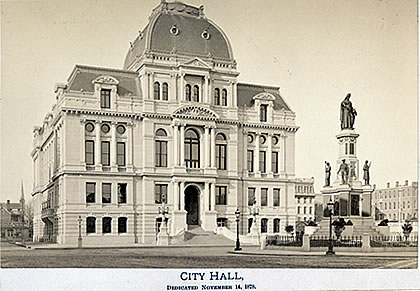
This is a cheeseball picture of City Hall, which if you didn’t know is adjacent to Kennedy Plaza.
311 functions extremely well as a one to one recorder of one constituent addressing one problem (such as a pothole or sidewalk), but I’m interested in using the recognizable and effective 311 infrastructure and applying it to larger city services.
As I settle into City Hall, my first impression is the high-spirited and infectious energy of the place. One of my first days I went on a tour and everyone was so genuine and excited for me to join the team, in a way that I was not expecting of municipal government. The current administration is super young and eager to leave behind the past (see Crimetown) and embrace the opportunities the city of Providence has; as a liberal powerhouse with a large immigrant population, great universities and old, but historic infrastructure. In fact, City Hall is home to the third largest self-supporting stairs in the world (said a Public Property employee to me once)

Photo for reference by Liane Brandon (pretty impressive)
My task the first two weeks is finding my way into the project by absorbing the various facets of the MCCS office and connecting with outside offices such as Innovation, Planning and Development and Public Works. I am trying to strike a balance of understanding the systems but not accepting them because my strength in this position is as an outsider.

City cases as a network of infrastructure projects? Stay tuned…
In my next few weeks, I hope to develop more relationships with municipal offices and focus on constituent outreach, learning about their perceptions of the 311 service and how it can be improved and expanded.

Being in government, I am learning a little politicin‘ and have been able to meet with various directors and leaders around the city and state. Today I actually got to have lunch with the Secretary of State, Nellie Gorbea, who is the first Hispanic person to be elected to statewide office in New England.
O.N.E. Mile, Anthony “Utē” Petit, BFA ID/Tex 2018
This summer I will be joining Agence Akoaki contributing to the complex project that is: The One Mile Mile Project (O.N.E. Mile) in Detroit. The project is a multi-disciplinary collaborative effort to support the cultural programs and socio-economic activity of Detroit’s North End neighborhood. I plan to assist in developing a masterplan to present to the City of Detroit by the end of the summer.

My first week in Detroit involved meeting a lot of people from the neighborhood. This can always be a bit nerve racking at first, but I quickly felt more at home in this beautiful “Afrotopia” as Mayoral candidate Ingrid Lafleur puts it. One component of the O.N.E. Mile Project is the Oakland Avenue Urban Farm. Arguably “ground zero” of the project, this is where most day to day operations take place. The first project I executed was developing jam labels for Ann Carter’s strawberry “AfroJam.” One of the products made on site. The final design is not quite ready, but updates to come on that.
My second week of settling in I was able to meet with my ‘mentor’ for the summer: Anya Sirota. She gave me and a group of students for University of Michigan a in depth tour of the site. We have been tasked with designing the function of three buildings that are in a state of transition. I will be working on a former liquor and grocery store, which will become the site of the masterplan unveiling come August or September. So far this consists of developing patterns, and thinking of formal interventions that can preserve the integrity of the neighborhood. In addition to that i’ve been tasked with developing patterns that reference the fruits, vegetables, and local fauna of the neighborhood (There’s a lot of wild pheasants).

Interior of “Shoeshine” : One of three buildings in transition
I intend to develop a collection of fabrics that can be used for interior (hostel, upholstery, wallpaper) and exterior (greenhouse, street painting, mural) uses. They need to be “almost wrong” in Anyas words, and I want them to be pure Detroit, which means it needs to be gangster and opulent. Heres the initial two i’ve come up with:


A personal goal i’ve set for myself this summer was to research what other changemakers were doing outside of the O.N.E. Mile Project. My first step was attending the Allied Media Conference, a 4 day event “bringing together a vibrant and diverse community of people using media to incite change.” The set of the conference involves a series of workshops, lectures, discussions, and parties to facilitate an exchange of knowledge and organizational strategy.


The summer so far has been full of growth and new knowledge; my love of Detroit grows strong. There have been so many beautiful people I’ve met who have been contributing to the city’s “rebirth” since before the term began to enter headlines. Im anxious to see what else the summer has in store, and am curious to see how this relationship between Downtown and the neighborhoods progresses with mayoral primaries coming soon.

Photo courtesy of O.N.E. Mile

Photo courtesy of O.N.E. Mile
Groundwork – Marie Otsuka & Lauren Campbell, MFA Graphic Design 2018
Project Goal
We’re working with Lowtech Magazine to create a content-management system and a digital and print platform. Lowtech Magazine looks back at old technology to see its benefits and forwards at the environmental implications of rapid technological advancements. Its founder, Kris De Decker, aptly navigates the tension of using the internet to get his lowtech message out to the world, and primarily, a US audience.

A screenshot of the Low-tech Magazine’s current website.
Two Weeks In
For the past two weeks, we’ve been acclimating to Dutch life (securing bikes for transport) and diving into the 10-year archive of Low-tech Magazine. We’re examining the articles looking for themes and popular content and proposing new organizational structures that best serve the well-researched articles.
We’re particularly interested in the ways that our work will also navigate the high and low-tech tension— a redesigned website, the environmental impact of a print publication, the impact of our travel to a different continent—and we’ve been mindful of what decisions we can make to allow these new platforms to be as environmentally friendly as possible. So far, we’ve been investigating whether white screens consume more energy than black ones (because of new LCD screen technology, they no longer do), what makes a typeface environmentally friendly (amount of ink it requires coupled with its letter-width and how that affects page count), and if the amount of bleach required in the process of recycling paper actually makes it more harmful than its original counterpart (we’re still figuring this one out).
We’re trying to embody LTM’s mission to consider sustainability in the full chain of the production processes in our decisions, while working within a limited budget.
Zero Footprint Campus
A big highlight has been seeing Low-tech Magazine’s involvement with the Zero Footprint Campus (ZFC). Kris, working with researcher Melle Smets, has proposed the Human Power Plant, a dorm powered by the physical volunteer labor of students. It’s an idea that, again, wrestles with the tension of low-tech solutions (physical labor in the form of exercise machines) to a highly tech-based society (energy to run laptops and cell phones).

Stickers from the “Read-In” project questioning their university’s library catalog.
Other projects within the ZFC umbrella include a critical “read-in” of the library canon, a Scenario machine to provoke discussions on possible futures, a Sweat(er) Shop that promotes full use of local resources by felting the wool from sheep on campus, and Spacekeet, a mobile DIY satellite ground station.
We’re thankful for the space to pursue these questions, something that’s not really possible during the hectic and fast pace of the school year.

Scenario Room for speculation about positive and bleak futures.

Politics and Cuban Life: Part One, Nicholas Fernandez and Natalia Blanco BFA Sculpture 2016
Due to the political nature of this post, I will not be naming any of the people quoted or described.
Through our work with Fundacion Amistad we were able to meet one of Havana’s prominent professors of architecture and urban design. He was interested in our perspectives as young artists and Cuban Americans and invited us to attend one of his lectures for an educational international travel program. We learned about Havana’s history from its official designation as Cuba’s capital, to the iconography of its coat of arms and its vast architectural influences. We even learned the Havana has its very own Chinatown and that its capitol building is twelve feet taller than its inspirational counterpart, the US capitol building.


Although the lecture was very informative, when it addressed more political topics, it was difficult to set aside our own opinions and dismiss our feelings of unease. Nick and I were both raised in the presence of highly critical opinions of Cuba’s government and its sociopolitical situation. My skepticism forced me to confront my bias. We considered the possibility that our parent’s and grandparents fears, although once valid, may no longer accurately describe the experience of the average Cuban. We also considered the possibility that the professor’s statements did not necessarily reflect his own opinions, but because he was in a public setting, he may have felt the need to express a certain stance to avoid risking his career. We just couldn’t shake the feeling that some of this information was deceptive, especially when it was in complete conflict with the sentiments of the residents we met and our own families.
The professor stated that many of the ideas foreigners have about Cuba are false and inaccurate; “cuentos de hadas” (fairy tales). He claimed that anyone that believes Cuba’s youth is desperate to leave its country, is greatly mistaken. He said that the only reasons the Cuban people want to leave their country are economic and financial ones. However, it is difficult to deny that these “economic reasons” are directly related to Cuba’s oppressive political system. In fact, we met one Varadero resident who told us that “economic reasons” often serve as an acceptable explanation for wanting to leave. He himself used that very same excuse when he was being questioned by Cuban authorities after trying to escape.
According to the professor, Cuba proportionately has the third largest elderly population as a result of a shrinking population, low fertility rate, and the effects of emigration. He said the Cuban government often encourages young Cuban adults to have children. Although we did meet some young Cubans that are looking to raise families, we also met quite a few that said they just wouldn’t be able to afford it. The professor proceeded to justify his claim about Cuba’s fleeing youth by pointing to the significantly larger number of Mexicans fleeing their country. We found this to be a highly misleading comparison because Cuba does not share a border with the US let alone any other country, making it significantly more challenging and dangerous to emigrate. I remembered a cook in Vedado that told me if a cruise ship were to invite any Cubans wanting to leave, the weight of the Cuban people would cause it to sink.

The professor explained that the Cuban people have many things the American people do not, like free education, medicine, and food rations. I couldn’t help but think about the number of Cubans driven to the ocean for whatever reasons; willing to risk their lives and even the lives of their infants, in order to leave Cuba. One woman told us that Cuba’s free education and medicine were of high quality, while another said that those who defend Cuba’s education and healthcare, don’t know what education and healthcare are like elsewhere in the world. She told us about an experience she had in a Havana emergency room and how she was so desperate to be operated on, she had to bribe her physician to take her in before the other patients.
Nick’s cousin and his friends explained to us that in order for a Cuban to even qualify for a visa and leave the country, they must undergo a rigorous and costly process of paperwork and interviews. Their leave can be denied at any point in the process. One of his relatives said some friends of his had illegally fled Cuba on boats they constructed themselves. He said he didn’t want to go like that, he wanted to do it the right way. He said he wants to be able to say goodbye without the fear of never seeing his family again. He wants to take his time preparing his belongings and fall asleep on the plane ride to Miami.
One woman invited us over to her home in order to discuss some important sites to research for our project with Fundacion Amistad. What began as a straightforward conversation about Havana’s public parks and museums, became a highly political and personal one. She works as a cultural promoter and her husband is an artist and jeweler. She is also her husband’s unofficial manager, often working to have his pieces exhibited in galleries and sold to patrons. Her boys are classically trained ballet dancers and triplets. We helped her hang unitards and uniforms on the lines in her patio while she told us things about Cuban life we would never have learned from a travel guide.

She told us about something called la pyramide social invertida (the inverted social pyramid). This explains why many Cuban people who have earned relatively valuable degrees in medicine or law, earn less money than taxi drivers and servers working in the private sector. Sometimes surgeons are part time taxi drivers and professors are also manicurists, fisherman, or street vendors. She said, “El Cubano vive inventado y lucheando.” The Cuban survives by way of invention. They live lucheando which means fighting, struggling, hustling. She explained to us that even if one is a successful entrepreneur, and one generates a significant amount of capital in comparison to his/her competitors, it is often unlikely they benefit from their efforts financially. We met members of the younger generation that expressed a lack of motivation to work hard because their is an understanding that they will receive the same pay whether they put effort into their work or not. There are rarely benefits for those who work hard nor consequences for those who don’t. Ideally, under Cuba’s political system, everyone should earn the same benefits in order to ensure the absence of social classes and capitalism.


She told us that tourism is Cuba’s primary source of economic gain and elaborated on the impact it has had on the Cuban people. She has witnessed Cubans resort to selling themselves by creating a sort of caricature or embellishment of the Cuban people. Sometimes they offer themselves up for photos or as unofficial tour guides and sometimes the caricature comes about in order to present the illusion that everything in Cuba is as it should be.

She held one of three ripe mangos as she complained about how expensive they were. She said Cuba’s agriculture suffers greatly because of its government. People can earn the same level of pay as office workers as they can as farmers, and so they choose to work in more practical, comfortable settings. She slowly peeled the mango skins revealing their shiny, orange bodies and began to dice them for tomorrow’s school lunch. She explained that at times, the Cuban mother and father struggle with teaching their children good morals; when to be honest and when to be cautious. It was once illegal to own a home computer and she would tell her boys to keep theirs a secret. She confessed her guilt for encouraging her boys to lie but she knew that it could cost them their education at the ballet academy.
With every story, Nick and I had more questions for her. In reference to everyday life in Cuba, she offered us some advice, “No le busques logica” which means, don’t try to find its logic. She explained that we would encounter conventions and protocol that would have no practical or logical reasoning. She said she feels like everything else in the world is happening at the speed of light but Cuba drags its feet like a tortoise. By the time something is legalized, it has already existed illegally for some time, hidden from the government. At which point it has likely evolved into something entirely different for the rest of the world.

Air Conditioned Agriculture, Josephine Devanbu, Painting, ’16
California farming gets an authentic new look. Like it or not.

Turlock Irrigation District Conference Room, moments after a meeting about Sustainable Groundwater Agency Formation.
In my Maharam Fellowship proposal, I pledged to “meet farmers on their own turf” – to get myself to the physical place where issues were unfolding. Given this commitment, my first invitation to visit a grower’s property brought with it a heady mix of excitement and trepidation. I was a month into the project and finally things were about to get real. Here’s a journal excerpt from the day before:
July 28 2016,
Tomorrow, I drive to a vineyard in Denair, California, to interview Al Rossini, a grape grower.
A month ago, I set out to write about grower’s experiences navigating groundwater regulation. This is my first trip to a functioning farm.
It’s not that I haven’t been reaching out. I’ve cold called, chased down and interviewed a dozen people so far. Half of them are part time growers or ranchers. But we’ve met in their offices, or the halls of meeting rooms and conferences, not their farms. I’ve even put a couple hundred miles and a stubborn layer of dust to my folks’ Honda Civic, plowing through the Central Valley. But I’ve parked at farm bureaus, not farms.
Several hundred miles, months and parental favors later, I can see that things were already real before I set foot on a farm. My experience on the vineyard the next day was indeed formative, but it didn’t mark a sudden turn to the authentic.
I now see the large amount of time I’ve spent in meetings and offices not as a failure of my project, but as a point of entry into the story of a changing industry. I wasn’t the only one in those meetings surprised by the amount of time I was spending indoors.

A plastic heifer and calf decorate metal filing cabinets in the UC Agriculture and Natural Resources Department based in the UC Office of the President.
Over the past 25 years, environmental regulations have reshaped the California agriculture industry. They have brought with them an ever increasing need for oversight, meetings, and paperwork, not to mention consultants, legal counsel, and lobbyists to keep further regulation at bay.
This shift is deeply trying for many farmers and landowners. Not only do regulations add another expense and source of uncertainty, they also threaten to interfere with established lifestyles. More and more of the work required to maintain a farming operation takes place in the office. Keeping pace requires engaging in meetings, paperwork or hiring someone to do so on your behalf – and often both. For people who may well have chosen their line of work to avoid sitting at a desk all day this can be depressing.
As one of the nation’s biggest food producers, California agriculture has a lot on its plate. CA agriculture operates at massive scale to meet demand. At this scale, the management decisions that farmers make have wide reaching societal consequences. Much is at stake- protecting against the contamination or depletion of groundwater reserves that other communities rely on for drinking water.
These are the kind of consequences that state regulation seeks to prevent by holding farmers accountable for their impact on the land the farm and the resources that flow through it. But for many farmers, the lived experience of working the land at scale fosters a narrative of self reliance and independence, not one where the minutia of one’s management choices belong in the public domain. Farmers have to be independent enough to choose the relative solitude of rural life, and bold enough to take major financial risks- and live with the consequences. They’ve got to be self-reliant and, unsurprisingly often believe they have a right right not to be interfered with. It makes sense that a farmer would expect the right to be left alone– just as it makes sense that government would intervene.
As much as it hurts, the new regulations -and the types of work and spaces they force into the agricultural life- are not going anywhere. This work they require is not a distraction from the real work of farming. It is real farm work. However frustrating, it can only be understood as a new authentic part of the farming experience.

View of TID landscaping from inside. The TID has drastically increased security measures said Robert David, supervising security guard. “People get upset when they see the landscaping” David said.”They say we’re robbing them and spending money on a garden.”
The Sustainable Groundwater Management Act, described in my second blog post, will usher in new level of cultural challenges between regulators and farmers. Whereas previous regulations have constrained farmers by making them measure and report on the levels of various pollutants on their property, SGMA goes beyond patrolling contamination, inserting itself into matters of volume pumped. For the first time, an outside force will have the ability to impose sanctions on growers for removing water from their own property, effectively forcing a grower to fallow some of his or her land.
In anticipation of sizable resistance, SGMA is founded on the principle of grower self-governance. SGMA explicitly calls for the formation of grower-run Groundwater Sustainability Agencies, or GSAs. This is a government enforced call asking farmers to incorporate meeting with each other and watching each other’s pumping into the hardwired rules of doing business.
Al Rossini, the grower I visited in late July, gets whats at stake here. Now is his 70s, Rossini is a third generation Italian farmer in the central valley. He’s served on boards and committees for the past 25 years, witnessing first hand the regulatory changes underway. He’s part of a team working on forming a GSA. He comes from a family that prioritized participation in meetings, town events – a value he noticed other families did not share.
“I know a lot of good growers who don’t show up for these kinds of meetings” he said. He gets that going to meetings takes time away from the farm and can be frustrating, but to him, as a property owner, its crucial: “If you want to stay in business you’ve got to stay involved.”

Meeting room minutes after East Side Water District’s August meeting. Al Rossini, the grower I visited in July, chairs the committee.”I like to sit where I can see everyone’s faces so I can gage what they’re thinking” Al said. View from Al’s side of the table.
Matanzas and Limonar, Nicholas Fernandez and Natalia Blanco BFA Sculpture 2016
After our first two weeks in Cuba, we began to shift gears and prioritize our own personal explorations of family narrative and environment. In the meantime, Fundacion Amistad and Ennead were reviewing our documented material in order to layout questions and identify opportunities for further research. They would then develop design formats for the work sessions in Vedado in preparation for the Planning Symposium, which had been rescheduled for December. FA was simultaneously working to gain official approval for these events. FA plans to return to Havana with Ennead to present their findings and conduct work sessions with the local community in order to collect their feedback and suggestions.

Because our work for FA and Ennead was temporarily out of our hands, we decided to travel out of Havana in order to meet family and see more of Cuba. We left Havana with one of Nick’s cousins, Lourdes, and her husband Roberto. Lourdes is a medical physician and Roberto works at the US Embassy in Havana. He was once a champion cyclist, who earned the title crocodilo (crocodile) because of his wildly crooked teeth. They generously offered us a room in their home and were eager to cook for us and pack our bags and suitcases with as much guava fruit as possible. We spent most of our time telling stories over home cooked meals or sitting outside under their mango tree. They told us a funny story about their marriage of thirty-five years. Lourdes and her husband wanted to invest in a second home in order to resell it and make a profit. Because it is illegal to own more than one property in Cuba, their financial advisor suggested they get a divorce and remarry after purchasing the second property. And that they did. They looked at each other and laughed as they recalled how odd it was to secretly divorce and openly remarry a week later with their two adult sons at their wedding. Roberto said he is probably the the only idiot to ever marry the same woman twice. Throughout our trip, we heard many people say, “en Cuba, la cosa esta complicada” (in Cuba, it’s complicated), and this was just another one of those circumstances that required some problem solving and creativity. They now have two homes in Havana and are working to sell the second home in order to send money to their sons who have recently begun new lives in Miami.

After a day or two on the outskirts of Havana, we left for Matanzas on a large bus with all of our belongings. We were paranoid we would miss our stop and spent the morning watching the sun rise and with it the dense fog dissipated and exposed the drowsy, wet, green lands of rural Cuba. Three hours later, we arrived in Matanzas and were greeted by another one of Nick’s cousins, Guillermo Nicholas. He walked us back to his home and invited us in for some coffee. He is considered the unofficial historian of the Febles family. He told us about Sabino, nicks grandfather, and how determined he was to leave Cuba with his wife and two daughters. And as I listened to him rocking back and forth in his chair, I thought about my grandparents and their two daughters. I remembered my mother showing me the small blue leather suitcase they used to carry the few belongings they could pack before fleeing to America. I remembered my grandfather having us promise we would never go back to Cuba while it was a communist country. I caught myself drifting into thought and returned my attention to Guillermo’s description of Sabino, a true guajiro, who represented a dying breed of men. These were men born and raised in el campo (countryside) dedicating their lives to cultivating the lands and harvesting crops; anything and everything from sugar cane to tobacco. When Sabino was trying to leave Cuba, the government was sending people to work in the fields of henequen as a kind of punishment for choosing to leave. El henequen yields fiber for making rope and twine but its leaves are long and sharp and can be painful to work with. Like many other Cubans who wanted to flee at the time, he was sent to work indefinitely until the Cuban authorities decided he would be allowed to leave. I pictured Sabino in the fields of henequen and thought of a man I saw in Havana cutting the grass on his lawn with a machete. I remembered my grandmother’s machetes propped up next to our washing machine in the linen closet; a large one and a small one. I remembered my grandmothers hands, particularly the perfect curve of her thumb like a crescent moon. I could picture her pearlescent manicure and her skin littered with brown speckles from the sun; a guajira no doubt.

Guillermo Nicholas gave us a small tour of Matanzas, often stopping to say hello to his friends and introduce the two young strangers that accompanied him. The streets of Matanzas were more narrow than those of El Vedado, more like the streets of Old and Central Havana; populated and bustling with voices and colors. Colors like the ones painted onto the balconies of apartments in Vedado, as signifiers of ownership and individuality. Sometimes they were colors that reminded me of clustered love birds or a freshly diced avocados paired with the tired pastels of old record covers and antique wallpaper. Colors exposing colors in layers of thick, pealing paint on walls or lines and lines of clothing hung out to dry in the day’s resilient heat. Arrangements of colors that seemed to recall the 1960s and 1970s, much like parts of Miami still do. At times, Nick and I felt the odd sensation of being in both Cuba and Miami all at once. It was as though our context could belong to either place or both. Sometimes we would sit in someones home for a time and feel as though we could walk out and find ourselves in Miami. As we moved through Cuba, there was an undeniable sense of familiarity and the identification of Miami’s ancestry.


Ulisis Rodriguez Febles, a playwright and another cousin of Nick’s, arrived in Guillermo’s home to greet us and take us on his own tour of Matanzas. He invited us to dinner with his family. We laughed awkwardly and apologetically as we tried to shuffle and arrange six bodies at a table meant for three. Like many of our meals in Cuba, this one was accompanied by the exchange of many stories. Ulisis’s wife shared a story that spoke to a kind of mythology about American life that seemed to have existed among the Cuban people at one time or another. She told me that as a child, she had this wild misconception about soda cans. At the time, anything that could be considered an American product or American merchandise was kept out of sight because it was illegal. She heard stories about soda cans but had never seen one. By word of mouth, she learned that when the small tab was flipped one would hear this “tkt sssssss“ sound and the soda would instantly become cold. One day she sat and watched the Greek tourists on are their boats in absolute awe. She would listen to them flipping the tabs; anticipating the strangely satisfying “tkt sssssss”. She couldn’t wrap her mind around this kind of technology and the lifestyle that came with it. I thought about how strange the circumstances between Cuba and the United States were that they could foster a kind of mythology about each place. These utopian or dystopian misconceptions were born out of the few limited forms of communication. As an island nation, Cuba is isolated geographically and this isolation is further amplified by its limited exchange of information. International phone calls can be costly for most Cuban citizens and public access to the internet was introduced only a year ago.

We spent the following two weeks in Limonar, a small town about an hour away from Matanzas. We occasionally visited Matanzas but found that the majority of Nick’s relatives on both his grandmother and grandfather’s side lived in Limonar. Nick’s cousin, Lazaro, offered us his home for the duration of our stay in Limonar. The following days were spent traveling around Limonar in just about any available means of transportation: by foot, bicycle, truck, motorcycle, and horse drawn carriage. Nick’s cousin Duniel was determined to have us meet every single one of Nick’s relatives on his grandmother’s side. She is one of nineteen siblings and all those siblings have had children who have had children who are now beginning to have children. Needless to say, we were on a tight schedule. At times, it was overwhelming to try and remember everyone’s names and their place on the family tree. We found ourselves swept up in stories of family, sacrifice, childhood, conflict, politics, culture, past and present. We ate home cooked Cuban meals like the very ones we were raised with in Miami. And it wouldn’t be a trip to Cuba if we hadn’t played a game or two of dominoes. None of these people were my biological family but they were more than kind and generous with their homes and their narratives. I felt as though I had connected with members of my own family and could identify with them on a cultural and personal level.

Unfortunately, I did not have adequate information about my grandparents remaining family in order to search for them during my time in Cuba. A part of me feels a sense of regret for not having found any of my family in Cuba, but a part of me understands it was the result of many circumstances beyond my control. I was raised in the same home as my grandparents. Although I have lived with them for the entirety of my life, we rarely ever spoke about Cuba or the people and things they left behind. My grandmother would show me a calendar with photos of Cuba’s beaches. She would hold the photos up to her lips and kiss them. She would run her hands against the photos as though she could feel something I couldn’t; her gold bracelets softly clinking in response. She would tell me how much she missed Cuba, but she always stressed how proud she was to be an American citizen. I remember the mini American flags she would plant on our lawn and in vases on her dresser. My grandfather’s sentiments were not ones of nostalgia but ones of anger and frustration. I don’t remember him ever talking about Cuba or perhaps I never asked. He did tell me one story about Cuba, and it was the one about how he met my grandmother and how they fell in love. In 1965, they left everything they had called home in pursuit of a better life and future for their two daughters. Their love of sixty-one years was the beginning of my family lineage as I know it.


Vedado: Capital of the Capital, Nicholas Fernandez and Natalia Blanco BFA Sculpture 2016
Nicholas Fernandez and Natalia Blanco
BFA Sculpture 2016

The first half of our grant project is part of a much larger collaboration between Fundacion Amistad, The World Monument Fund, and Ennead to develop a “strategic vision” and advocacy program for el Vedado. Before leaving to Cuba, we attended several meetings with Fundacion Amistad and Ennead to develop preliminary steps and goals that would ultimately feed into a larger Planning Symposium in mid October.
El Vedado is a vital part of la Habana; what many consider to be “the capital of the capital”. Because el Vedado is not a primary tourist location, it lacks many of the necessary resources and funding to maintain its streets, architecture, housing, cultural centers, educational institutions, recreational and public spaces. The ultimate goal is to revitalize and activate what already exists in el Vedado and develop strategies for its preservation, future urbanism, and upward mobility.

Before any of these organizations can even begin to ideate and initate planning efforts, they need as much background information as possible. We were given the task of collecting said information through photo and video documentation, mapping and annotation, and recorded interviews with Vedado’s residents. Before arriving in Cuba, we worked with FA and Ennead to develop key themes that would serve to drive and guide our documentation and discussions. The key themes are as follows:
Transportation/Connectivity: Public transportation and mobility within the neighborhood and its connection to the rest of the city

Local Economics/Entrepreneurship: Established businesses, small business, and hotspots of economic activities

Open Areas/Public Space: Activated areas vs. Potential areas (parks, plazas, sidewalks, streets)

Institutional/Cultural Centers: Formal centers for arts and culture as well as informal or spontaneous gatherings of culture and community

Anchors: Key locations where several themes intersect

Underutilized Assets: Potential hubs or areas for growth

We were essentially working to get a general idea of how Vedado’s residents felt about each of these issues. We spent our first two weeks in Cuba collecting and organizning this information in order for it to be taken back to the U.S. to be utitlized by FA and Ennead. We focused on covering a specified region of el Vedado that was described as a “golden triangle” of sorts and eventually moved beyond that. Its perimeter was composed of three major streets: Avenida de los Presidentes (Calle G), La Rampa (Calle 23), and El Malecon. Because of Vedado’s gridded layout we were able to cover each street within the triangle, scanning the urban landscape, photographing and noting everything and anything from empty lots, to home-run businesses, active spaces and inactive ones.
It was challenging to prepare for our trip to Cuba because information about traveling and residing in Cuba is relatively limited and not easily found online; we relied heavily on word of mouth and problem solving. We went into our assignment with very little knowledge of the area and virtually no one to guide us other than the locals we encountered on a daily basis. Initially we were observers, but quickly found ourselves involved in many social interactions and gatherings.

We used Concepcion Otero’s book El Vedado, to cross reference maps and gather some general information about the area but found that most of our research and information was gained in conversation with Vedado’s residents. It was interesting to find that many of Vedado’s residents echoed each others thoughts and shared the same views on these particular issues.
Our interactions with locals were very casual and positive. We typically worked to develop somewhat of a relationship with a resident before requesting any sort of recorded interview. We were very much aware of our presence as outsiders and quickly noted that many residents were not comfortable with video footage during interviews and so we chose to only to use audio recordings or transcriptions. We made sure to avoid any topics that would encite discomfort or unease. Outside of our interviews, we found that most of our conversations with residents were actually highly political and opinionated. To our surprise, the Cuban people were extremely vocal and open about their personal thoughts on Cuba’s culture, economy, and policies.
In retrospect, our approach in terms of interacting with members of Vedado’s community was very generative and successful. We approached each interaction with sincerity and did not seek any immediate outcome from our exchanges with each indivdual. It was certainly a huge advantage to speak Spanish and at times we found ourselves acting as translators for FA. Even having Cuban accents seemed to encite a kind of excitement and curiosity among residents. In a matter of a week, we met a wide variety of locals that occuppied very different roles within thier community. We were able to discuss these issues with students, the owner of a small home run business, a fisherman, a professor, a photographer, the president of a Korean culture club, two prominent architects, a performer at a nightclub, a taxi driver, and a preist in addition to other residents. Most of the people we have met have been extremely helpful and generous with their thoughts on these issues as well as larger themes regarding Cuba’s past and present.
It has been quite difficult to navigate our available means of communication. It is expensive to make calls from Cuba to the US and somewhat more affordable to communicate via internet. However, we are required to purchase time cards for internet use and can only access the internet at designated wifi spots. The connection is often quite unreliable and sometimes even inaccessible. It has proven to be costly and difficult to connect to family and friends back in the States, as well as communicating with FA and posting to our blog. We cannot download any applications or access our RISD gmail accounts. We are also required to show identification each time we want to purchase an internet card.
Budgeting our available grant money was also somewhat of a challenge for the first week or so in Cuba. We have no access to our bank accounts and so we had no choice but to bring our funds in cash, which became somewhat unnerving. We then converted our US dollars to CUC and eventually CUP (National currency). In Cuba, there is a dual currency system, one form of currency is used by Cuban cicitzens and the other is used by tourists or non Cuban residents. The value of 1 CUC is nominally $1 USD. However, US dollars are exchanged with a 10% tax imposed by the Cuban government along with a 3% exchange fee, rendering the exchange effectively .87 CUC to $1 USD. Fortunately, we no longer have as many concerns about our budget and available funds thanks to the hospitality of many family relatives that have offered to house us, transport us, and even feed us throughout the course of our stay in Cuba.
Although they have been few and far between, we have had some relatively challenging interactions and experiences in Cuba. Because both of our families are composed of Cuban refugees, it is somewhat complicated to navigate certain conversations about the relationship between Cuba and the US. Fortunately, the majority of the people we have met are extremely opnionated and insightful and have fostered an environment in which we could openly discuss issues that one would consider to be highly controversial for the Cuban citizen. We sometimes noticed that although we initiated an interaction with someone, we were either ignored or looked at in a way that was not welcoming. But we have since learned that for many Cubans it used to be a very dangerous thing to interact with a tourist, especially an American tourist. We have also had one or two individuals express relatively negative ideas about life in the US or the American citizen. But we have had many other individuals step in and take the time to explain why those misconceptions and feelings remain among some of the Cuban people.
The background information we collected is currently being used by FA and Ennead to develop presentations and discussion formats for their work sessions and Planning Symposium in Havana. FA is currently working to recieve authorization to host the event from the Cuban governement. We have left la Habana and are now exploring Matanzas, Limonar, and Varadero in order to collect material for more personal work as part of our own artistic practice. Most of our current material is composed of photography and audio recordings.

You must be logged in to post a comment.