

Radical Collaborations by Samantha Dempsey ’13, Mayo Clinic
The summer I spent as an experimental illustrator at the Mayo Clinic Center for Innovation followed none of the predictions I’d made about how a RISD student, science enthusiast, and a born-and-bred New Englander would spend her summer. First of all, I never expected to spend so much time around so much corn. Second, I never knew that the radical collaborations happening at the CFI could exist anywhere outside my daydreams. The CFI is a multi-disciplinary team of designers and healthcare providers who collaborate and ask difficult questions to revolutionize healthcare. For one summer, I had the opportunity to join this brilliant team and to revolutionize my own understanding of design.
First, let me explain how a RISD illustration senior found her way to the CFI. I’d been exploring “health” in my work for a few years before I realized that I wanted to make art that did more than describe healthcare. I wanted to make art that would change it. Realizing this, I applied to and was awarded a Maharam STEAM fellowship. The fellowship supports RISD students who propose a unique internship with a government agency or nonprofit organization to explore how art and design can affect change in policy and practice.
With the support of my fellowship, I arrived at the CFI and began my Minnesotan adventure. I started collaborating with the Practice Redesign team where I created medical illustrations embedded in experimental surgical education videos. I next worked with the Community Health Transformation team to develop a method of real-time doctor/patient conversation capture to facilitate shared understanding of primary care visits. In my third project, I developed a series of wordless comics illustrating patient stories that communicated an experimental Care Team approach. Next, I created an animation for the Center For Individualized Medicine that visually explained the complexity of exome sequencing while simultaneously keeping the big picture of the patient experience at the forefront of the conversation.
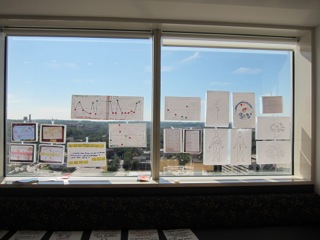
All these collaborations radically altered my understanding of what it means to be a “designer”, but my final project allowed me to explore the unique value of an illustrator within a design community. Working closely with Lorna Ross, the inspirational design manager of the CFI, I proposed, designed, and executed my own experiment. My experiment was based on two assumptions: 1) patient stories have value and 2) to reveal that value we must collect those stories.
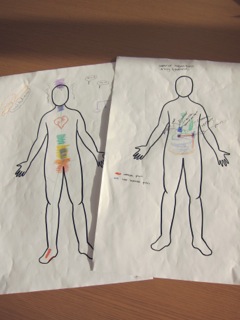
I began interviewing patients and always started with the same question: “Tell me the story of your illness”. This let me enter the conversation without an agenda, and allowed me to hear whatever story the patient wanted to tell. This free exploration revealed things I would never have known to ask about. Once patients understood that there was someone who wanted to listen, their lids popped off and the bottled up stories came pouring out.
I asked the patients to do a little more than just tell me their stories. I asked them to think about their experiences in a new way. Most people store their stories linearly and verbally. I had to get them to think differently so we could avoid the same, old, pre-packaged story. Telling narratives visually got them to revisit their old stories and make new connections. Both the patient and myself learned something from this kind of retelling.
These new kinds of stories also allowed me to understand the context of their care. Patients didn’t feel like they could only talk about their condition as it existed within the hospital. They shared with me how their healthcare affected their home life and visa versa. By listening instead of leading, I could understand the role of healthcare within the bigger picture of their lives.
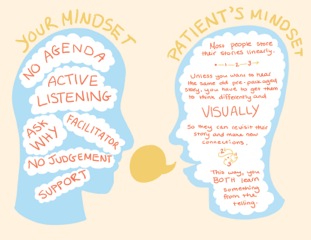
My colleagues on the design team asked me to create kits that would allow other groups at Mayo to collect visual patient narratives. The kits combine patient prompts like body maps, image dice, symbol cards and stickers with a how-to workbook. The CFI currently uses the kit to introduce design thinking to providers, and to allow resident designers to gather new kinds of patient data. Mayo medical students also use the kit to comprehend the larger context of patient care. Finally, the Center for the Humanities in Medicine uses the kit to engage patients in therapeutic visual storytelling and to create a library of patient stories to benefit future members of the clinic.

The Mayo Clinic Center for Innovation is something far bigger than any single designer, provider, or illustrator. It’s a tangled web of active thinkers who ask questions that may not have answers. When I graduate in the spring, I’ll be looking for the biggest, nastiest problems I can find. Because I’ve learned that design isn’t just part of the solution. Design changes how we see the problem.


Maharam and 2ndLife Summer work
In Rhode Island when you throw away something into the trash it will mostly end up in the Johnston Landfill. To facilitate the disposal of waste there is a government system that works around the clock– involving desk jobs and manual labor, hard hats and conveyor belts, satellite-informed software and diesel trucks. The system is designed to ensure that trashed items end up in their designated location, and are processed accordingly. However, there is no component, no job, no machine responsible to ensure that whatever that enters the waste- stream is actually trash.
Each of the 2,400 students at the Rhode Island School of Design is expected to spend $2,781 on art supplies per year. And until 2004, most of unused, unwanted art supplies was thrown away during annual move out, when RISD students leave Providence for the summer. In 2004, two RISD students started a program collect these art supplies and redistribute back to students. Doing do would help students with cost, while also being more economical and environmentally sound. Most preferred by the Environmental Protection agency this waste-stream intervention program is referred to as reuse, or upcycling. The two students who started this program at RISD called it 2ndLife.

 Since 2011 I have managed RISD 2ndLife from a shipping container beside the RISD Store along the Providence canal. Over the past few years, we have seen our supply and demand increase among students, local artists, and members of the greater Providence community. So we began coming up with new ways of dealing with this new flux. We began dreaming of a storefront.
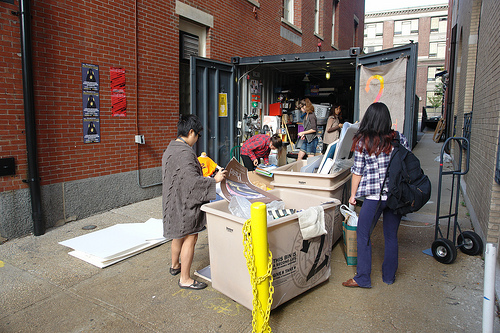
2ndLife as a greater reuse program not only meant more free art supplies, it meant more comprehensive services. Through the Maharam STEAM grant, I began developing a model for progressive waste management between the City of Providence and RISD. Both would mutually benefit from the reuse of art materials. By diverting these durable goods from the waste-stream the school and the city save money in labor, waste production, and landfill fees while reducing our carbon footprint and ensuring that art supplies are used to their potential.
In late April I shared this proposal with Sheila Dormody, the newly appointed Sustainability Coordinator for the City of Providence, who then agreed to act as my advisor over the summer. After our first official meeting we were both excited. The potential of this city-university collaboration, given its creative and industrious efforts, would help make Providence, “one of the Greenest cities in the nation,” a hope voiced by Mayor Angel Taveras. Both Mrs. Dormody and I recognized that in order for 2ndLife to really impact waste-stream programs in Providence– and possibly nationwide– it needed to be self-sustaining and effective in its collection and distribution of art materials.
In late May, RISD Facilities and the Office of Residence Life sponsored a three day twenty-four student-led effort to collect unwanted items from residents moving out from the dorms during annual move out. We at 2ndLife realized that all the work were doing for college material upcycling was new, unique, and, in a way, pioneering. I thought it worthwhile to write a manual which was pragmatic and well-researched, so I asked Mrs. Dormody to connected me to Sustainability Coordinators in New York City and Boston so that I could learn from them. The funds for annual moveout also allowed us to produce a “How To” for university students which explained how organize a materials collection drive and how to start a reuse center on their own campus.
 Cal and Phil, two other 2ndLife members, joined me on the trip to NYC for a meeting with Emily Rubenstien, Coordinator or Long-Term Planning and Sustainability, and Benjamin Rose, Director of the Materials Exchange Development Program under the Department of Sanitation. We all had an hour long conversation about the upcycling/reuse program in NYC where transportation and space are the two main issues when it comes to moving materials around the city. NYC has a mandate of 75% waste diversion by 2030; “So we had to explore reuse,” Mrs. Rubenstien told us. Ben recommended weighing and tracking the inventory since waste is often measured in tonnage and priced by pound. With this and other recommendations back in Providence we collected hard data for the some of the paper we collected in May. It seemed like we had a ton of it.
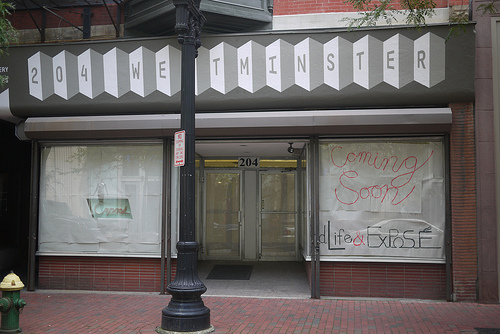
The video above shows the intensive process it takes to organize textiles from our old space that overlooked the river along South Main. We took the the time to ensure all inventory is displayed properly so similar goods are placed together and the whole inventory is easy to navigate.Normally the conclusion would go here, however, I am compiling a document that describes in depth the meetings I had in NYC and Boston and, here in Rhode Island, and the developments of 2ndLife that are taking place as of the writing of this. I will print a few small editions. Those who would like to get a free copy can email me at jescobar@risd.edu. Check us out at the grand opening on September 15th at 204 Westminster. We hope to see you there.
A design for storytelling by Andreas Nicholas, GlobeMed

Jill and Samuel discuss his role as a human rights volunteer during our final interview
My first job as a designer/filmmaker in the development field is to consider my approach. During my time in Gulu, I saw firsthand the Western tendency to arrive with pre-conceived notions of the place and to develop quick or easy ‘solutions’ to problems based on Western knowledge. To be honest, there is really no set of knowledge that can be applied to development work as a one-size-fits-all solution. It is a very American notion to think of quick ideas that will ‘solve’ major problems, and understandably so.
In the context of the American economy, an entrepreneurship approach makes a lot of sense. But everything is relative, and many of the issues that American entrepreneurship addresses are not as applicable to the problems of northern Uganda. The rapid prototyping model doesn’t bode too well in a place with such delicate political, economic, and cultural circumstances.
Coming into the project, my collaborator, Jill, and I knew we wanted to use our combined skills (our studies in anthropology and film respectively) to tell the stories of Gulu and GWED-G (Gulu Women’s Economic Development and Globalization). We hoped to understand what an investment in media and storytelling could look like, integrated into the work of a non-governmental organization in northern Uganda. But we were determined to let the unique context drive our approach: we began exclusively by listening.
For the first 10 days, we filmed in-depth, life history interviews with upwards of 45 GWED-G beneficiaries. In many ways, it was a humanistic survey of GWED-G and northern Uganda. We started with very fundamental questions like “Where were you born?” and let those questions guide us into conversations. We considered our interviewees as equal partners in building shared knowledge. And more often than not, people dove very deeply into their stories with us. During one of our first days of interviews, Pamela explained to us:
“Even if someone starts crying during their story, they still want to talk about it. They want you to know – do not let that scare you.”
She was right. Almost every person we interviewed had been affected by Joseph Kony’s Lord’s Resistance Army (LRA), and almost every person wanted to share their story. Those days were intense, to say the least, but they allowed us to understand deeply the context and history that we were working in. After those interviews, we decided to follow the story of Samuel, a human rights volunteer who had a profound and transformative effect on his community. (More on him in future posts.)
Patience became our partner in the process. We learned to sit through silences and take as much time as needed for stories to be told, for the past to be explained. And the outcome was revelatory. We gained a complex picture of the people of northern Uganda, their history, their lives, their communities, and the impact of GWED-G’s programs.
Today, we have a catalog of these stories, in addition to a longer film piece that will serve as a benchmark for what effect an organization like GWED-G can have on a community and how they do it. Through this media creation, we understood our role as tools for the people of northern Uganda to share their stories and for GWED-G to communicate its work. And our work is certainly not done.
We have only scratched the surface of what can be learned through the stories of Gulu. Design is a process-based way of working. It unfolds in unexpected ways, takes itself in unique directions while revealing things about the task at hand. This is what development work is asking to be, and in order to answer that request, the designers and media-makers who decide to work in development need to make long-term commitments. We need to let our solutions take the same course as our evolutionary design process.
VIDEO: Considering art + design in development
Pamela Angwech on Art+Design from Andreas Nicholas on Vimeo.
Art + Design in development: These are words that I never imagined a development professional using in the same sentence to describe the future of their work. Fortunately for me, I found an exception. Pamela Angwech is the executive director and founder of GWED-G (Gulu Women’s Economic Development and Globalization). I asked her about what role art, design, and media could play in development, and here’s what she had to say.
According to Pam, what the development field needs most are better methods to communicate stories and impact. And I don’t just mean this in the conventional marketing sense. I mean, communication in all senses: externally and internally, within the organizational structure and its programs. If development organizations were to adapt the methods of storytelling that artists and designers use, just imagine how far reaching the impact would be. Not only would the world understand these organizations and their work better, the organizations would understand themselves better. In turn these organizations would have the ability to think more critically about where they are putting their time, passion, and energy. Check out Pam’s full response in the video above.
In Defense of Design by Olivia Foss, National Defense University
I have found that it takes a little extra effort to explain why a designer, like myself, might work with the Department of Defense. Before I began working with the National Defense University on an initiative called TIDES (Transformative Innovation for Development and Emergency Support), I would explain with big, sweeping arm gestures that I would be working at the intersection of design and policy (intersecting my hands to form an ‘x’). Perhaps it was the gesturing, but I was usually met with blank stares. What kind of ‘designing’ could she possibly be doing at ‘the government” they would ask with their eyes, blink, blink. One intrigued inquisitor said, “Oh, like DARPA?!”. Another responded, “Is it something like how the government buys things, like hammers and helicopters, for ten times the actual price?”
But in truth, I wasn’t exactly sure how to explain what I would be doing. Both TIDES and I know that me being here is an experiment. So, I began to explain it by telling little stories like this: TIDES is seeking a better way to integrate the different types of sustainable technologies currently used in Humanitarian Aid and Disaster Relief situations. So, for example lets suppose that Sergeant Henderson’s team is helping transport X, a product, system, or a service to Benjamin. Benjamin lives in a refugee camp. He might live there for a few days or up to 7 years, which is the average amount of time spent in a refugee camp. So, let’s say that by the time Henderson and Co. pack up and leave, X product, system, or service has been used/consumed/ or broken. So the question now becomes, how can Ben refill/reuse/ or re-purpose X?
Sounds daunting? Human lives are at stake. Complicated? How do you know which technologies will be useful? On an unfathomable scale? Disasters caused by global environmental changes are expected to increase. The thing is, within the military it hasn’t been any one persons job to address the life cycle of relief aid. The scenario I described is THE 64 million dollar dream, the holy grail of design solutions. Yet the quest for this type of functionality indicates the military’s shift in approach from simply defending lives to sustaining them instead.
So, it is with these issues in mind that I will be working to coordinate the STAR-TIDES yearly field demonstration at the Fort McNair Army base. During the week-long event vendors demonstrate how their products actually work in the field. In years past, the demo has been completely off the electricity grid and has featured snacks cooked in solar cookers and coffee purified on-site using solar energy. If you’re in Washington, D.C. October 2-5th, you should check the Demo out – I’ll give you a tour!

Currently I’m working with a multidisciplinary team composed of PhD’s who research, NGO’s that coordinate, Non-Profits that support, hackers who build, geeks that tweak, and military personal to design a useful, usable, and desirable field demonstration experience. Most of my work so far has focused on creating a shared vision for a long-term strategy. Currently, I’m in the process of linking design principles to design solutions. So, for example I’ll start working on outdoor (waterproof!) wayfinding elements – the visual markers that show people, “Hey, the demo is different this year”. Next I’ll be working with exhibit elements to help articulate our chosen theme, “Infrastructure as a System”. More on that soon…


Every morning I pass through the security gates, I swipe my badge. It kind of reminds me of my old RISD ID. In a similar fashion, the badge has my name and picture on it and when I wear it, it makes me feel like I belong with a group of people who’s sole mission, whose actual directive it is, to save lives. And for a moment, I am able to look past the pomp and circumstance of the regalia, flags and shoe shine to recognize that though we may be on different teams, we are definitely on the same mission.

Most people assume that designers work in design firms on designer products for designer clients, including most designers themselves. But to anyone who’s paying attention these days the tides (not to make a pun) are turning.
Now when people ask me about what I’m doing this summer, I say “I’m introducing a government agency to design thinking”.
Minnesota Nice meets Massachusetts Mean by Samantha Dempsey
When I first secured an internship with the Mayo Clinic Center for Innovation, I had no idea what it would actually mean to spend a summer in Rochester, Minnesota. I’d spent my life rooted firmly on the East coast, so naturally I turned to wikipedia to learn about my new home. I discovered that the city of Rochester has a population of 106,769, is one of only four counties in the entire “Land of 10,000 Lakes” without a natural lake, and is home to the renowned Ear of Corn Water Tower .

The next step in my Minnesota education was watching Fargo, a Coen brothers movie filmed in a small Minnesota town much like Rochester. That might not have been the best film choice, since after watching it, I was fairly certain that I was going to meet an unfortunate end in a wood chipper like one of the main characters. With this research in my pocket, I boarded a flight to Rochester to begin my Minnesota adventure. I took my first steps on Minnesota soil after disembarking from the smallest plane I’d ever flown on and walking through the smallest airport I’d ever seen– and stepping directly out into a cornfield. Welcome to Rochester, Minnesota.
The inkling of thought that first struck me in that cornfield later grew into one of my biggest realizations about my new home. Although Rochester is technically a city, its inhabitants strongly adhere to a small town mentality. The first indication of this is the three coffee shops within walking distance of downtown Rochester. One is a Starbucks that closes at 6 on weekdays and 3 on Sundays. One is hidden somewhere within the Marriot hotel. And the third is a chain called Caribou Coffee where I spend the better part of my Sundays. The nightlife in our fair city closes down and locks up at midnight sharp, and while public transportation exists, I have never actually heard of anyone using it.
The best part of Rochester is the people who choose to live here. They’ve taught me that there really is such a thing as “Minnesota Nice” and that, likewise, there’s also something I’ve dubbed “Massachusetts Mean”.
One of the hardest things for me to grasp was that Minnesotans really want to share and give things away. Whether that means giving compliments to strangers (I’ve been stopped three times on the street and told, “You look gorgeous this morning”), or giving food to friends, they always want to leave you with more than you came with. One of my coworkers hosted a party at her house, and on my way out the door, despite my protests she loaded my arms with leftover strawberries, Cool Whip, pizza, two unopened beers and peaches from her pantry that weren’t even being served at the party. I experienced similar generosity from a friend’s yoga instructor. A few minutes after meeting the yogis, I told him how much I admired the meditation beads he’d crafted. He immediately removed them from his wrist and offered them to me. I told him I didn’t want to take his beautiful beads to which he responded, “You’re not taking them, I’m giving them to you.” After that answer, I felt as if I’d been thoughtlessly rude and accepted the beads without further dissent.
You must understand that I’m a born-and-bred New Englander to the core. When people offer me things, I assume they’re just doing it to be polite. The worst thing a New Englander can do is be a burden to a friend, and so back home in Massachusetts, it is much better to decline something honestly offered than to accept something offered out of politeness but that will be sorely missed. Here, however, people really genuinely just want to share and go out of their way to be nice. At the farmers’ market in Rochester, I once asked a vendor if she sold spearmint seedlings. She said, no, but there were plenty in her home garden and I should stop by and dig up a few. She promptly wrote down her address, and when I asked how much she’d like in exchange for the plants she told me not to worry about it and that the plants were getting overgrown anyways.
I’ve learned a few tangible things from the people of Rochester as well.
- Really good cheese curds squeak between your teeth when you bite down.
- At least three kinds of “egg bake” should be served at any respectable brunch.
- A “hot dish” doesn’t simply refer to a warm entree, but rather a particular kind of casserole involving multiple layers of potato, ground beef, and cream of mushroom soup.
- Belly-dancing cowgirls shaking their bells to the tune of Cotton Eye Joe are a legitimate form of entertainment.

The last Minnesotan experience I’ll mention will be the large-scale events I’ve taken part in. Hundreds of Minneapolites pelted me with pounds of overripe tomatoes at the Midwest Tomato Fest, a huge, street-wide food fight in the Mill City. At “Nordic Fest”, I came to appreciate the Swedish heritage of my Midwestern brethren surrounded by more blond and blue-eyed people then I’d ever seen in one place. I discovered that “Pizza farms” are not, in fact, places where magical pizza trees grow, but instead are weekly events were Minnesotans drive deep into the corn to dine on pizzas made from ingredients grown on same farmland where they spread their picnic blankets. And finally, one of my biggest life regrets will be that I was unable to attend the Midwestern Lumberjack Championships that occurred during my first week here.

I knew I’d learn a lot from my professional mentors at the Mayo Clinic Center for Innovation, but I didn’t realize that the entire state of Minnesota would make sure I left with more than I came with.
So just what does an illustrator do at the Mayo Clinic?-Samantha Dempsey, Mayo Clinic
In the seven weeks since I started my Maharam STEAM Fellowship at the Mayo Clinic Center for Innovation, I’ve been asked that question by a lot of people. The good news is, I am finding new answers to that question every day. I am a little more than half way done with my time here, and already I’ve shadowed midwives and doctors, acted as a graphic facilitator for patients, taught med students about the importance of visual communication, and made comics illustrating brand new methods of care. That’s not even mentioning the things I’ve done outside the walls of Mayo where I’ve single-handedly eaten my first batch of fried cheese curds, admired tons of massive farm equipment proudly parading down main street, and been pelted by pounds of overripe tomatoes the at Midwest Tomato Fest. Given the nature of my outside-of-work activities, it’s impressive that my work within the clinic has been the most exciting part of these seven weeks.
I began my fellowship with a more traditional illustration job. Working with the Practice Redesign team, I completed a series of images that were embedded in customized education videos intended to communicate surgical procedures to patients. These videos are part of a larger experiment that aims to rethink the outpatient experience, reduce healthcare costs by 30%, and simultaneously improve patient satisfaction. While the idea of an illustrator doing medical illustration is not surprising, I was surprised by the way my team immediately treated me as a professional illustrator. I wasn’t told what to draw and then simply sent off to a dark corner to crank it out. Instead, I read through video scripts, decided myself where and if a visual was needed, defined what that visual should be, and then created it. I’d never felt so valued in a professional setting as an illustrator. You can see a screenshot from my project here.

In my third week at CFI, I joined a new team and began working with rural care delivery at the Mayo Family Clinic Kasson alongside CFI’s Community Health Transformation team. There, away from the main clinic’s tall buildings and armed with nothing but a pad of paper and box of markers, I shadowed primary care providers and developed a method of real-time conversation capture. As doctors and patients conversed, I sat with them in the exam room and charted the flow of conversation using a series of images, words, and symbols to record their interaction. These quick and dirty conversation maps or “graphic facilitations” allowed the patients to understand how recommendations came about and where decisions came from. You can see an example of one of these recorded conversations here.

With that same team, I also worked to develop a series of wordless narrative comics. These comics illustrated real patient stories that exemplified the experimental Care Team approach being developed by the Community Health Transformation team. The Care Team approach pushes each medical provider to operate at their highest level of function, to work together to treat patients as a team, to increase their awareness of the social determinants of health, and through these to develop a holistic view of each patient. My team used my comics to communicate the new Care Team approach to audiences both in and out of the Mayo Clinic institution. The comics were also used to instill the importance of such new medical values within Mayo 1styear medical students’ work in conjunction with the Community Health transformation team. You can see one of my comics below.

My next step at Mayo led me to the Center For Individualized Medicine. This center does not yet physically exist, but a talented group of designers and providers is hard at work imagining how such a center dedicated to patient exome sequencing will function. The process is incredibly complex, and the team asked me to find a way to visually express the nitty-gritty details of their many new concepts as well as the way that those all come together to form the big picture of the patient experience. After many hours spent trying on the shoes of the doctor, genetic counselor, and bioethicist, finally I understood the process well enough to visualize it. I then created an animation that functions as a metaphor, giving my team the freedom to verbally explain the many details of each concept, while the animation visually presents how each part fits into the larger whole. You can see a clip from my animation here.
Next week, I’ll begin the final and most exciting phase of my time at CFI! Acting as the lone illustrator cutting her path through the untamed grounds of Mayo, I will start my own research/design project here to explore the role of empathy, narrative, and illustration in the clinic. It’s kind of a secret, but I’ll let you know that the entire project revolves around “unpacking” patient stories and finding visual ways to prompt realizations. So stay tuned!
Meeting with Harriet Taub, Materials for the Arts-Joseph Escobar, City of Providence
This past Friday I met with Harriet Taub, Executive Director for Materials for the Arts. MftA is a program under the NYC Department of Cultural Affairs, which, “collects unneeded items from businesses and individuals, and distributes these donations free of charge to non-profit organizations with arts programming, government agencies and public schools across the five boroughs.”
For an hour, we talked about the upcycling structure of the program within NYC, covering considerations such as working with the government, artists, material sources, and reaching out to other universities. The MfrA also has an eco-friendly component; Harriet informs the Sanitation Department on how much material they divert from the landfill.
Projects such as MftA can influence class room learning. Through the Common Core, which many states including RI have adopted, public school teachers need to incorporate project-based learning into their lesson plans. These reuse centers provide and encourage creative reuse of unwanted materials, creating a following of teachers who constantly return back for supplies.
MftA public-private entity, represents a good partnership between the government and nonprofits, ensuring that durable goods do not enter the waste stream and instead are reused.
Project Based Learning-Giles Holt, City of Providence
My Maharam Fellowship research has focused on effective methods for mid-sized city governments to crowdsource talent and insight around defined planning and policy issues.
During the week of June 11th I was able to participate in the Cooper Hewitt Symposium on Design Education for Teachers sponsored by the Pearson Foundation a (501 c-3 focused on literacy, learning, and ‘great teaching’). Cooper Hewitt’s intent in hosting the symposium was to take great teachers from across the US and show them how to teach design education. While this seems out of the realm of City Planning and Policy, there is an incredible gap between our ability to conceptualize of cities as a system of systems that starts with education.
The workshop took participants through the standard design phases from scoping to user interaction within the Harlem community. Two aspects became key-takeaways. Project based education and experiential learning. Both of which represent a larger trend in education, which when taken at a systemic scale can mean the difference between ownership and dismissal. For resident engagement to be effective, such as the UK’s opening of government data (see: http://data.gov.uk/blog/new-open-government-license), it requires ownership on the part of an individual. A process that starts with education.
Speaking with Tobias Shepherd in Providence City Hall brings up the fact that the city doesn’t lack talent, it lacks systems to crowd-source talent. I have been fortunate enough to be able to bridge my work with the larger goals of STEM to STEAM education by collaborating with technologists to start initial iterations of an open city government application that will enable public officials to create defined digital spaces dedicated to a single problems.
Existing methods deal in either superlatives or absolutes. Problem solving at either too granular a scale, a single pothole, a building’s energy usage, or issues too systemic to tackle from a macro level, relationships between public spending and resource utilization. The Cooper Hewitt Symposium brought a component of design to education that effectually will result in stronger abilities to work across scales with agile tools for engagement.
You must be logged in to post a comment.