

Final Reflections- Kate Aitchison, MFA Printmaking, 2016
As I sit here in my RISD studio reflecting on my thoughts as a Maharam STEAM fellow, I can’t help but think about how grateful I was to have the opportunity to return to a familiar location with an intentionality of making art, learning about science and formulating visual communication. Working closely with scientists and non-profits educators elevated my understanding of the place and how to produce an understanding of that place from many different angles.

I have always felt attached to the Colorado Plateau and to a myriad of specific locations within in, especially rivers and canyons, soaring sandstone cliffs, and having the ability to see for hundreds of miles in every direction while simultaneously feeling small and a part of it all. My feelings rival that of any interpersonal relationship I have and yet its always been hard for me to articulate that feeling to others, and articulate those feelings in my own art work. It has always been an “intangible”. It is something I’m still working on, but somehow, over the course of the summer, working in a variety of ways to communicate visually different aspects of the Colorado River watershed and the importance of its existence within the Colorado Plateau and greater Western United States, something shifted. Working with scientists taught me the value of clear and literal visual tools to communicate very specific scientific concepts. Working with youth taught me how to translate complicated scientific ideas and greater topics in conservation into simple bits that resonated with meaning. Creating a specific visual language catered to a certain audience taught me the value of specificity and intention that I have now been able to translate into my own, more metaphorical and emotional art practice.
I am beginning to put together all the pieces.
Images of Final Grand Canyon Food Web for USGS use. (all imagery originally block prints that have been digitized and put together into this food web)

Grand Canyon Aquatic Base Food Web
DETAILS from food web
 Humpback Chub (endangered fish)

Myotis

Flannelmouth Sucker (native fish)

Desert Spiny Lizard
Ultimately, this piecing together of art, science, conservation, and collaboration is, for me, a life long project. This fellowship was a stepping stone on my path to finding the connectedness between the things that I love and to show other people, from all walks of life, that everything is more connected than it may first appear. I wanted to show scientists the importance of art as a visual communication tool, and I began to. I wanted to show youth the importance of connecting with place on many different levels, and I began to. And I wanted to show everyone I met that art and science can work symbiotically to create new things neither one can accomplish on its own. I see this project more as a beginning than as an end, and I hope to work more in this realm as I move forward beyond graduate school and into the next phases of my life.
Below you will find a few images from my most recent body of work, a collection of monotypes created in response to the summer and my connection with Grand Canyon and the Colorado Plateau. Working with maps as well as personal memories of place, I am weaving together imagery that represents the landscape, the way we abstract the landscape into flat, categorical measurements, and how those measurements and mis-measurements have led us to this tenuous place we occupy today. Water, especially Colorado River water is becoming a more and more precious commodity as western populations continue to grow. There is no easy answer, only the knowledge that we will reach a tipping point, and something will have to give. This is my opportunity to define, through visual means, what this place means to me and how I interact with the political framework surrounding these beloved, endangered landscapes. I couldn’t have made these without my experience this summer and I am glad to have been able to develop such a rich body of work because of it.


Grand Canyon Boating for Art and Science! Kate Aitchison MFA Printmaking 2016
Upon return from my river trip without phone or internet for 16 days, it has been hard to re-enter society. It’s always hard, especially when the magic of place overtakes you and the Grand Canyon works its magic on your mind, body, and soul. It’s always a bit of a culture shock to try and explain where you have been, what you have been doing “down there” to those who haven’t had the opportunity to see it themselves. But I’ll do my best….
The Beginning:
The beginning of a trip always starts with the gear. Piles and piles of gear. Boats, frames, oars, dry bags, rig bags, coolers full of food, dry boxes full of food, science equipment of all shapes and sizes, and of course, 5 guides– armed with a range of skills– cooking pancakes and bacon, catching fish, righting upturned boats, hiking into the hot desert sun in order to find the most magical waterfalls in the most magical places possible, and of course, rowing boats.

Piles of gear

Unloading the truck at the put-in

Rigging Boats

The Launch:
This is no afternoon tubing adventure. This is a 16 expedition style trip and everything we need for 16 days fits onto 5 18 ft. oar boats. These boats are heavy– a few thousand pounds each–and yet they float, and sometimes even flip over. We launched at Lees Ferry, a historical crossing point for the Colorado River and the only access point for vehicles until 226 miles downstream at the takeout, Diamond Creek. Technically this trip was scheduled under a science permit through Grand Canyon Research and Monitoring, so that means that we had a mission to collect data about fish, aquatic insects, and bats– a food web trip. Our passengers– youth from around the country interested in adventuring and science and of course, the Grand Canyon.
Our role as guides- to mentor youth and play to our own strengths in order to inspire curiosity in the place and encourage the idea of stewardship. For me, that meant using art, music and silliness to remind youth that its ok to play, to be a goofball, and interact with the landscape in many different ways including adventuring, making art, writing, and simply reflecting at the power and beauty of being disconnected from the fast pace societal norms encourage us to take.

Lees Ferry (the night before launch)

Lees Ferry (morning of launch)

(some of) The Guides
The Building of the Tribe:
Being at Lees Ferry can sometimes feel like being a part of a circus. There are boats upon boats upon boats, motor rigs, oar trips, private trips and commercial trips. Fisherman going upstream, rafters going downstream. Just a mess of people and noise and excited preparation as everyone prepares for their own personal adventure. The best part of Lees Ferry? Pushing off from shore and leaving it all behind… knowing that 16 days later, you will come out the other end a changed individual, part of a new tribe, on an adventure that can never be repeated, no matter how many times you do it over.
Let the Science Begin!!:
With the first night’s camp comes the first opportunity to do science- Setting up hoop nets catch fish, setting up light traps to catch bugs and setting up the bat detector to see what species of bats hang out in the upper reaches of Grand Canyon. These are tasks that happened every night of the trip– to collect data along the river corridor about different species that rely on aquatic insects for food.

First Night’s Camp (Badger proper)

Setting up Hoop Nets

Putting Hoop Nets up along the eddy

Watching the bat detector app identify bats at night
After the science and camp routine had been established- the trip continued as any good river trip should. Boating, hiking, looking at cool things in cool places, drinking water till our insides hurt, playing, and learning about all things Grand Canyon.

Eric, our resident entomologist, showing everyone the bug diversity of side canyons vs. the main stem.
Moving downstream we talked about how the artificiality of Glen Canyon Dam (upstream of Lees Ferry) effects bug diversity in the main stem of Grand Canyon and how the side streams flowing into it have a much greater diversity due to their more natural cycles and flows. We talked about the cold clear water that flows through Grand Canyon and the effect that has on the native fish, which evolved to survive in the warm muddy water that used to flow through Grand Canyon pre-dam. And we talked about the mysterious night fliers, the bats– and how little is actually known about them but how cool and crazy their lives are.

Scanning Humpback Chub (native and endangered fish) for pit tags!

Let the Art Begin!!
Then it was time for art! As a printmaker, I can’t just let a river trip go by without introducing printmaking and talking about the importance of art in relation to Grand Canyon. Painter Thomas Moran made huge contributions to the preservation of America’s first public lands, Yellowstone and Grand Canyon National Parks because of his paintings of these iconic vistas. Without his paintings, Congress would not have been able to grasp the grandeur and uniqueness of these places and we have him to thank for his role in saving these localities for posterity.
In addition to Thomas Moran, I also like to mention Everett Ruess, a young adventurer and artist from the 1930s who traveled all around the southwest making woodcuts and selling and trading them along the way. His black and white imagery of southwestern landscapes is now some of the most celebrated in the area and his letters home about this experiences traveling through the wilderness are poignant and thought provoking for any age. (he was only 16-19 at the time all of this occurred).
But you can’t just talk about art, you have to make it too! And so we busted out the block print kit and got to work engaging with the landscape in a different way than science allows… a more personal and reflective time to observe the place in a way of your own choosing.

Carving blocks at camp

Printing the blocks


The finished piece!

WHITEWATER!
And of course it wouldn’t be Grand Canyon without some of the biggest whitewater in North America. It’s all a part of the adventure!


Bringing it all together:
All together, we took to groups of kids down the river– one group came with us from Lees Ferry to Phantom Ranch, where they hiked out and another group of kids hiked in and came down with us to Diamond Creek (the takeout).
We were able to combine art and science in such a way that it became a part of our lives down there, something that happened as naturally as the turning of morning into night. It was incredible to make Grand Canyon our home for a few weeks and to let all the aspects of the fellowship mesh together in a very natural way. It felt good to show the youth that it was possible to be and artist and a scientist and a river guide, and that ultimately, these paths are not mutually exclusive but instead mutually inclusive and better off that way. Oh man, what a trip!
Signing off for now with a few more photos:


Swimming in the Little Colorado River
Butt Dams in Shinumo Creek


Boat Repairs after the Inner Gorge (where all the biggest whitewater is)

Guitar in Blacktail Canyon

Baby Humpback Chub!

Fishin’ for SCIENCE!– Flannelmouth Sucker

The Harbor at Havasu Canyon

Matkatamiba Canyon
Pre Trip excitement– Kate Aitchison MFA 2016 Printmaking
Tomorrow I launch on a Grand Canyon River trip. That means 16 days without cell phones or internet. Just me, 4 other guides, a scientist, and 12 youth with varying degrees of visual impairments. Our task is to collect scientific data for the Aquatic Food Base lab at USGS, to discover the magic of the river, and of course, to have fun. My task is to row the more than 150 rapids as safely as possible, facilitate stewardship of place, and to encourage everyone to be themselves, rise to the challenge, and break the boundaries of what and who they thought they could be. It’s going to be an exciting trip, filled with adventures, stories, laughter, and of course art and science. But every trip is different, that is the beauty of it, and while I can plan for what the future holds, possibilities abound and we will just take it all in one day at a time.

getting all my rigging together for the trip (rigging are all the nylon straps that will hold the frame to the rubber raft and hold all the gear to the frame)
My fellowship has been going well– very well in fact. I’m working on a few different projects right now, but my main focus for the river trip is going to be to figure out the best way to explain all the pieces of the puzzle vying for the resource that is Grand Canyon. There are ecologists, hydrologists, and conservation groups, there are recreation groups, states, tribes, and the National Park Service. There are groups whose focus is irrigation, hydropower, and water rights. And there is The Grand Canyon Monitoring and Research Center, whose job it is to do the science that shows whats going on in Grand Canyon and how the Glen Canyon Dam is affecting the ecosystem as a whole. All of these stakeholders, as they are called, form a group called the Glen Canyon Adaptive Management group which reports directly to the Department of the Interior making recommendations about how the dam should be best operated in order to serve all the various interests at stake. All in all its a complicated and important system, and one that not a lot of people know about. I want to make a visual representation of the puzzle to allow anyone and everyone to understand whats going on, especially the youth on these science trips. (if you want to know more about the stakeholders and what they represent you can visit this website http://www.usbr.gov/uc/rm/amp/ )
I will also be working on art and gathering inspiration for my second year of grad school. More on that when I return.
Wish me good runs and keeping the black side down (that means not flipping the boat)!!!
See you in August 🙂
USGS Citizen Science Video- Kate Aitchison, MFA Printmaking, 2016
Check out this video on the citizen science project I’m working with this summer! Its a great way to better understand what’s going on in Grand Canyon ecology management and to learn more about how citizens (a.k.a river guides, private boaters, and youth partnership trips) are critical to the gathering of data for USGS.
The art of aquatic insects and how bugs keep the world on track– Kate Aitchison, MFA Printmaking, 2016
As I walked into the Aquatic Insect Lab at Grand Canyon Monitoring and Research/ United States Geologic Survey in Flagstaff, AZ, my first thought was– this is no art studio. However, in its own way, this laboratory covered in microscopes and full of lab technicians affectionately called “pickers” (because they spend their days picking apart bug samples and identifying and quantifying species and numbers) it is a place with a lot of exciting, innovative, and creative work going on. This is my main spot for the summer, working with biologist, Anya Metcalfe, to bring art and design into a place where science reigns supreme. There are two other labs at GCMRC, the Fisheries Lab, which looks at (you guessed it) fish, and the Sediment and Geomorphology Lab which looks primarily at sediment movement through Grand Canyon. All three are a part of a research and monitoring plan to learn about and look at the health of an ecosystem altered by Glen Canyon Dam.
But lets get back to the bugs. Hundreds and hundreds of small sample bottles filled with bugs sit in a storage unit outside the building: these bottles are the data the Aquatic Insect Lab is working with. These samples are all a part of a massive citizen science initiative happening in Grand Canyon that asks commercial and private boatmen on Grand Canyon river trips to collect samples of aquatic insects for one hour each night of their trip. USGS provides the instructions and materials necessary, and the boatmen provide the leg work. Here’s how taking a sample works: each night, within an hour of sunset, a small tupperware is placed along the river’s edge with a black light balanced on top of it. Then a small bottle of ethanol is poured into the tupperware and left out for one hour. The bugs are attracted to the light and fly into the ethanol (then the bugs die, but it is a quick and painless death, and its all in the name of science!). After one hour of collecting, the ethanol is poured back into the bottle and the time, date, weather, and river mile are all recorded and placed with the sample. After 14-21 days on the water, these samples come back to USGS, a wealth of knowledge for the scientists who wouldn’t be able to get this much data any other way. All of this data goes into a huge data set that can them be analyzed to look at numbers and types of aquatic insects during specific times of year, when hatched of specific insects tend to happen, etc.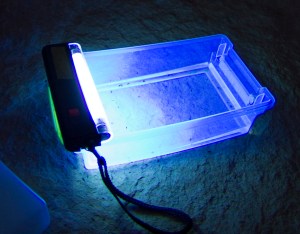 A light trap in action!
But really, bugs? Who cares? Why should we put so much effort into studying aquatic insects? The larvae are so small that you can barely see them and when the bugs themselves become mature you only really notice them when they bite you or fly incessantly around your headlamp. Believe it or not, aquatic insects are essential to the ecosystem. In their egg and larval form, they are the main source of food for fish. In their emergent form (airborne form) they are a food source for bats, birds, lizards, and spiders. They are a very key aspect of the food web and without them, things have the potential to become very problematic.
So now that you have a little background info– back to the art. Where does the art fit into all this data collection and bug picking madness? It fits in two different places. Firstly, it fits into the illustration of different insect’s lifecycles and the food web cycle as a whole. While general insect lifecycles have previously been illustrated there are insects specific to Grand Canyon that have never been studied before that can now be discussed in scientific papers thanks to large collection samples. To go along with those papers, illustrations must be made that can visually represent the data in a clear, concise way. My internship advisor, Anya, and I have been talking a lot about the power of an image and what it can do for science: a good illustration can give all the information in the paper in such a way that the key knowledge is effectively and accurately communicated without needing the paper there at all, while a bad image only serves to confuse. You add good design to a good illustration, and great things start to happen!
 Angel Lichen Moth lifecycle in progress

Finished Angel Lichen Moth lifecycle
In terms of the food web, there hasn’t ever been a food web illustration made specifically for Grand Canyon. Making an effective and elegant Grand Canyon food web illustration means that it will become a resource for all the ecological scientists working at GCMRC, not just those in the Aquatic insect lab. Very exciting indeed!
Now, back to the second place the art fits in: Art also fits into the public outreach part of the program. Anya and I are working with USGS partner, Grand Canyon Youth, to develop ways to better integrate art and communication into their science river curriculum. Grand Canyon Youth already does light trapping on all of their youth river trips however, the reasoning behind the light traps isn’t always made clear and often it feels more like chore than an exciting opportunity to describe the ecosystem and all of its components. It’s also difficult for youth to understand how something so small can fit into a much larger picture of public land management and public policy. So, we are beginning to develop some ideas of how to visually represent where the science goes once it’s collected, and how science fits into the bigger picture of Grand Canyon Stakeholders and how stakeholders drive critical policy decisions. We are also creating block print kits to take on the river to help kids make personal observations, connect to the place on a personal level, and start to feel a personal stewardship towards wild places that can carry far beyond their river trip.
I think that’s enough overload of information for now. It’s been an exciting beginning and the momentum is really picking up. More coming soon!
Kate
You must be logged in to post a comment.