

Wrapping Up – Henry Ding BArch 2026
My months of gathering, conversations, and research has led to my final design deliverable! I’m designing, writing, and curating a digital collection! Based on the themes of “The Queer Home”, I’m designing a book to be published in The ArQuives digital library as well as set to be displayed physically later at the end of the year! An incredible opportunity that has become a true passion project of the last few months.
The collection will entail three sections based on: placemaking, domesticity, and forgotten narratives. After processing and transcribing my interviews I went to straight to work on the collection’s visuals. The aforementioned sections will be accompanied by photographs that I’ve gathered through archival digitization and fieldwork throughout Toronto. These will also be accompanied by self-made designs and architectural visualizations. The goal is to reframe a period of Toronto’s queer history from the 1970s-90s through the perspective of home and architecture. The alternative and revolutionary lives lived by thousands of queer people in Toronto has been inspiring to study, and I’m excited to help spread that spirit in further. Below I’ve attached some excerpts of two spreads for my section on domesticity!


The process of putting together this work has been tough. I had never realized a book could be so much work! Besides archival categorization and research, digital design programs, writing/transcribing, I also have to worry about copyright and sourcing! I’ve grown an immense amount of respect for anyone who has to do any of this work professionally. It has definitely been a community effort and I’m so thankful to the archival, library, and research staff at The ArQuives and several friends that have helped me review and check my writing and designs—I write this book on the backs on so many people who have made groundbreaking research before me.
Below are some pictures of my everyday work at the end of this fellowship! Spot my fun little work corners that I would set up in the deepest, darkest corners of The ArQuives’ libraries!


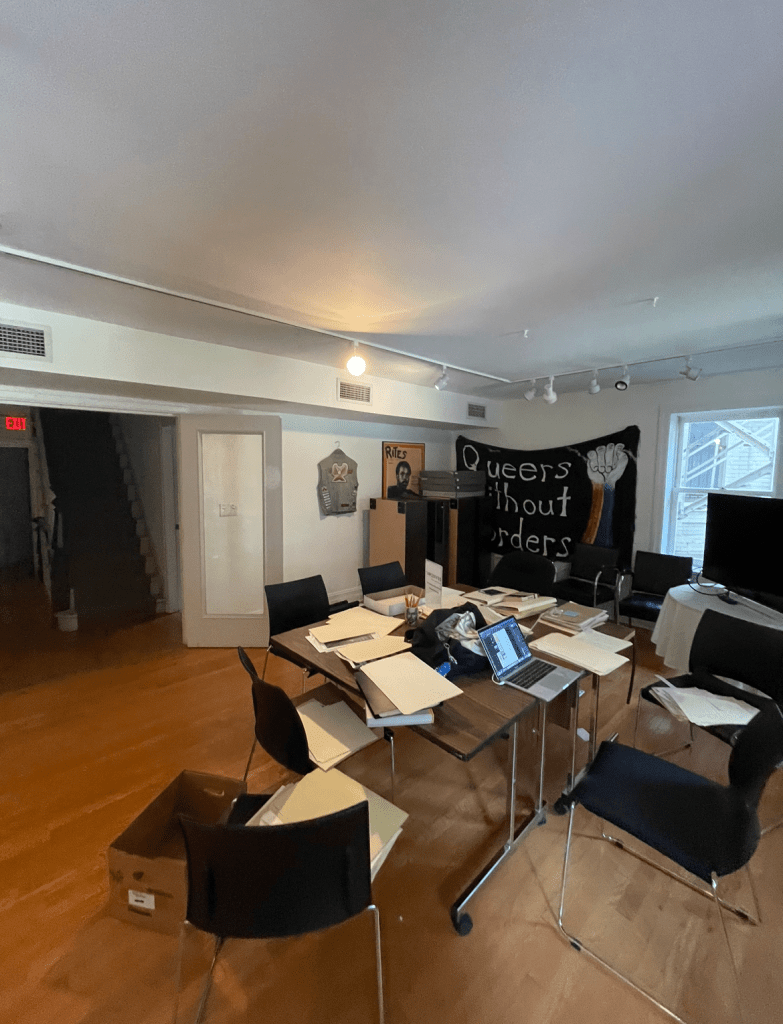

And that’s really all for now! My next post with my finished book will be my final sign-off! So super excited!
The People – Henry Ding, BArch 2026
It’s been a while since my last update so I’m just gonna update y’all on the second phase of my fellowship—the hard labour part. In this phase, I began to venture away from The ArQuives’ headquarters into offsite storage locations, exploring a small bit of the true extent of a 100k+ strong collection.
I only accomplished this by teaming up with some wonderful coworkers to search for obscure legal documents and floor plans—who also taught me extensively about the archival process and queer history along the way. I became obsessed with discovering details of historic police raids, government actions against queer individuals, the details of no-longer existing queer infrastructure, and the daily lives of those living in queer collective houses. To truly understand the relationships that queer Torontonians had to community, architecture, and infrastructure, I needed to dig deeper.


After outlining my initial research, I began to become referred to prominent figures and experts in Toronto’s queer community to conduct some of my own first-hand research. Getting connected from one person to another, travelling along a network of connections, I began to learn how truly tight-knit and welcoming Toronto’s LGBTQ+ community is.
I first spoke to Richard Fung, a prominent gay filmmaker, activist, and professor from Toronto. He’s been heavily involved in Toronto queer activism since the 1970s, and we spoke extensively on his life in a queer collective commune, his work detailing queer Asian narratives and his personal life as a Chinese-Trinidadian, and wider activism involving the queer Asian community.
From there, Richard connected me to Alan Li, another prominent gay Asian activist and doctor involved in queer and HIV/AIDS activism in Toronto. From there another connection was made to an architecture professor involved in archival projects focused on Toronto’s Chinese community—and thus I learned first-hand the power of networking.

I then spoke to Dennis Findlay, a longtime activist and the owner of the last known queer collective house in Toronto. We spoke extensively on the impact of queer collective living on how LGBTQ+ people have historically viewed domesticity, relationships, community, space, gathering, mutual-aid, and more. It was a fascinating look at architecture through a lens that I had never experienced before. Someone who viewed the built environment through a radical and innovative lens.
I began to accumulate too many connections to manage (highlights include Beck, a sexual-diversity-studies student at UofT & Charlie, a PhD candidate from Cornell studying Asian queer history in the US). But, I welcomed these interactions with open arms as each conversation I had became an extremely educational and inspiring experience—truly pushing my project with The ArQuives forward.
I’ve come to realize that one of the benefits of archives and archival work, is not just the preservation of the past, but the bringing together of the present. LGBTQ+ people from all over Toronto, old and young, bonded by a collective need to celebrate their shared histories. As Dennis aptly put it when speaking about the queer community in Toronto: “These people are my family… It’s called love. It’s more than just a support system”.
And with that concludes my second post, stay tuned for what my research will culminate in and some more exploring in my beautiful hometown!
Research, Research, & More Research – Henry Ding, BArch 2026
So it’s been around 3 weeks into my time as a Maharam Fellow at The ArQuives in Toronto. It’s been one of the most reflective, enriching, and unexpected experiences I’ve had yet as a student at RISD. While it was initially quite nerve-wracking, I found myself entering a space of extremely passionately queer, intelligent, and kind experts in their fields! It is no wonder that my brain has grown quite a lot since being here.

Some fun acts about The ArQuives:
- With over 100,000 items in its collection, The ArQuives is the largest independent LGBTQS+ Archives in the world and the only one of its kind in Canada!
- I’ve also been told it has one of the largest porn collections in the country, if not the world, as well.
- We do our work in a historic building that dates back to 1860! One small historic house surrounded by the skyscrapers of one of Toronto’s busiest shopping and business districts! (Think the house from the movie Up!)
- Did you know archives actually write about space three-dimensionally? A storage room isn’t 150 square ft, it’s actually 1500 cubic square ft! Even records as small as magazines are catalogued by thickness as well as diameter. How are you gonna know how many records you can store when you only think two-dimensionally?
These facts may or may not help illustrate what my experience has been as of late—combing through thousands of records in this little treasure trove of history in the heart of Toronto. Man have I done a lot of combing. My projects and initiatives are all based around discovering what home and domesticity was like for Toronto’s historic queer community. What does that look like aesthetically, infra-structurally, and politically? How can I visualize this history and make it more accessible to the public? I’m especially becoming interested in queer POC communities!


Everyday at work is a little different. I may be reading through The ArQuives’ extensive books collection, looking through old artifacts (newspapers, census records, etc…), digitizing photographic records, or watching videos made by prominent queer filmmakers in Toronto. Along the way I’m taught archival vocabulary (which is kind of a lot), tour offsite storage facilities, and learn about Toronto’s queer community from my colleagues. It’s been a lot of reading, writing, and learning.
That’s about it for now but stay tuned for a couple interviews, research trips, and new findings I’ve set up that I’m very excited for!

You must be logged in to post a comment.