

Immigration and the Prison Industrial Complex (PIC)
Hello everyone!
Last Saturday I attended my weekly PIC workshop and learned about how the United States prison and immigration systems are deeply intertwined, and how they are separated. We covered so much information and so many terms that it will be hard to relay them all here in a timely fashion, so I will provide the gist of the situation and the questions that arose for me during our conversations.
To begin the workshop, we drew another map of the prison system, starting from arrest/booking and ending in release.
Prison System:
Arrest/Booking -> Criminal Court -> Return OR Arrest/Booking -> Criminal Court -> Captivity -> Release
We then drew a map on the same page of the immigration detention system, showing how it overlaps and how it deviates from the prison system of justice.
Immigration Detention System:
(for undocumented immigrants who were not arrested for a crime, for example during a raid by ICE (Immigration and Customs Enforcement))
Arrest/Booking -> ICE Captivity -> Immigration Courts -> Deportation OR Arrest/Booking -> Deportation
(for undocumented immigrants arrested for a crime)
Arrest/Booking -> Criminal Court -> Captivity -> ICE Captivity -> Immigration Courts -> Deportation
Basically what this means is undocumented immigrants who are arrested for a crime must first go through punishment for their crime in prison, then when they are released they are sent to ICE captivity, and are either given a trial in an immigration court, where they are often present only through skype, or they are deported straight away. An immigrants rights are rarely respected, as adjudicators are often trying to deport as many people as possible to meet their quotas. Immigrants can be confused by the legal jargon, often don’t speak the language, and are not represented by a lawyer. ICE is also guilty of locking up and deporting U.S. citizens (http://www.thenation.com/article/155497/lawless-courts#)
We often hear that our government is getting rid of the “bad guys”. That the people they deport are the worst of the worst offenders – people who have committed aggravated felonies. One example of an aggravated felony under immigration court law is shoplifting. Immigration courts are able operate under different laws than the laws that apply to U.S. citizens. This makes it easier for our government to rapidly deport many people.
Why are so many people deported? Why is it so hard to get a green card? One idea is that an influx of a population, mainly hispanic, is threatening a national idea of what America is and who America is for.
What would happen if it were easy for anyone to attain citizenship in America? What role does the U.S. play in making not want to live in their own countries of origin? How do other countries deal with immigration? Is there a role model we could be like?
How does citizenship organize unjust social policies? What would happen in a world without borders?
The biggest question I had is this – if we are all immigrants in America, who decides who gets to live here? What makes a person worthy of citizenship, and how does our popular culture support those ideas?
I will be reading “Beyond Walls and Borders”, a book by Jenna Loyd, Matt Mitchelson, and Andrew Burridge to try to find answers to these questions.
My next post coming later this week will be about my work on my children’s book about incarceration and how it is developing.
Bianca
A Visual Approach
Lizzie Kripke Marine Biological Laboratory, Woods Hole, MA
Huddled together around a glowing computer monitor, the only source of light in this crannied room, we watch. An image slowly resolves on the screen. Vaguely green forms suddenly burst into full fluorescence.
“It worked! Well, at least, a little bit!”
Steve, with joystick and computer mouse as his steering wheel, shifts the focus of the microscope a little to the right. And then, greater fluorescence – this time, delineating a more precise edge.
“Promising.” Steve looks content.
Our specific method of preparing this specimen has brought us face to face with the complex inner-workings of an embryonic squid. We are seeing life in a way that it has never been seen before.
It is no small coincidence that my interest in integrating neuroscience and painting is heavily embedded in the world of microscopy (the use of microscopes). Microscopy is a field that is totally obsessed with visual investigation. It is a field that, above all else, takes visual thinking seriously. Furthermore, it is a field historically rooted right here in Woods Hole.

As an artist, this is unbearably refreshing. It reminds me of similar communities in which I have immersed myself (why do we go to art school, again?). After all, it is at places like this that visual investigation truly flourishes.
So what is my particular visual investigation about? And why am I in a dark room clogged with tools and buttons and lots of other stuff I don’t actually know how to use?
I am here to learn. And I am here to learn how to learn.
This starts, accordingly, with not knowing.
I do not know how cephalopods are able to change their body color so dynamically, so dramatically. I do not know the details of their nervous systems. I do not know what those sacs of pigment embedded in their skin actually consist of, or what would happen if I tried to isolate them, to paint with them…
But I am here to learn.
And I am here to learn how to learn: How have others already approached this particular uncertainty? What methods did they use? What questions did they ask? What questions did they not ask? Why does any of this matter?
“Uhh, Steve, was I supposed to flip that switch?”
And as questions carefully accumulate, a methodical interrogation begins to take shape. Enzymes, dyes, microscopes, sharp objects – my questions must take forms like these in order for my specimen, the skin cephalopods, to understand what I am asking. And if I ask just the right questions, then maybe, just maybe, in some small way, I will know life in a way it has never been known before.

Catch-up Post: What is Poverty Porn?

As I am here in Uganda to do research on poverty porn, I feel it is crucial to define it as best I can. Firstly, no. It is not a type of pornography. I’m not sure who coined the term, but I have mixed feelings about it. It’s provocative for sure and grabs people’s attention, but it’s a very biased term, in that it already takes a firm stance against the use of poverty porn. By predisposing readers to think negatively about it, it narrows and simplifies the debate to a pro and anti-poverty-porn banter. You’re either for it or against it. You use it or you don’t. And as we’ve seen in national debates, when we simplify debates to a pro vs anti competition, you get, for example, people who think the abortion debate is about stopping abortion, not unwanted pregnancies.
This project does not intend to take sides. Instead, it intends to understand what the problem really is. That’s as specific as I will get for now, but I expect that by the end of my time here, my project won’t be about poverty porn at all. But to begin, here is a primer on poverty porn as we know it now:

THIS is the type of photo often criticized as “poverty porn.” It is also a classic example of the white savior complex, captured in a black and white photo. Angelina Jolie’s pale white face contrasts against the darker surroundings, where the anonymous child’s face is excluded from the shot, possibly for fear of detracting from Jolie’s savior spotlight. Who knows what was going on in this photo. Perhaps it was a truly candid shot that nobody can blame. But why is it in black and white? Who made that intentional editing choice? And for what purpose?
I don’t intend to micro-analyze every pixel of poverty-porn-guilty photos, but some photos just get you thinking – what in the world are they trying to say? Anyway, here is a more technical definition of poverty porn that doesn’t single out Angelina Jolie.
Definition from Aid Thoughts
“…any type of media, be it written, photographed or filmed, which exploits the poor’s condition in order to generate the necessary sympathy for selling newspapers or increasing charitable donations or support for a given cause. Poverty porn is typically associated with black, poverty-stricken Africans, but can be found elsewhere.”
Though this is the technical definition of poverty porn, the issue goes deeper into problems with NGO marketing, post-colonial legacy (!), donor dependency, flawed business models, brand psychology, and approaches to development to name a few.
Current Status of Project
This introductory post should have come weeks back but there were some internet troubles as I was traveling to eastern Uganda for the field research component of my project. For the remaining 2.5 weeks, I will be analyzing the folders full of questionnaires and files and files of audio recordings and film to see what people think of poverty porn here. In the meanwhile, I will be posting several catch-up posts about the planning process, my workplace, my research partner, our approach, and the challenges in the field. Stay tuned.
Cheers,
Leah
… the beginning
I arrived in Delhi three days ago.
I see echoes of home (East Africa) everywhere. I see it in the architecture, the chaos, the smells, the food; I even hear it in the language and see it in certain customs. East Africa is home to a very large population of Indians the majority of whom descend from the Gujarat region of India. Although largely segregated from the African population, their influence extends deep into our cultures, impacting our language, our food, our homes and some traditions.
My first impression of Delhi, therefore, is that of a strong familiarity, forcing me to think about what we carry with us as move through the world, what we pass on through the generations and what we attach identity and belonging to. The familiarity I feel here in Delhi is also a testament to the strength of a specific Indian culture – that it can survive multiple generations in a faraway region (East Africa) and I, an East African, can come to Delhi and find echoes of my home here.
Nupur and I are here to do work on gender politics and sexual violence. My understanding of the underlying drivers of gender-based violence is that, among other things, it resides in certain social norms and cultural ideas of masculinity and femininity. It is through the prism of this ‘knowledge’ that I have been trying to understand what I’m seeing around me. In the many social spaces that we have been to in the past three days I see public demonstrations of a certain egalitarianism between the genders. The women are very present and vocal and the men aren’t overwhelmingly patriarchal. Most conversations we have entered into with strangers, both men and women (and unprovoked by us), have been about gender politics in India. A man we met one evening said he felt that the only way to address gender-based sexual violence in India is by enforcing harsh draconian measures on the perpetrators, which we took to mean enforcing castration or even the death penalty. Another stranger we spoke to, the sole woman in the company of five men, said that she was a feminist. When we asked how she defined feminism, she said that to her it meant a belief in equal rights for all people, women included. One of the men in her company disagreed with her and didn’t believe we were all entitled to the same rights, as an example, he asked us whether he had the same rights as President Obama. His concern was about equal rights across social stratifications as opposed to gender lines.
We were at a party last night and everyone was free to smoke and drink and flirt and dance without judgement, recrimination or segregation. But again, this was a public space and a public display. As I looked around me at the party last night, I wondered what happened in the private spaces, in the homes, where traditions are passed down, identities are forged and social norms are first learnt? Does the public display of egalitarianism reach into the home? Or maybe yet, could this public display of egalitarianism actually originate in the home?
For the rest of the week Nupur and I will be meeting with activists, artists and members of civil society. These meetings have been organized by Pattie Gonsalves, our focal point at the IDEAS NGO. We will be using these meetings to inform our understanding of the politics of gender in India and to shape and sharpen our ideas about our outputs for the fellowship.

Patti Gonsalves and Bathsheba in Discussion
[end]
The India Project Begins
BLOG ENTRY 1
Nupur Mathur
New Delhi July 5th 2013

A week ago I flew into Delhi, a place I could call home. I say I could because even though I have family here and spent a large part of my childhood here the city seems more different this time than before. On a day to day basis I find myself angry, or feeling helpless. India is a giant country with a billion people. It is an extremely complex place with a complicated history.
My work here in India along with my colleague and classmate Bathsheba Okwenje is to use our artistic practice to fight for change in an area that has burdened this country for generations: Gender based violence
I ask myself what is gender based violence and why people only rise up to protest when something extreme like a gang rape occurs? Rape is everywhere in India. And by this I don’t mean physically. More so I would like to make a note, that what people refer to as women’s right’s, I prefer calling Human Rights. For me in the distinction itself lies the problem.
I have an older brother. When he was still young my parents were visiting my grandparents one summer. My mother who comes from a family with fairly liberal views asked my brother to take some glasses and cups lying on the table to the kitchen so they could be washed. My grandmother was astonished and scolded my mother, ‘How can you ask him to do that?” In India this is still common, especially in the upper middle class. Most men don’t enter the kitchen. They’ve never cooked or cleaned or washed or ironed their own clothes. It is a long standing patriarchal system that exists here, and men and women alike don’t realize more often than not, when they are enacting a role that they never chose themselves.
Everyday I notice something like this. Something small and it gnaws at me from the inside telling me that is is important to focus on these things. It is important to realize in your daily conversation and your daily choices where you are doing what you want to do, and where you are doing what this society thinks you ought to do. I feel it is important to realize, in order to bring change to how rape is dealt with in this country the responsibility lies not solely on the judiciary system or the police or on politicians. All of these people who have the power to bring about policy change are also people. People who live and work in the same city and country as everyone else. People who despite having moral and legal obligations will still make biased decisions and comment on the affairs of the state in a reckless and crass manner because they are not any different.
I’m interested in developing a method to document, archive and collate the subtle day to day instances that provide an insight into the complex world of gender based violence in India. Rape does not just happen, gang rape does not just happen, eve teasing does not just happen, dowry does not just happen, being scared to death on your wedding night does not just happen. I feel if we give importance and time to understand the smaller more internalized dynamics of gender roles in India, they might help us in our fight against gender based violence.
It has now been a few days since my colleague and classmate Bathsheba has arrived. I’m now seeing things from the perspective of introducing someone from outside of India into Indian culture. What is Indian culture? It’s funny because as I mentioned before the population of this country is huge. So in effect what I’m introducing Bathsheba to is life here in Delhi.
The friends I have here are almost all artists or musicians or designers. It isn’t important in our friends circle who is a man and who is a woman. Not to each other it doesn’t. At home however, scenarios vary. And in this I could speak for myself.
I come from Rajasthan, a state that ranks high in gender based violence and discrimination against women. My family which comprises of highly educated individuals living all over the country and abroad still have strong patriarchal ties. You cannot really date anyone openly because you cannot have sex before marriage. You certainly cannot date someone and bring them back home. So where do you go? To cafe’s and restaurants, and motels to hide from your family and other people who might recognize you? Women especially are escorted by their brothers or go out in groups of friends. They don’t just go out even for dinner or a movie with a man alone, unless they are married, or are siblings, or in a group. And people rarely, almost never go out alone. Everyone is shy and awkward about anything remotely sexual. In effect you grow up feeling extremely uncomfortable about sex and relationships and don’t really know what it’s like to be alone in the company of a man or a woman. In fact you grow up pretty awkward in terms of yourself because you’ve never been alone, and many times never lived away from home. I’ve been fortunate that I’ve gone to international schools most of my life and lived away from home. The kind of friends I’ve made and people I’ve met have allowed me to be the liberal person I am today. I’d be curious however, to ask my female cousin’s how it was for them. Many of them have had arranged marriages and are all now living their lives in accordance to the home of their in-laws.
——
Bathsheba and I met Pattie Gonsalves who is the representative for the NGO IDEA. She is a young woman working in the field of health, environment and gender based politics. Pattie is arranging for us to meet with several specialists, organizations and activists to give us a deeper understanding of the complexities at play here in Delhi, and India at large.
Updates from the Forum
Ryan Murphy: World Economic Forum – Rethinking Personal Data Project

Hello again from New York City, where life has been remarkably hot but overall enjoyable.
I have now been at the World Economic Forum for about a month, and things are moving along excitingly fast. These past few weeks have been spent immersed in the world of big data (and more specifically personal data).
I am working with the Forum to develop and implement a user-centric and contextually-driven policy framework for using personal data. I know that can seem both broad and confusing (largely my thoughts the first week or so), but it really all boils down to a shift from old thinking (meaning before “big data”), which was largely based on data ownership, to a new-world model, based upon data usage.
To understand this necessary shift in thinking consider the following example. When you sign up for a cell phone subscription you agree to let your mobile operator anonymously collect your location data in order to improve network efficiency. So now let’s say you’re the mobile operator, and you “own” all of this location data. You can imagine how many companies would love to buy geolocation data off you. Let’s say a big technology comes knocking, and wants to use the geolocation data to better target advertisements at consumers. Not exactly what the individual signed up for when they agreed to let you “improve network efficiency”. In this case the shift in context (i.e. the different situation in which the data would be used) does not fit the individual’s original consent, so no go. But then the City Transit Authority comes to your door, wanting to use the data to better route their buses based on population density. This falls under the same context (improving network efficiency), and so is fair to sell/share without getting further individual consent. Identifying these shifts in context is especially important in the case of a disaster, where you want information to flow as efficiently as possible. So while this example was a little bit long winded, I believe it shows how the same geolcation data could be acceptable or not in various scenarios.
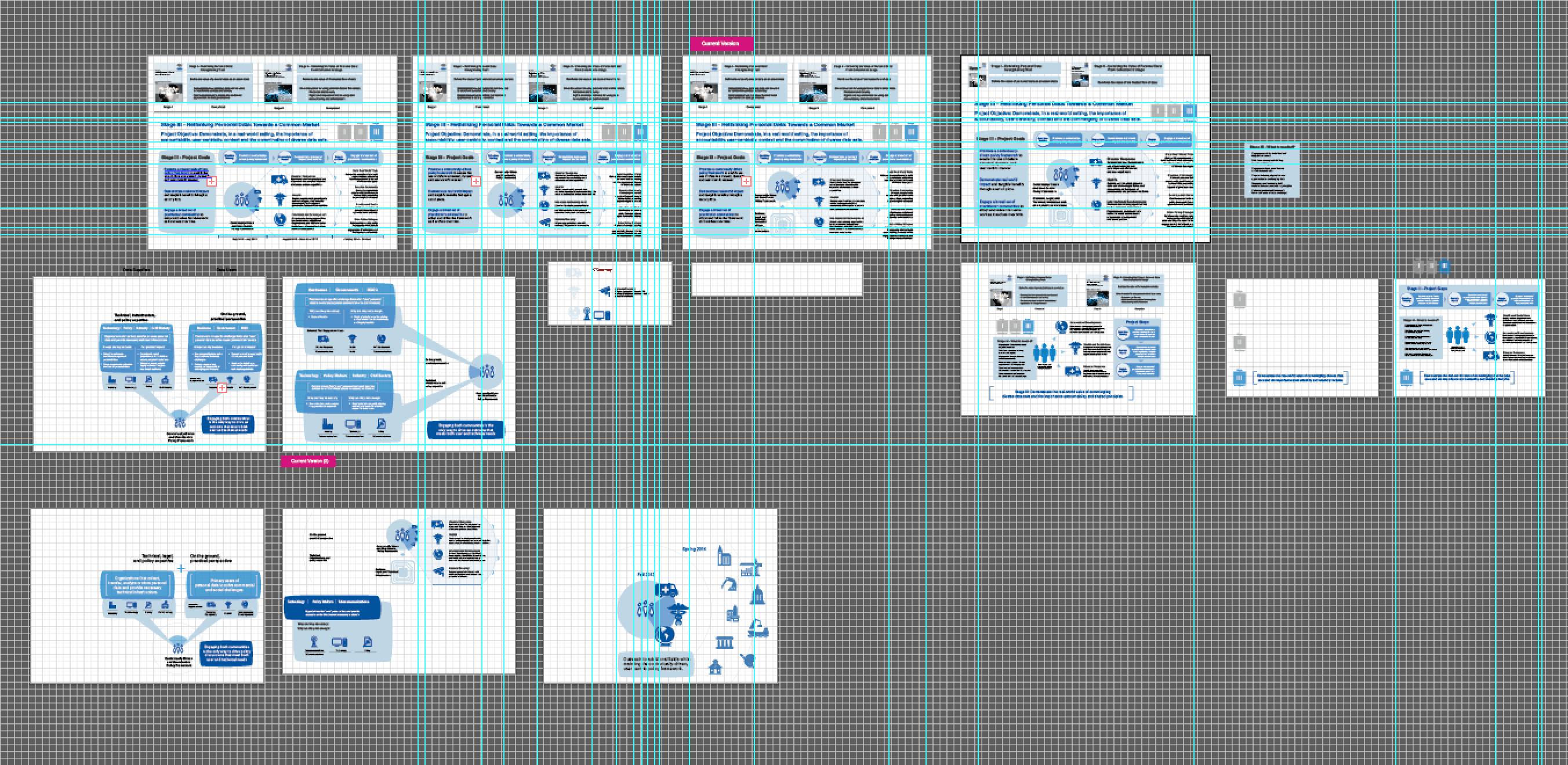
(Small) Process Shot of Graphic Visualization in Adobe Illustrator – Click to Enlarge
My hope is that some of this makes sense, and in the next week or two I will give a more comprehensive look at my role within the Forum’s personal data initiative.
In the meantime you can check out some of the graphic visualization / web interaction work I have been up to here.
Cheers,
Ryan Murphy

Hello from the D!
Hello from Detroit.

gratiot ave _ 2013.6.26
If you’re a native Michigander like me, you might affectionately call our big city, ‘the D’. It’s one of the many nicknames for a city that has played a large role in American culture throughout the twentieth century. Some of the other names that people across America might be more familiar with are ‘the Motor City’, ‘Motown’, ‘Detroit Rock City’, or ‘Hockeytown’. During the middle of the twentieth century, Detroit was one of the biggest and most prosperous American cities. Unfortunately, over the past few decades, Detroit has become a desolate post-industrial city where it is often difficult for residents and outsiders alike to uncover positive aspects of the place. National media fuels the fire for the negative light. Few tourists visit the city and often when they do, they are here to photograph what is sometimes called ruin porn. It is the exploitation of abandoned city infrastructure and buildings at the expense of the city’s image. One of the most photographed sites in the city is the old Packard plant. The abandoned factory sits on the edge of the district in which I am working.

Packard Plant _ 2013.6.20
Much of the district where I am working is covered by fields where single family homes once stood. These fields and vacant spaces are what LEAP is focused on dealing with. How can these abandoned spaces become productive? How can the Eastside residents be involved with the process? How can re-designing these spaces help with water remediation? Create jobs? Feed people? Remove blight? Boost Detroit’s image? Improve the lives of residents and existing businesses? These are all questions that LEAP has been asking. These questions are also the reason that I am working in Detroit this summer.
One of the overarching goals of LEAP is to develop the Eastside as a green district. I have been placed within the framework of a project that is in its initial stages of planning. The project which is named, the Mack Avenue Green Thoroughfare [Green T], sets out to accomplish several things. It will establish a ‘green’ corridor along Mack Ave using green infrastructure. The Green T will improve water remediation throughout the corridor which in turn alleviates some of the impact on city storm water systems. Pennycress fields will be planted as part of a larger biodiesel production business. The low height of pennycress will improve visibility along the corridor because in many areas, it will be replacing overgrown lots. Opportunities for installing public art will become available. The neighborhood aesthetics will be greatly improved. Neighboring homes and businesses will benefit from positive change along Mack Avenue.
The definition of green corridor and green infrastructure is open for exploration within this project. They are new concepts for Detroit and therefore could be redefined for this city.
An initial ‘demonstration block’ will be implemented as the first phase of the Green T project. The design and implementation process is yet to be determined. This is what I am currently helping with. A lot of legwork has been done already within LEAP and the larger non-profit group named the Detroit Neighborhood Partnership East [DNPE]. The Green T is the initial catalyst that hopes to spark the beginning of the LEAP district’s transformation into a green district. Within the demonstration block, there are opportunities to place public art alongside informational signage about the project. This is a really exciting time to be involved with LEAP and the Green T because the opportunities for positive change are endless! The demonstration block is located on the South side of Mack Ave between Lakeview St and Coplin St.

Mack Ave Green Thoroughfare demonstration block site _ 2013.6.14

demonstration block site
One week from now, I will be touring a facility where pennycress is processed into biodiesel. The intent is to fully understand the process from planting the crop to consumption so that it can be explained through graphics to the public. I’m excited to see how all of it works and meet the people involved!
For now, I’ll leave you with this shot of downtown from Belle Isle Park during a rainstorm. The waterway is the Detroit River.

downpour _ 2013.7.1
What is the Prison Industrial Complex?
Hi!
Just so we’re all on the same page, my name is Bianca Diaz and my project involves interviewing parents who have been incarcerated and the children they were forced to leave behind. With the photos and interviews I collect, I will create a children’s book that will attempt to speak to the emotions and struggles that incarcerated parents and their families are facing. It is my hope that this book will provide these families with a way to begin the conversation about a very difficult time in their lives. It is also imperative for me to find a way that teachers and students can have access to this book to promote understanding and open discussion.
Later this week I will have my first meeting with my project leader, Mariame Kaba of Project NIA. Until then, this post will be an update on the workshops I have been attending for the past three weeks about the Prison Industrial Complex (PIC). These workshops are held in the Jane Adams Hull House Museum and are lead by members of Project NIA and the PIC Teaching Collective. Here is a schedule of topics for each week:
- June 15th: PIC 101
- June 22nd: Intro Part 2–History
- June 29th: Cycles of Incarceration
- July 13th: Immigration and the PIC
- July 20th: Youth and the PIC
- July 27th: Gender and the PIC
- August 3rd: Restorative and Transformative Justice
- August 10th: Visualizing a World Without Prisons
During week 1, Chez Rumph lead the group in introductions. There were close to 30 of us, and we went around the table, stating our names, preferred gender pronouns, and what brought us to the workshop. I was amazed at how many different interests and goals everyone had, and at the variety of age groups represented. It felt great to sit in a room full of people who were so passionate and deeply connected to the work they were doing. At the core of it all, I felt in the group a passionate belief that things can change if people can imagine something better and work for it.
After introductions, we created a mind map where the entire group tried to think about who the PIC affects. The results were eye opening. As a group we also edited a definition of the PIC which was written by Critical Resistance.

A mind map showing just how pervasive the prison system is in our societies.

“The prison industrial complex (PIC) is a term we use to describe the overlapping interests of government and industry that use surveillance, policing, and imprisonment as solutions to economic, social and political problems.” – Critical Resistance
Once we created the mind map, we thought about how we each fit into the system. We asked the questions, how do I personally benefit from this system? Where are my points of leverage? How can I start making changes? To myself I wondered, what can I do as an artist?
We were presented with a lot of statistics, facts, and maps as well. These statistics highlighted the increasing rate at which women are being incarcerated, the disproportionate number of black males and people of color in prison compared to those who are white, and the incredible fact that though the US is home to only 5% of the world’s population, we are home to 25% of the world’s prison population. These were shocking and depressing, but failed to paint a picture for me of the real people behind the numbers.
Unfortunately I had to miss week 2 to attend a weekend residency lead by the Chicago Artist Coalition, but yesterday at meeting number 3 I was able to put a face to those statistics. The highlight of this week was the panel that Mariame and Chez invited to speak to our group.
On the panel:
N’Dana Carter – an organizer for the Chicago Mental Health Movement and the Heal Chicago Campaign, which is a platform created to “stop violence in Chicago at its roots by making sure all residents have the sources, conditions and resources to heal.”
Marlin Chamberlain – a former prisoner now working with FORCE (Fighting to Overcome Records and Create Equality), a Chicago based organization which just recently was able to pass HB3061, a house bill which works to seal the criminal records of certain people who have proven to be law abiding and deserving of the relief.
Johnny Walker – traveling educator and former prisoner of Tamms correctional center, a supermax prison in Illinois.
Darrel Cannon – supervisor at Cease Fire in the Woodlawn neighborhood of Chicago, where he works through street-level outreach to stop the violence and shootings in the neighborhood. Former prisoner of Tamms correctional center.
Each panelist shared with us their perspective of how the PIC has affected their communities, their families, and their lives. N’Dana spoke about the loss of 6 public mental health clinics in the Woodlawn neighborhood, some of which served entire families. She talked about the unfair expectations held concerning a prisoner’s “re-entry” into society. While incarcerated prisoners do not receive an education, are not paid for their labor, and are not taught useful skills. They are tortured through isolation, sensory depravation, and physically by guards, Tamms being one of the worst offenders. More often than not, these prisoners came from places with limited to no resources to begin with. What are they re-entering? How are they supposed to feed their families and provide if they can’t get a job because of their record?
It was eye opening and humbling to listen to the powerful words of everyone on this panel. Marlin, Johnny and Darrel tried to explain to us the physical and mental toll that isolation takes. Isolation creates stress, deterioration, and denies a person the right to interact with their children. It does not create a person who is “rehabilitated”. It exacerbates and creates mental illness. It is inhumane. It is torture.
Together we discussed strategies for creating change. The biggest lesson I took with me is that it is the power of people who care uniting that has made an impact in this fight, and in any fight. It is about teaching each other, sharing knowledge within our own circles, passing things on by word of mouth. Walking in unity, we can create the power to create change.
At the end of this day that was not without tears, we sat in a circle for our weekly checkout, wherein everyone in the group chooses one word or phrase to express how they’re feeling. Mine was charged with responsibility. The day ended on a positive, beautiful note with some words of inspiration from Mariame Kaba.
How do you keep the fight in you? How do you maintain your energy when everything seems stacked against you?
Have a vision for yourself, and fully enjoy your triumphs.
I will end this post with the best advice I’ve heard in a long time: “If you’re gonna fail, fail HUGE.” – Mariame Kaba
Until next week,
Bianca
You must be logged in to post a comment.